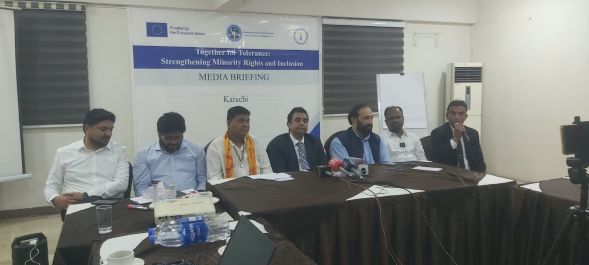
Parliamentary Council for Human Rights and representatives of minority communities present an eight-point set of demands for the protection of minority rights in Sindh.
KARACHI: The Parliamentary Council for Human Rights and representatives of minority communities have presented an eight-point set of demands for the protection of minority rights in Sindh.
Speaking at a media briefing at a local hotel, MNA and former federal minister Kamran Michael, Parliamentary Council for Human Rights Executive Director Shafiq Chaudhry and others said minority rights should be treated as fundamental citizenship rights rather than as a specific or secondary interest.
The speakers called for addressing gaps in political participation, civil liberties, employment, education, social protection, cultural rights, and protection from violence and coercion.
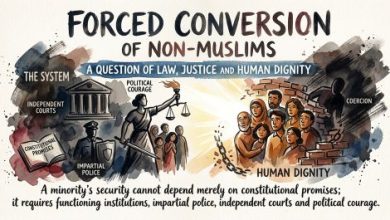
They said that, according to the National Commission for Human Rights (NCHR), 136 alleged cases of forced religious conversion were recorded in 2023 based on civil society reports, with most cases involving Hindu women and girls in Sindh.
Read: UN experts concerned by forced conversion through marriage in Pakistan
The speakers called for the removal of discriminatory and stereotypical content from textbooks, inclusion of the history, contributions, culture and heritage of religious minorities in the curriculum, scholarships for minority students, and recruitment of qualified teachers from minority communities.
They also demanded the collection of disaggregated, religion-based data to assess minorities’ access to social protection programs, healthcare, education, housing, clean water, employment and welfare schemes.
The speakers further called for meaningful participation of minority communities in the protection and restoration of places of worship, cemeteries, religious seminaries and historical sites.
The media briefing presented eight demands for the protection of minority rights, including transparent implementation of the five per cent employment quota, strict enforcement of the minimum marriage age of 18 years, effective legislation against forced religious conversions, establishment of a district-level minority protection mechanism, implementation of religious education, curriculum reforms, improved religion-disaggregated data, and meaningful participation of minorities in political and parliamentary institutions.
The speakers called for measurable allocation of government resources for minority inclusion, including in education, employment, legal assistance, social protection, and the preservation of places of worship and cultural heritage. (Press Release)
Read: Political Silence Stalls Minority Quotas
__________