Minority Parliamentarians have just Reserved Seats for Keeping Silence
- On paper, Pakistan possesses a remarkably clear administrative history of protective employment measures. But where is the quota?
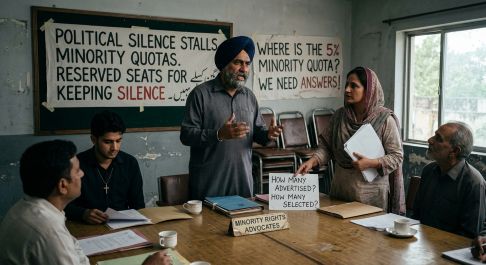
- If a 5% minority quota exists, every recruiting authority should be able to answer simple questions: How many vacancies were advertised? How many were reserved for minorities? How many minority candidates applied? How many were selected? How many reserved posts remained vacant? How many were carried forward? And how many minority employees are presently serving in each category of government employment?
By: Kalavanti Raja
Pakistan was created with the promise of a society in which citizenship, rather than religion, would determine the rights and dignity of an individual. In his historic address to the Constituent Assembly on 11 August 1947, Quaid-e-Azam Muhammad Ali Jinnah spoke of religious freedom, protection of life and property, and a state in which citizens would be able to live according to their faith. The National Assembly itself continues to describe that address as laying the foundation for religious freedom, equality, tolerance and the rule of law.
Yet Pakistan’s subsequent history presents a complicated picture. While the principle of equal citizenship was proclaimed at the birth of the country, the State simultaneously recognized that some historically disadvantaged communities could not achieve genuine equality merely through a declaration of equal rights. This was the reasoning behind affirmative measures for Scheduled Castes and, decades later, for religious minorities.
Ignored 6% quota and Scheduled Castes
The roots of the Scheduled Castes classification go back to British India. Under the Government of India Act, 1935, the colonial constitutional system formally provided for identification of communities requiring special safeguards, followed by the Government of India (Scheduled Castes) Order, 1936. The underlying purpose was to identify communities that had suffered generations of social exclusion and discrimination under the caste system.
After the creation of Pakistan, the new state did not simply discard this inherited protective principle. On 19 October 1948, the Establishment Division issued O.M. No. 56/2/48-Ests.(ME), reserving 6% of vacancies in direct recruitment to the All-Pakistan Superior Services and Central Services, Classes I, II and III, for Scheduled Castes. The policy therefore became part of Pakistan’s own post-Independence administrative framework.
The decision was not merely symbolic. By 1957, the government had recognized that the reserved vacancies were not being adequately utilized because qualified candidates were often unavailable. Instead of simply abandoning the arrangement, the Establishment Division issued further instructions on 30 October 1957 requiring greater publicity of federal vacancies in areas where Scheduled Caste communities lived. This is a revealing historical fact: the government recognized that historical deprivation itself could prevent a community from benefiting from a formal quota.
The 6% reservation therefore represented an early form of affirmative action. It acknowledged that formal equality and substantive equality are not always the same thing.
There is no reliable evidence in the surviving published order to establish that the figure of 6% was calculated precisely from the population share of Scheduled Castes. It is therefore better not to repeat that claim without documentary evidence. What is clear is that the Government deliberately selected 6% as the employment reservation for Scheduled Castes in 1948. The arrangement survived for nearly five decades. Then came a decisive change.
On 24 September 1996, the Establishment Division issued O.M. No. F.4/15/94-R.II, withdrawing with immediate effect the separate Scheduled Castes quota created through the 1948 order. The official formulation was that Scheduled Caste candidates would thereafter compete alongside other candidates of their own province.
The published withdrawal order, however, does not provide a detailed explanation of why the government decided to abolish the separate quota. That omission matters. It would be historically and legally unsafe to claim a particular reason unless the underlying government record or Cabinet decision is produced.
From Scheduled Castes to minorities
The next major development came not in 1991, as is sometimes stated, but in 2009. On 20 May 2009, the Federal Cabinet decided to introduce a 5% employment quota for minorities. This was followed by Establishment Division O.M. No. 4/15/94-R-2 dated 26 May 2009, reserving 5% of posts across the Federal Government for Minorities (Non-Muslims) in direct recruitment, including CSS, in addition to their right to compete on open merit.
The 2009 notification was broader than the old Scheduled Castes arrangement. It defined minorities through Article 260(3)(b) of the Constitution, thereby covering the non-Muslim communities specified in that constitutional provision, including Christians, Hindus, Sikhs, Buddhists, Parsis, Ahmadis, Bahais and Scheduled Castes.
The notification also contained an important safeguard: where qualified minority candidates were unavailable for reserved vacancies, those vacancies were to be carried forward and filled by minority candidates in future. The order was also extended to attached departments, autonomous and semi-autonomous bodies, corporations, public corporations and companies administratively controlled by the Federal Government.
On paper, therefore, Pakistan possesses a remarkably clear administrative history of protective employment measures. But where is the quota? This is where the real question begins. What happened to these provisions when they left the government file and entered the workplace?
The central concern is not whether Pakistan has issued notifications. It has. The concern is whether ministries, departments, public bodies and government-controlled institutions have actually maintained transparent data showing recruitment against the reserved quota.
If a 5% minority quota exists, every recruiting authority should be able to answer simple questions: How many vacancies were advertised? How many were reserved for minorities? How many minority candidates applied? How many were selected? How many reserved posts remained vacant? How many were carried forward? And how many minority employees are presently serving in each category of government employment?
These questions should not be difficult for a modern state to answer. Yet the absence of easily accessible, consolidated and department-wise data creates a serious credibility problem. A quota without transparent monitoring risks becoming a provision that exists beautifully in official notifications but weakly in actual implementation.
This issue deserves particular attention because today’s minority population includes highly educated professionals, engineers, doctors, lawyers, academics, scientists, administrators and other qualified citizens. Their problem is not necessarily the absence of talent. The more fundamental question is whether the State is providing them the fair institutional opportunity that its own policies promise.
A call to Parliament
This is therefore an issue that should rise above political party lines. The present Parliament, including minority parliamentarians and members of the relevant standing committees, should ask every Federal Government ministry, division, attached department, autonomous body, corporation and public-sector organization to produce verifiable recruitment data relating to the minority quota from 2009 to the present.
The exercise should not be limited to asking whether the quota exists. It should establish whether it has been implemented.
Every department should disclose the number of sanctioned posts, vacancies advertised, minority quota vacancies, appointments made against those vacancies, unfilled vacancies and carried-forward positions. The same information should be placed before Parliament and made publicly accessible.
Pakistan cannot simultaneously proclaim equal citizenship, create affirmative safeguards for disadvantaged citizens and then remain silent about whether those safeguards are functioning.
The history is clear: in 1948, the State recognized the need for a 6% Scheduled Castes employment reservation; in 1996, that separate quota was withdrawn; and in 2009, a 5% quota for minorities was formally introduced across Federal Government direct recruitment.
The question before Pakistan today is therefore not whether minorities have been given promises. They have. The question is whether those promises have ever been converted into measurable representation.
Read: Deepa Mehta – Voice of Courage
_________________
Kalavanti Raja is a social and political activist from Gambat, Khairpur Mirs, with 30 years of work on women’s rights, minorities, and social justice. She has served in Sindhiyani Tahreek and participated in national and international forums across Asia, Europe, and America.. She can be reached at kalavanti.raja@gmail.com