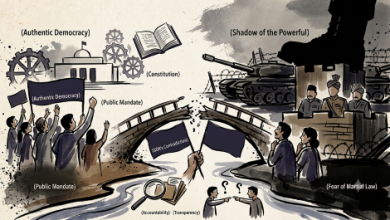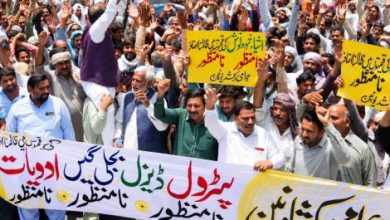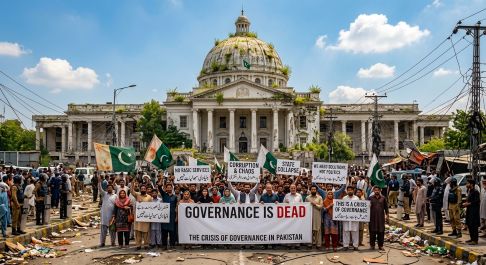
This Is Not Just a Political Crisis in Pakistan; It Is a Crisis of Governance.
By Ali K. Lashari
District autonomy, a revived civil service, and the transformation of local assets into regional economic opportunities are the key to a successful outcome.
Governments, institutions, and political parties all seem to be at odds amid Pakistan’s current political turmoil. Everywhere you look, people are talking about elections, coalitions, constitutional conflicts, and political confrontation.
But there’s a more fundamental issue at play here: The Pakistani state is overly bureaucratic, cuts out the middlemen, and fails to deliver on its promises to the people.
The question of who should have ultimate authority remains open. Why is there so little real power accessible at the bottom? That may be a more pressing concern.
Another convoluted political experiment is not always necessary to solve Pakistan’s problem. Because of this, we need to reconsider the role of the state.
Empowering the districts, professionalizing and adequately compensating the public sector, and building local industries around local resources are three changes that might serve as a practical foundation.
Reduce the Federal Government to a District Level
Pakistanis have long discussed the possibility of establishing additional federal entities and provinces. There is a more expedited change that can bring the government closer to the people without necessitating a total reorganization of the federation, while these discussions may have their own constitutional and political virtues.
Make the districts stronger
Dividing provinces into more manageable districts is a good idea when the population, topography, and administrative needs support it. However, just making virtual districts is insufficient.
To be able to make decisions on its own development, a district needs legitimate administrative power, sufficient funding, and the ability to establish itself.
Planning and implementation of a wide range of services—including healthcare, education, agriculture, municipal services, local infrastructure, and economic development—should be carried out as near to citizens as is practically feasible.
You can see the reasoning behind it
Decreased direct responsibility is a natural consequence of decision-makers’ increasing distance from the public. It becomes more difficult to disregard local issues when the decision-maker is physically close.
Administrative restructuring should not be the only definition of decentralization. Responsibility, resources, and accountability should all be transferred simultaneously.
An officer in charge of a district should be able to take charge when things go wrong and own up when things don’t work.
For the average citizen, this is how the state manifests itself.
Reforming the Civil Service via Penalties Alone Is Ineffective
The second issue, the state of Pakistan’s public service, is just as critical.
Officers of the state are expected to decide matters pertaining to public treasury, property, development initiatives, taxes, regulations, and basic services. Public employees under a lot of pressure, have a lot of duties, and are expected to perform to a high level; nevertheless, their pay does not always reflect this.
Embezzlement of funds is not justified by this.
Cronyism, misuse of power, or embezzlement of public funds are never acceptable justifications for a salary.
Institutional incentives are important, but we must grasp this if we are to construct a professional state.
Considerations such as salary, opportunities for advancement, working conditions, respect from peers, and job security are only natural when a bright young professional weighs the pros and cons of a career in the public sector vs the private sector.
Read: Governance Crisis in Pakistan — Causes, Consequences, and the Way Forward
When top talent leaves the public sector due to a lack of professional opportunities, the state suffers.
Consequently, Pakistan’s public sector remuneration system requires a thorough evaluation.
Government workers ought to get competitive pay that is tied to their level of responsibility and how well they perform. Suitable benefits, including healthcare, training, and career paths, should be available to them.
Yet an analogous principle is required:
Accountability must increase in tandem with salary.
An officer’s level of honesty and productivity should be significantly higher if they are well paid for their work.
A professional bargain should be established by the state:
Your professional dignity will be respected, and we will offer you a career path in addition to reasonable compensation. In exchange, we anticipate honesty, proficiency, and quantifiable results.
The public sector can reclaim its former glory in this way.
These days, the public has a tendency to equate the term “government employee” with corruption, incompetence, and delays.
That view needs to shift.
Any well-qualified public servant deserves the utmost respect from their peers.
Refrain from Shipping Raw Materials Out of Low-Income Areas
Economic issues are addressed by the third reform.
The districts of Pakistan are a treasure trove of human, cultural, agricultural, mineral, and environmental capital. However, the communities that provide these resources often see little to no economic benefit from them.
Think about the fundamental economic chain.
An agricultural good is made in a certain area. For further processing, packaging, and marketing, the raw material is sent to a different location. Much of the better employment opportunities and higher-value economic activity takes place in other parts of the world.
Mineral resources and building supplies are not an exception to this rule.
This model has to be revised.
The resource’s location should serve as the starting point for the value chain, taking into account both economic and environmental considerations.
The food processing, cold storage, packaging, and export sectors should be developed by agricultural districts.
As an alternative to being solely dependent on raw material extraction and transportation, mineral-producing districts should foster enterprises that responsibly process and add value.
There ought to be suitable local processing and manufacturing capabilities in regions abundant in building materials and stone.
Responsible heritage tourism, museums, conservation businesses, research institutes, and local hospitality economies should flourish in districts rich in cultural and archaeological artefacts.
Extra extraction is not the only goal.
Making better use of what we already have is the goal.
An Economic Plan Has to Be in Place for Every District.
All of Pakistan’s districts might benefit from an Economic Development Plan.
A basic question should be asked at the outset of every plan:
In what areas does this district excel?
The answer might lie in renewable energy, agriculture, minerals, fisheries, tourism, heritage, heritage, manufacturing, or a mix of these and other fields.
After that, you need to ask:
The economy relies on raw materials; how can we transform them into something of more value?
Following that:
To achieve that goal, what resources (financial, human, and others) will be needed?
The current method of development planning would be drastically altered by this.
Each area may compete for investment based on its own economic capabilities rather than waiting for a development plan to be crafted in the provincial capital.
An agricultural processing center could emerge in one area.
Still another could focus on minerals only.
One more could turn into a historical and touristic site.
Still another option would be to establish dairy and cattle industries.
One more might turn into a manufacturing or logistical hub.
Instead of attempting to standardize the entire country, the government would focus on strengthening each region based on its unique strengths.
Invest in Your Community by Using Local Resources
The link between local resources and development needs to be strengthened as well.
Communities should get a fair amount of the advantages when a district makes a substantial contribution to the national economy through resources such as agriculture, mining, tourism, or anything else.
Education, healthcare, water, roads, environmental protection, and skill development are just a few local concerns that could benefit from a District Resource and Development Fund that is created with care.
An effective social compact might be forged using this process as well.
When citizens witness the positive effects of responsible economic development firsthand, they are more inclined to back it.
Shifting from Hierarchy in Government to Financial Decentralization
Having too many political conversations might not be Pakistan’s biggest problem.
Maybe there isn’t enough good leadership in the areas where people actually reside.
We have centralized political and administrative authority and then pondered the question of why the general public does not feel involved with their government.
Increasing the number of government agencies is not always the solution.
The goal is to streamline and improve current institutions so that they are more efficient, effective, strong, and accountable.
A more robust district system, a more professional civil service, and economic development with roots in the community can all support one another.
Investment can be facilitated by a competent district administration.
Jobs can be created by local industries.
Work opportunities can mitigate migration.
Local markets can benefit from higher wages.
More efficient regulation of these activities can be achieved through a professional public service.
The tax base can be expanded as a result of thriving local economies.
There is no easy solution. However, this path toward systemic change is feasible.
Developing Pakistan from the Ground Up Is Necessary
Whoever controls the center is the central question in Pakistani political discourse.
We need to start with a new inquiry:
How can we equitably bring more resources, including money and power, to the people?
At that point, change can start to take place.
It is unnecessary for Pakistan to have all its decisions made in Islamabad or any of its provincial capitals.
Wherever the issues are, decisions must be made.
It is unnecessary to have a larger civil service.
A competent, well-compensated, technically savvy, and unwaveringly accountable civil service is essential.
Additionally, it is unnecessary to continue extracting raw materials.
It should make better use of the resources it currently has.
Even though the political turmoil is all anyone can talk about today, the fate of Pakistan will be decided by changes to its governance.
We can start creating a state that people can see, access, and trust if we give authority back to the districts, make public service respectable again, and turn local resources into local businesses and labour.
Pakistan’s future cannot be constructed solely by those in positions of power.
Building it from the ground up is the best approach.
Read: Rewire Your Brain, Transform Your Life
_________________
 Ali K. Lashari is an Archaeologist & Cultural Heritage Advocate