Changing Battle between Capital and Labor
From the Industrial Revolution to the AI Revolution

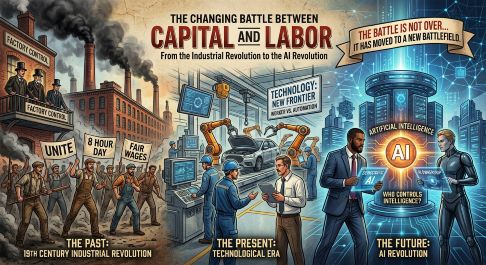
The battle between capital and labor is not over. It has simply moved to a new battlefield. Yesterday, the struggle was over the factory. Today, it is increasingly about technology. Tomorrow, it may be about who controls intelligence itself.
By: Ramesh Raja
Human history has always been shaped by the tools people create to make their lives easier. But sometimes a new technology does much more than improve production. It changes society itself. The Industrial Revolution was one such moment. Artificial intelligence may be another. Between these two revolutions lies a story of factories, workers, wealth, inequality, trade unions, political revolutions, welfare states, globalization and now intelligent machines. At the heart of that story is an old question that has never really disappeared: who controls the means of production, and who benefits from the wealth they create?
From the Factory Floor to Class Struggle
When the Industrial Revolution began transforming Europe, production moved from small workshops and homes into large factories. Machines dramatically increased productivity, but they also changed the life of the ordinary worker. A person who had once possessed a craft and some control over his work increasingly became a wage-dependent factory worker. The factory owner owned the building, machinery and capital; the worker owned little more than his ability to work. Long hours, low wages, unsafe workplaces and widespread child labor became painful features of early industrial capitalism.
It was this new social reality that Karl Marx and Friedrich Engels tried to understand. They saw capitalism not merely as an economic system but as a relationship between people who owned capital and people who had to sell their labor. Their concept of class struggle gave a name to a conflict that was becoming increasingly visible: the interests of capital and labor were often different, particularly over wages, working hours, working conditions and the distribution of wealth.
Yet history did not follow one single path. The Paris Commune of 1871 briefly demonstrated the possibility of workers exercising political power, while the Russian Revolution of 1917 transformed the idea of proletarian revolution into a governing project. The Chinese Revolution of 1949 later adapted Marxism to a largely agricultural society. These revolutions showed that the question of economic ownership could become much larger than the factory itself. It could become a question about who should control the state and the direction of society.
Workers Organize and Capitalism Changes
But revolution was not the only response to industrial inequality. Workers discovered another powerful instrument: organization. Trade unions brought individual workers together and gave them a collective voice. Over time, struggles that once seemed impossible helped establish the eight-hour working day, collective bargaining, workplace safety, social insurance and other labor protections.
Capitalism itself also changed. Governments gradually understood that an economy could not remain stable if large sections of society lived in insecurity. The welfare state emerged, providing education, healthcare, pensions and social protection. In countries such as the Nordic states, social democracy combined private enterprise and markets with strong welfare systems. Germany developed its social market model, while many other countries adopted mixed economies in which private businesses operated alongside state enterprises, public infrastructure and government regulation.
The great ideological battle of the 20th century was therefore not simply capitalism versus socialism. Different societies experimented with different balances between markets, state ownership, taxation, welfare and regulation. Even countries that remained strongly capitalist accepted that workers needed protection and that economic growth had to provide wider social benefits.
Globalization Changes the Worker Again
Then came globalization. Capital became increasingly mobile. Companies could design products in one country, manufacture components in another, assemble them somewhere else and sell them across the world. Technology made this possible, while cheaper labor and global supply chains reshaped entire industries.
The factory did not disappear, but its meaning changed. Automation began taking over repetitive physical tasks. Computers entered offices and transformed clerical work. The modern worker increasingly depended not only on the factory owner but also on corporations, software, digital platforms and global markets.
This created a new kind of economic power. Ownership was no longer concentrated only in factories, mines and machines. It increasingly rested in finance, technology, intellectual property, networks and information.
From Machines to Artificial Intelligence
Artificial intelligence takes this transformation one step further because it does not only replace physical effort. It can perform tasks that once appeared uniquely human: analyzing information, generating text and images, writing software, translating languages, recognizing patterns and assisting in complex decisions.
The means of production are therefore changing again. Data, algorithms, semiconductor chips, cloud infrastructure, data centers and AI models are becoming economic assets of enormous importance. A company with access to vast amounts of data and computing power may possess an advantage comparable, in the digital age, to the factory owner of the Industrial Revolution.
This brings us to a remarkably simple question. During Marx’s time, people asked: Who owns the factory? Today, we increasingly have to ask: Who owns the data, algorithms, AI systems and computing power that will produce the wealth of the future?
The New Battle between Capital and Labor
The danger is not that every human worker will suddenly be replaced by a machine. The more immediate transformation may be that many jobs will be redesigned. Some tasks will disappear, others will become more productive, and entirely new occupations will emerge. The worker who knows how to use AI may become considerably more valuable than the worker who refuses or is unable to adapt.
But there is another side to the story. If the ownership of AI becomes concentrated in a relatively small number of corporations and investors, the productivity gains created by intelligent machines could also become highly concentrated. A machine that replaces ten workers does not automatically mean that society becomes poorer. It could mean society becomes enormously richer. The real question is who receives that additional wealth.
This is where the old debate between capital and labor returns in a new form. The central conflict may no longer be simply between the factory owner and the factory worker. It may increasingly be between those who own technological capital and those whose labor is being transformed by it.
The answer will depend on choices made by governments, businesses and societies. Education will have to change. Workers will need opportunities to continuously learn new skills. Labor laws will have to respond to platform work, automation and AI. Tax systems may need to evolve as the sources of wealth change. Most importantly, the enormous productivity created by AI will have to be connected with broader human prosperity.
The Industrial Revolution gave humanity machines that multiplied physical power. The AI Revolution is giving machines a growing capacity to perform intellectual work. The first revolution changed the factory. The second may change the very meaning of work.
The battle between capital and labor is therefore not over. It has simply moved to a new battlefield. Yesterday, the struggle was over the factory. Today, it is increasingly about technology. Tomorrow, it may be about who controls intelligence itself.
And perhaps the most important economic question of the 21st century will be neither capitalism nor socialism, but something much more fundamental: when machines produce an increasing share of society’s wealth, how will that wealth be shared among human beings?
Read: New Proletariat in the Age of AI
__________________
 The author of this article, Engr. Ramesh Raja, is a Civil Engineer, visionary planner, PMP certified and literary enthusiast with a passion for art and recreation. He can be reached at engineer.raja@gmail.com