

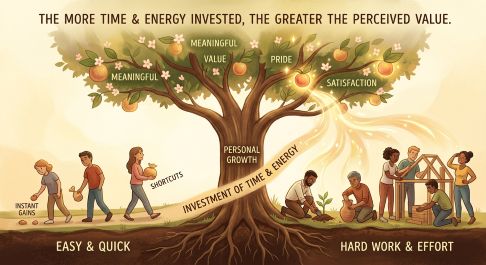
The more time and energy that individuals put into something, the more important it will seem to them.
- Not everyone appreciates the things that are easy to get. They tend to place a high value on things that they have worked hard to make.
Ali K. Lashari
Rarely do humans place equal importance on all things. What we put the greatest effort into tends to be the thing that matters the most to us in the end.
In most cases, the significance of an objective grows when it necessitates effort, perseverance, sacrifice, and time, as opposed to when it is easy to achieve. Reason being, putting in effort does more than just get the job done; it also makes you care about the outcome.
A deeper bond forms between two entities when one party devotes more of themselves to the other, whether in the form of time, effort, focus, emotion, or material possessions. More than just a thing, an accomplishment, a relationship, or a position, the result becomes something greater. It turns out to be a mirror of their investments.
Why We Strive and How We Do It
Our perception of something’s value can be enhanced by exertion.
Here are two examples. Even though they may be grateful, people are usually rather good at letting go of important things that they acquire without working for them. But it’s far more difficult to let go of something that someone has worked on for a long time, given up opportunities for, overcome obstacles with, and failed at.
In this case, it is not the thing’s objective worth that matters.
What matters is the amount of money the individual has put into it.
Education, jobs, relationships, companies, leadership, and individual objectives are all aspects of this mental process. A higher feeling of ownership and connection can develop in response to a larger investment.
The Reasons Why Investing Leads to Attachment
People start to identify and feel emotionally tied to the result of something in which they have invested significantly.
Someone who puts in a lot of time and effort to build a profession could start to feel that their job defines them. If you start a firm from scratch, you could get attached to it on an emotional level that surpasses its monetary worth. Similarly, after overcoming relationship challenges, one may come to cherish the bond more deeply, recalling all the efforts made to keep it strong.
That is why dedication can be achieved through exertion.
After contributing to something, people are more likely to guard it.
Relationship Principles
Human interactions are not immune to this principle.
Deep meaning can develop in a relationship when both partners put in the work emotionally, mentally, and physically. A deeper sense of belonging and shared responsibility is fostered when each partner works to keep the relationship going.
Be careful not to misunderstand this principle, though.
You can’t build strong connections by intentionally causing someone pain or by not showing them affection. Getting people to put more money into it is not the point. It takes work, respect, and reciprocity for two people to form a true bond.
When both partners in a relationship feel that they are contributing to its growth, it tends to be stronger.
A Key Concept in Professional Success
Making an effort usually makes a success feel even better in the business world.
A person’s job may hold greater significance for them if they begin with little and work their way up, gaining knowledge, skills, experience, and a reputation along the way.
Every challenge, setback, late night, tough decision, and lesson learned contributes to the final product.
For that reason, the mental gratification that comes from working hard for something is often greater than that which comes from taking the easy way out.
In light of the sacrifices made, the sense of accomplishment takes on a new dimension.
Principles of Effective Leadership
The concept of creativity can also be understood by leaders.
When people have a hand in creating something, they are more likely to care about it. A team that takes part in brainstorming, problem-solving, and the overall process can build a stronger sense of ownership than one that just follows orders.
Doing everything for others is not necessarily indicative of effective leadership.
Leadership isn’t about taking charge; it’s also about letting others shine.
People are more inclined to take pride in, and do their best for, what they helped create.
The Unseen Threat: Sunk-Cost Analysis
Nevertheless, you should be aware of this crucial psychological caution.
An item is not necessarily worthwhile to retain just because it has received more investment.
Since they have already put so much effort into it, some people keep going even when things aren’t working out in their relationships, careers, businesses, or projects.
A concept called the sunk-cost effect describes this.
Read: Innovation predicts higher profits
One might consider:
This has already consumed a great deal of my time. Here, I am unable to move away.
A return on investment (ROI) from the past is no guarantee of a prosperous future.
To be wise, one must be able to distinguish between dedication and being too attached to the past.
Not only that, but the correct inquiry is:
“What amount of money have I already put in?”
Furthermore, it is:
“Should I put my money into this?”
Achieving Anything Deserves Effort.
Difficulty is not necessarily a threat, which is arguably the most important takeaway from this idea.
The significance of a feat might be defined by the challenges it overcame.
For mountaineers, the value of a mountain is not in the peak itself but in the ascent process.
Having spent many years in school, a degree is worth far more than a certificate alone.
When it comes to risk, learning, failure, and perseverance, a successful firm is worth more than just the money.
In a meaningful relationship, both partners make an effort to understand, support, and develop alongside each other; this goes beyond simple companionship.
The plot incorporates the effort.
The Fundamental Idea
This is a common way that human psychology functions:
Ownership is resulted from investment.
Attachment is induced by ownership.
Loyalty is shaped by attachment.
The more time and energy that individuals put into something, the more important it will seem to them.
Use caution while applying the theory, though. To help people appreciate something, we shouldn’t make their lives more difficult than they need to be. Participation, effort, responsibility, and earned success have inherent psychological force, which we should instead acknowledge.
Make it possible for individuals to construct.
Permit them to offer input.
They should be allowed to go on the trip.
Why? Because when people have a hand in making something, they tend to feel a sense of ownership and pride, rather than just possessing it.
Not everyone appreciates the things that are easy to get. They tend to place a high value on things that they have worked hard to make.
Maybe that is why the things we’ve worked for, created, safeguarded, and fought for are more significant than the things we were given.
“The more one puts into something, the more difficult it is to release it.”
Read: The Pursuit of Happiness
__________________
 Ali K. Lashari is an Archaeologist & Cultural Heritage Advocate





Very well written moreover got a lot of new information