Pakistan is a federation of four geographical territories which were independent nations before colonization by the British Empire.
Ambassador M. Alam Brohi
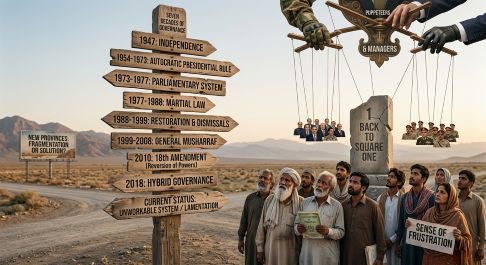
It is easy to say that the system has collapsed. It is not so easy to replace it with a new system that withstands the challenges of good governance, exacerbated by repeated disruptions in constitutional rule; the abrogation and suspension of Constitutions; authoritarianism and coercion; mismanagement and corruption; partial accountability; and the imbalance of power between political and military leadership. The last Viceroy of British India, Lord Mountbatten, was biased, partial and a dishonest arbiter. He was won over by the wily Nehru, who had access to his bedroom. They had mala fide intentions.
He handed over a moth-eaten Pakistan to the Quaid, with two wings in the east and west separated by over a thousand kilometers of Indian Territory. The Governor General played this political chicanery only a month or so before the independence of the Dominion Republics of Pakistan and India, dividing Punjab and Bengal, triggering an en masse exodus of people across the border in Punjab and Sindh.
The Quaid was undaunted by the odd geographical situation of his country. However, two factors were weighing against his will and resoluteness. The odd political crowd he had allowed to jump on the Muslim League’s bandwagon to win the crucially important elections of 1945 and 1946. These elections were determining whether the Muslim League was the sole representative of the Muslims. With this odd crowd, the Quaid won a thumping majority of the Muslim seats, but he had to discipline them in the process of nation building. The second and the most daunting challenge was the Quaid’s collapsing health. He left us leaderless and the country rudderless. His successors ruined Pakistan through their incompetence.
Pakistan emerged as a federal state by the initial consent of the territories of East Bengal, Sindh and Punjab, which provided geographical boundaries making its establishment possible. Later, the erstwhile NWFP and Balochistan were annexed into the federation. The federation of Pakistan is distinctly different from other contemporary federations, including the Indian Union of States.
Pakistan did not exist before August 1947. It was an abstract concept, or an ideology. It was founded on the geographical boundaries provided by the above territories, which were distinct national, political, geographical and cultural entities with an ethnic and linguistic identity and historic heritage. The corollary is that Pakistan owed its existence to these federal constituents and not vice versa.
India existed as a sub-continent represented by independent nations/territories and princely states. India was a united country only during Ashoka’s rule or the Mughal dynasty up to Emperor Aurangzeb. The present 28 states were created by administrative decree in line with a two-year study made by the Delimitation Commission of India, formed in 1951 for the demarcation of the boundaries of States and Legislative Assemblies. Therefore, the states owe their existence to the Indian Union Government.
Federations come into existence mainly due to shared political, economic and strategic interests or cultural, linguistic and ethnic affinities, or the fear of a bigger and more powerful neighbour, and are sustained by representative, participatory, inclusive and just governance. Any constitutional disruption resulting in authoritarian rule not only creates disharmony in the federation, it also alienates the federating units from the central power, refuelling centrifugal or nationalist feelings.
India has been saved from disintegration by democracy, with all its defects and fault lines. The Indian states have political and economic autonomy and term-based self-rule through democratic elections. There, the size of the state – small or big – does not matter. It has big provinces like Uttar Pradesh and Bihar, with populations of 240 and 131 million respectively. The population or the territory of a province has never impeded its development. Similarly, countries with dozens of states face poverty, under-development, hunger, famine and civil strife, while states with vast territorial boundaries and a smaller number of provinces have achieved high levels of development.
Systems do not collapse; they are failed by frequent disruptions, unconstitutional interference in political processes, and the excessive indulgence of the establishment in political gerrymandering and electoral engineering, and political patronage. When the political leadership fails to keep the state institutions within their constitutional jurisdictions, or excessively depends on them for rule, the rot begins setting in across the entire governing structure. All modern Constitutions specify the state organs and their purview of responsibilities. This is what the 1973 Constitution has done.
Pakistan is a federation of four geographical territories which were independent nations before colonization by the British Empire. The federation of Pakistan was founded on the basis of the Resolution of 1940. At least Bengal, Sindh and Punjab were prompted to become part of it by the political and economic autonomy promised in the Resolution. We won the battle of Pakistan under the leadership of the Quaid, and lost the second battle of nation building with his successors at the helm. We also utterly failed to respect the cultural and fraternal spirit underlying the federation.
We have already alienated substantial segments of populations within our federation by our ill-advised political adventures, manifested by insurgency in Balochistan, political unrest in KPK, and growing nationalist feelings in Sindh and South Punjab. The estrangement of the Baloch dates back to the forcible annexation of the Khanate of Balochistan into the federation. Pakhtun anger has manifested itself in the slogans of Pakhtunistan and the Pakhtun Tahafuz Movement. The imprisonment of leaders does not mean that the anger against the state has faded away. It remains underneath the surface, simmering and festering.
The purported fragmentation of the existing provinces has outraged Sindh’s people. From Karachi to Kashmore, they have voiced their anger against the purported fragmentation of their land. Their anguish and unity remind one of the heyday of the national movement against the One Unit, which was emblazoned by intellectuals, poets, authors, academia, the legal fraternity, political parties, leaders and activists, and civil society.
Undertaking such an arduous, costly and divisive exercise when the country is politically divided, economically hard-pressed and strategically on high alert would shake the foundational understanding, as explained above, that holds the federation of Pakistan together. The exercise will ensue in a plethora of political, economic, financial and territorial issues and controversies.
Click here for Part-1, Part-2,
___________________
 The writer is a former member of the Foreign Service of Pakistan and has served as Ambassador for two terms. He is the author of five books.