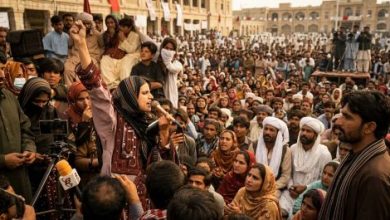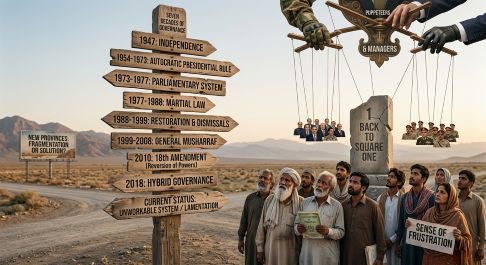
The country has been ruled by a combination of civilian and military leaders. We maintained the federal nature of the country hardly up to 1954.
Ambassador M. Alam Brohi
As put by a fellow columnist, a leader can say that the system has collapsed. It sounds like an admission without holding anyone accountable. The question is whose system, which system has collapsed, and at whose hands it has collapsed. The odd political experiments and political electoral engineering surpassing those practiced by us since the inception of the country could only be found in the evolutionary odyssey of African or Latin American states. We have left no system untried, oscillating between Martial Laws and authoritative Presidencies, semi-presidential, parliamentary, and quasi-parliamentary governance, and a unique hybrid rule marked by informal power sharing by military and civilian leaders, with the former at the wheel. All these forms of governance have collapsed. Why is it so? It is not difficult to find the answer.
The country has been ruled by a combination of civilian and military leaders supported by a well-trained cadre of bureaucrats. We maintained the federal nature of the country hardly up to 1954, and moved over to a unitary state by forming one bigger province of West Pakistan to maintain parity with the former East Pakistan with mala fide intentions. This backfired, not only refuelling Bengali nationalism but also estranging the smaller provinces of Sindh, KPK and Balochistan by depriving them of their political and economic autonomy. They regained their separate geographical and cultural identities when the West Pakistan province was dissolved on the unanimous demand of the political parties in July 1970.
The first general election on an adult franchise basis was held on 7 December 1970 after over 23 years. One provincial general election was held in the former East Pakistan in March 1954, in which the United Front of A.K. Fazal trounced the All Pakistan Muslim League, winning a thumping majority. He formed his provincial government in April 1954. His government and the Assembly were dismissed by the federal authority after two months, levelling charges of treason and anti-Pakistan activity against the person who had played a conspicuously prominent role in authoring, presenting, defending and adopting the Pakistan Resolution in 1940.
His was not the only elected provincial government dismissed by the federal regime. The provincial administrations of Dr. Khan Sahib in June 1947 and that of Muhammad Ayub Khuhro in April 1948 were dismissed. Khuhro was punished for resisting the en masse settlement of migrants in Karachi. Khuhro, as the President of the All India Muslim League, was instrumental in adopting the resolution in favour of Pakistan in the party’s annual provincial session of 1938, presided over by Muhammad Ali Jinnah. This resolution, with minor changes, was adopted in March 1940 in Lahore. Khuhro was brought back as Chief Minister to have the resolution of One-Unit passed in the Sindh Assembly in 1954, though he was under EBDO for ten years. The foundational stone was laid wrongly.
General Ayub Khan not only abrogated the 1956 Constitution and imposed his Constitution on the nation, adopted through an administrative decree, but also introduced the Basic Democrats system, reducing adult suffrage to 80,000 local councils distributed equally between the two wings despite the majority of the Bengalis. He ruled the country as an authoritative President for over a decade and handed over power to his Chief of Army Staff. He could have proved the saviour of this country, following the footprints of Kemal Ataturk Pasha or General de Gaulle. Time and tide wait for none. He ensconced himself in the limbo of history.
General Yahya Khan held the general election in December 1970. In contrast with his expectations, the general elections catapulted Shaikh Mujeeb Ur Rehman as the majority leader with 162 seats from East Pakistan, and Z.A. Bhutto as the representative of the West Pakistan wing with 80 seats. Mujeeb should have been invited to frame the constitution and form the government. He was in contact with many nationalist leaders from West Pakistan, including National Awami leaders, Khan Abdul Qayum Khan, and had the political sympathies of some independents from Sindh. The military junta failed to transfer power to him, which resulted in political agitation, insurgency, military operation and war, and finally, the death of Jinnah’s Pakistan.
The disgrace and humiliation we suffered should have set us on a path to serious introspection and course correction. Power was transferred to the late Bhutto as a result of rebellious agitation by a young cadre of army officers against their seniors in many cantonments. Bhutto worked hard and literally collected the pieces of the broken ship, repaired it and steered it to safe shores. Within a short span of time, he restored the confidence of the heartbroken nation, reinstated Pakistan as a viable and vibrant country, giving it a unanimous Constitution and a parliamentary system of governance. He resolved the post-war issues with India and reset bilateral relations with both superpowers.
This system was allowed to function from April 1973 to July 1977. Bhutto’s rule was not ideal. However, the system he had so assiduously put in place was adopted by Parliament through a consensus vote. This system was wrapped up and thrown into the dustbin of history. What we received was Martial Law, lashes, strong censorship, a ban on fundamental rights to expression and assembly, Majlis-e-Shura, a non-party Assembly, constituency-based development funds, and a mutilated 1973 Constitution, lame-duck parliamentary governments overshadowed by civilian Presidents vested with executive powers through the Eighth Amendment.
The third country-wide Martial Law, as a result of differences between the Prime Minister and the Chief of Army Staff, was imposed on 12 October 1999, plunging the country into the American anti-terrorism war, a quasi-parliamentary form of government and a new district government system instead of established local governments and district councils with separate jurisdictions. We lost over 80,000 civilians and security personnel in terrorist attacks from 2000 to 2008, including the iconic Benazir Bhutto. She had lost her father under the previous Martial Law government and was full of resolve to rid her country of terrorists, and she herself fell victim to terrorists.
(To be continued)
Click here for Part-1,
______________
 The writer is a former member of the Foreign Service of Pakistan and has served as Ambassador for two terms. He is the author of five books.