The size of a country or the number of its provinces does not make it governable or ungovernable.
Ambassador M. Alam Brohi
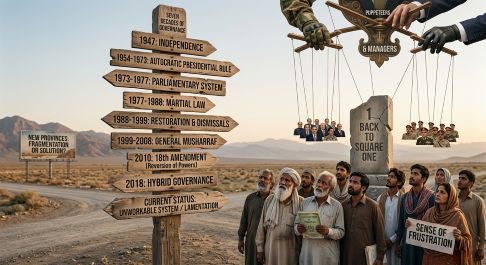
We are at a crossroads, struggling to understand why all the known systems of governance we tried in the past seven decades of the independence of this country have ended in failure, leaving us with a sense of frustration, disillusionment, and despair, and forcing Pakistan’s civilian and military leadership to fall back on the same lamentation about the collapse of the system, heard nauseatingly from political and military leaders. Each military-led government lasted, on average, for a decade, barring Martial Law of General Yahya Khan. The civilian leaders reigned, on average, for less than three years.
With the inception of Pakistan, we inherited Governor General rule; switched over to an autocratic Presidential form of governance from 1954 to 1973; the parliamentary system from 1973 to this day, with the exception of the intervening two decades of the two Military Presidents from 1977 to 1988, and 1999 to 2008. We could add the experiment of the current hybrid governance being practiced since 2018.
Throughout these years, we witnessed two Martial Laws; the abrogation of two ill-fated Constitutions; amalgamation of the small provinces into Punjab in One-Unit, forming West Pakistan with Lahore as its capital, depriving the people of Sindh, KPK, and Balochistan of their geographical, cultural and historic identities. This was done to deny the majority share to Bengalis in political power, economic and financial resources, and senior administrative cadres. The One-Unit transformed Bengali nationalism into a formidable electoral force.
The parliamentary form of governance under the 1973 Constitution was allowed to function from April 1973 to July 1977. The country was again plunged into Martial Law. The Constitution was amended and all executive powers transferred to the President in military uniform. He dismissed his handpicked Prime Minister, and the non-party National Assembly, which had granted him indemnity and conferred these powers on him.
The parliamentary form was restored following the general election in 1988. From December 1988 to October 1996, three civilian elected governments – two of Benazir Bhutto and one of Mian Nawaz Sharif – were dismissed by elected civilian presidents using these executive powers. The second government of Mian Nawaz Sharif was overthrown by General Musharraf in October 1999. President Asif Ali Zardari reverted the executive powers to the Prime Minister through the 18th Amendment in April 2010. However, two Prime Ministers from 2008 to 2017 were removed through the Apex Court.
Notwithstanding all these experimental exercises in governance, and cataclysmic debacles, we have come back to square one, lamenting the unworkability of the system. Nobody questions the managers of the failed systems, who have been at the wheel for the past seven decades, steering the country directly or indirectly. Should we blame the system or the political controllers? They have played the central role in collapsing the country’s political and electoral systems. They never accepted their bad workmanship.
Now, they plan to fragment the federal units into twelve or more small provinces, susceptible to manipulation and easy control. They should understand that the present federal constituents existed historically, culturally, linguistically, and geographically as separate nations before their occupation by the British Imperial forces. Sindh was ruled by Talpurs, Punjab by Sikhs, KPK by Afghanistan, and Balochistan was an independent country ruled by Baloch since the early fifteenth century.
As the movement for a separate Muslim country was close to culmination, Sindh took the lead to join Pakistan in March 1943, Punjab opted for the new country in June 1946. KPK voted for Pakistan in the controversial referendum held by the Government of Pakistan after dismissing the administration of Khan Sahib, while Balochistan was annexed forcibly in April 1948. These federal constituents are distinctly different from Union States, created by administrative decrees, and cannot be dissected by any authority at the drop of a hat. With this factor in mind, the Constitution makers not only recognized the historic status of these lands, but also adopted a complicated and tough procedure for any re-adjustment of their territorial borders.
Does the country afford to have new political, economic, financial, administrative controversies, and a host of concomitant disputes when it grapples with insurgency in two provinces, hostility from India and Afghanistan, a badly sick economy, political tension, a mounting debt surpassing the staggering figure of Rs.100,000 billion, and a circular debt of over Rs.5000 billion at home? Would the fragmentation of the federal constituents make any difference if the perceived small units are ruled by the same corrupt lot of politicians, run by the same inertia-ridden bureaucracy, and controlled by the same puppeteers? The answer would definitely be in the negative.
Countries with dozens of provinces, including Afghanistan, Ethiopia, Nigeria, Democratic Republic of Congo, Somalia, Sudan, and South Sudan have been suffering from chronic misrule, mismanagement, poverty, and misery. The remote-controlled governance has led them to civil wars. Geographically big countries including Australia and Canada are good examples of multi-cultural, multi-linguistic federations with exemplary democratic and participatory governance. Australia sprawls over 7.6 million kilometers with 29 million people, and six provinces, while Canada has a population of 41.5 million people, and a vast territory of 9.98 million kilometers divided into ten provinces.
The size of a country or the number of its provinces does not make it governable or ungovernable. The commitment, honesty, and competence of the leadership and the continuity of the political system matter.
California, with a population of 39 million people and a territory of 424,000 sq. km has a GDP of 4 trillion dollars with good democratic governance by elected leaders and political institutions. Uttar Pradesh of India has a population of over 241 million, an economy of Indian Rupees 36 trillion, and a territory of over 253,000 sq. km, has never faced the question of fragmentation.
Notwithstanding the size of a state, it is the maladministration, mismanagement, and injudicious use of resources, the lack of merit, and the absence of free and fair elections that lead to deprivation of the vulnerable populations. We should concentrate on improving governance rather than dividing lands with a view to tightening control on the levers of political and economic power.
Read: Stirring The Hornet’s Nest
____________________
 The writer is a former member of the Foreign Service of Pakistan and has served as Ambassador for two terms. He is the author of five books.