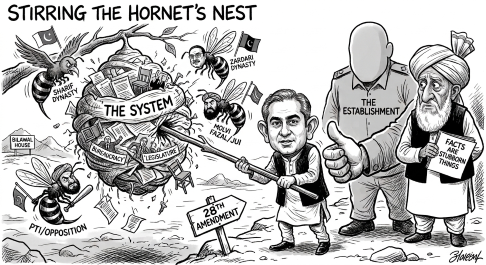
Mr. Naqvi has stirred the hornet’s nest. The Sharif family was livid about it. Rather, it felt the hardness of the slap. The dynasty had back to back huddles at Jati Umra
Ambassador M. Alam Brohi
“Facts are stubborn things; and whatever may be our wishes, our inclinations, or the dictates of our passion, they cannot alter the state of facts and evidence”, John Adams.
Last week, after meeting President Asif Ali Zardari in Bilawal House, Federal Minister Muhsin Naqvi made a statement in an economic Summit in Karachi that the current system had completely collapsed and needed to be overhauled forthwith. He added that even if the country produced a Prime Minister committed to work for 18 hours a day, the system would not deliver unless more administrative units were carved out. However, he did not outline the factors leading to the collapse of the system nor did he elaborate who was responsible for the political and economic crises, the country has suffered repeatedly since its inception.
Probably, he did not think it necessary to enter into polemics at this stage. He wanted us to understand and endorse his suggestion for the reform of the system. If so, how can we reform the system if we do not identify those responsible for this tragic national failure, and how do we endorse a new system when its outlines have not been revealed to us? We should not deceive ourselves about the apparently innocent and straight forward motives of his statement. It actually represents something deeper – reflective of a new scheme governance. The establishment is surely behind his audacious move to lock horns with the politically influential ruling coalition, and the mainstream political parties.
Nevertheless, Mr. Naqvi has stirred the hornet’s nest. The Sharif family was livid about it. Rather, it felt the hardness of the slap. The dynasty had back to back huddles at Jati Umra. Their unconditional collaboration with the security establishment has pushed their political standing to the lowest ebb. TThe Zardari dynasty is also upset. Their Pakistan People’s Party has demanded the immediate resignation of Minister Muhsin Naqvi whom President Asif Zardari has repeatedly patted on back calling him his boy. Obviously, the PPP could not have moved against him without the consent of President Asif Zardari or its Chairman Bilawal Bhutto Zardari.
Similarly, the other mainstream political parties including Jamiat ulema e Islam (JUI) of Moulana Fazal Ur Rahman, and Pakistan Tehrik e Insaf or the opposition alliance have also opposed his suggestion. Rather, the JUI has been criticizing the establishment as the perpetrators of the challenging situations in Balochistan, KPK, GB, and AJK, and the repeated failure of the governance system in the country.
Minister Naqvi’s statement apart, speculations about dividing the country into more provinces through 28th amendment in the Constitution have been swirling around since the enactment of the earlier 26th and 27th amendments, which were aimed at achieving specific results. As a consequence, the judiciary lost its status as the third state organ as recognized by the Constitution, and certain state employees achieved life immunity from prosecution. Nothing for the country or the common man.
There is a silent but visible consensus that the country should not be subjected to an experiment like that of One-Unit which, in the final analysis, was a very bad political and administrative decision with ugly consequences. It sowed the seeds of the secession of East Pakistan as it not only disregarded the majority of the Bengalis, but also created an artificial province of West Pakistan as a countervailing force to deprive them of their majority share in political power, and the divisible pool of financial resources, and federal superior positions of the country.
This was mindlessly done by amalgamating the existing historic, and culturally and linguistically compact three provinces into Punjab and calling it West Pakistan with Lahore as its capital. This deprived Sindhis, Baloch and Pakhtun of their historic geographical, cultural and linguistic identities, and the right of self-rule as per Pakistan Resolution of 1940. These smaller provinces had to struggle hard for a decade and half to wriggle out of the political and economic dictatorship of Lahore.
There is also a consensus that the country, economically weak, and politically fragmented as it is, cannot afford to go through a new and unnecessary exercise of political disputes and tensions; controversial division of economic and financial resource and fresh apportionment of the irrigation waters; the demarcation of new boundaries, districts and divisions and constituencies of the new administrative units; allocation and transfer of bureaucracy; appointment of Governors, Ministers, and setting up of Provincial Secretariats, Legislative Assemblies, spending huge amounts on contingencies, rents and royalties, pays and pensions, allowances and privileges particularly when we are facing bad security situations in Balochistan, KPP, and tenacious political unrest in the AJK.
The ruling clique is mistaken to consider the existing federal units as administrative units. These lands historically existed as separate nations before the advent of the British Raj. They voluntarily supported the movement for Pakistan. The Quaid did not have a kinetic forces to compel Sindh to pass a resolution in March 1943, and Punjab in June 1946 to join Pakistan.
The country has administratively devolved from the capital to the tehsil level. The country has witnessed tremendous administrative changes since inception. Sindh has grown from one division in 1947 into the existing seven; Punjab from three into ten; KPK from two into seven and Balochistan from two into eleven divisions. The number of divisions has grown from 8 to 35, and of districts from 40 to 150 in all the four provinces since the creation of Pakistan. These are administrative units.
Will we outsource the new administrative units to angels from the heaven to perform wonders? We have the same politicians, the same bureaucracy, the same federal institutions, the same law enforcing agencies, with their strengths, weaknesses, prejudices and foibles to run the new administrative units. We can well imagine how the new administrative units will be run. Do we expect wonders from these reforms? The new bottle will not change the acerbic taste of the wine.
The Federations are strengthened by the volunteer support and endorsement of federating units under a constitutional framework – free from any exploitation, coercion, and political and economic gerrymandering, and firmly anchored in plural, representative, participatory, inclusive, and democratic governance; rule of law, equality before law, social and economic and financial justice, and meritocracy.
The example of India has been repeatedly cited to justify the creation of new provinces. We should not mix up Federation and a Union of States. A Union of States is created by the Central authority by administrative acts for political and administrative convenience, while federations rest on the voluntary and constitutional endorsement of historically recognized national lands. India has not divided Uttar Pradesh with a population of over 220million. The province of Behar, with a population of over 130 million, carries on as one province without any problem.
Keeping in view the sensitivities of the federal units about their historic status as national lands, the 1973 Constitution, adopted by almost a consensus vote, has recognized the four provinces, and laid down a tough process for the division of a province or creating a new province. The process needs the endorsement of the concerned provincial Assembly by two-third majority, and a two-third majority in the Parliament.
Read: The Imperiled National Security
_____________________
 Based in Karachi, the author is a former member of the Foreign Service of Pakistan and has served as Ambassador for seven years
First published in The Friday Times Lahore