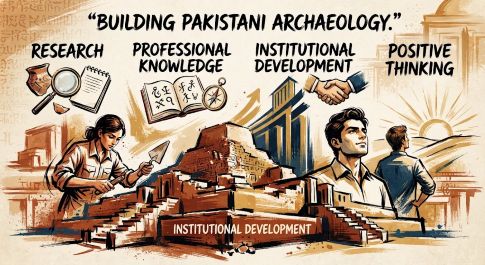
The Importance of Research, Positive Thinking, Institutional Development, and Professional Knowledge in Pakistani Archaeology
By: Ali K. Lashari & Ayaz Ahmed Mughleri
A professional degree isn’t enough to understand archaeology. Gaining academic credentials is critical, but nothing beats hands-on experience in the field, research abilities, familiarity with relevant historical context, and familiarity with relevant institutions when it comes to building scientific knowledge and technical competence. Due process dictates that archaeologists uphold the highest standards of professionalism as the field is highly specialized. But it’s also important to know how archaeological institutions in Pakistan came to be and what led to their development.
There were few options for specialized archaeological education and professional training when Sindh’s Department of Antiquities and Archaeology was first founded. This led to the department’s recruitment of scholars from fields such as sociology, general history, and allied social sciences. There was a severe shortage of highly trained archaeologists during that era, especially for professions requiring advanced technical knowledge or administrative acumen.
These appointments were a product of the educational possibilities and institutional climate of the time, and that much is true.
Numerous individuals from this group have made substantial contributions to archaeological digs, research, documentation, conservation, and heritage management via their dedication to furthering their professional education, honing their abilities, and gaining practical experience.
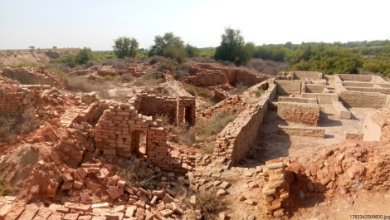
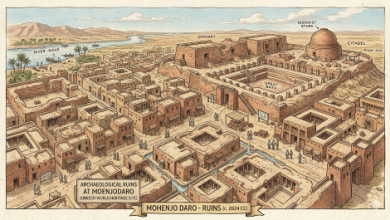
The province of Sindh was in the forefront of Pakistani archaeology for a long time. Artefacts from the Indus Civilization, early historic towns, the Islamic era, Buddhist structures, and other periods are all part of the province’s remarkable archaeological history.
On the other hand, investing in professional knowledge, research, and HRD on an ongoing basis is essential for institutional advancement.
Advancement Opportunities in Different Provinces
Other provinces, like Punjab and Khyber Pakhtunkhwa, have been actively working to build up their archaeological institutions and professionals’ abilities in the past few years.
The presence of highly qualified archaeologists in Khyber Pakhtunkhwa’s top posts highlights the value of domain knowledge in archaeological management, research strategy, and heritage preservation.
In a similar vein, Punjab has instituted new avenues for archaeology graduates to take part in heritage-related endeavours, including as contractual work. With the right recruiting procedures in place, these kinds of programs can help young professionals get experience in the field and even pave the road for more permanent employment opportunities.
These changes should be seen in a good light. They can teach other provinces a lot about how to improve their own professional recruitment, technical capacity building, and institutional continuity efforts, which is especially important in Sindh.
Crucial Problem: A Deficit of Research-Oriented Institutional Thinking across the Country
Neither archaeology nor any one person, agency, or province is to blame for the underlying problem.
The larger problem that Pakistan must overcome is the lack of appreciation for the value of evidence-based policymaking, scientific research, institutional growth, and professional specialization.
Decisions made at the administrative level in many government agencies are not necessarily well-grounded on the knowledge of experts in the relevant subjects.
This problem affects fields that rely on research, such as science, education, cultural heritage, conservation, museums, and environmental management, in addition to archaeology.
Research is seen as an essential part of a country’s progress in many nations. The importance of knowledge production to economic, social, cultural, and intellectual advancement is widely acknowledged by governments, which is why they allocate resources to educational institutions, labs, archaeological expeditions, professional training programs, and scientific institutions.
Research in Pakistan has sadly never gotten the attention, funding, and backing from policymakers that it merits.
Research is not a frivolous expense; it is an investment in the future of our nation, and we must come to a national consensus on this.
Honoring Archaeological Work in Sindh Despite Challenging Conditions
The administrative, budgetary, and institutional frameworks are crucial for making sense of the present situation in Sindh.
Archaeological project initiation, funding, fieldwork organization, technical team maintenance, authorization gaining, and international research collaboration development are not easy jobs.
Important heritage sites are still being studied, documented, and excavated despite a lack of funding and a plethora of administrative hurdles.
These endeavours are deserving of praise, expert backing, and critical assessment.
This in no way absolves archaeological initiatives of professional scrutiny and responsibility. No, if we want to see archaeological work of higher quality, we need scientific evaluation, peer review, open documentation, and constructive critique.
But there’s a big difference between encouraging people who are trying to make progress despite obstacles and offering constructive criticism.
Professional standards should be the goal of criticism, not the denigration of individuals, projects, or continuing efforts.
The correct course of action when faced with project constraints is to propose workable alternatives, suggest enhancements, and encourage the growth of more robust professional practices.
Collaboration, Not Rivalry between Institutions, Is Necessary in Archaeology
The field of archaeology is fundamentally interdisciplinary.
For it to be effectively implemented, a wide range of disciplines must work together, including but not limited to: history, conservation, architecture, engineering, geology, environmental science, museum education, community engagement, and public administration.
Recognizing professional contributions based on knowledge and relevance is essential, and every field plays a vital role.
Also, people with the right mix of professional credentials, technical know-how, and relevant work experience should be entrusted with specialized archaeological tasks.
Instead of becoming competing arguments, professional qualifications and practical experience should work together.
We should also refrain from making needless distinctions between seasoned experts who have amassed decades of experience and newer graduates who have received specialized academic instruction and are joining the field.
Through mentoring, collaboration, and the sharing of information, members of both generations can make significant contributions to the advancement of the institution.
Improving Sindh’s Archaeological Institutions: Moving Forward
Our top goals should be to enhance Sindh’s archaeology and cultural heritage management by doing the following:
- Professional Recruitment: Making sure that people with degrees in archaeology and related fields can find suitable jobs.
- Strengthening archaeological departments through ongoing professional training, field experience, and technological progress is the second component of institutional capacity building.
- Research-Based Policymaking: Making sure that decisions about archaeological research, excavation, conservation, and heritage management are informed by qualified professionals.
- A Career Path Based on Merit: Creating clear standards for hiring, creating professional cadres, and laying out promotion routes that take into account skills, experience, and performance.
- Allocating long-term funds for scientific studies, documentation, publications, conservation efforts, and archaeological digs is the fifth component of research funding.
- Interprovincial Cooperation: Promoting knowledge sharing and best practices in heritage management between the provinces of Baluchistan, Sindh, Punjab, Khyber Pakhtunkhwa, and the federal government.
- Global Cooperation: Deepening alliances with educational institutions, archaeological expeditions, research centers, and environmental experts across the globe.
- Encouraging an atmosphere of evidence-based, courteous criticism that is focused on enhancing archaeological practice is the eighth tenet of constructive professional dialogue.
Read: The Demise of the Indus Civilization
Shifting Focus from Individual Responsibilities to Group Achievement
The propensity to dwell on personal failings rather than group duties is one of the biggest problems confronting modern organizations.
Criticizing a person, an initiative, or an institution’s shortcomings is simple. Contributing constructively toward workable answers is far more challenging.
Everyone in Pakistan has a stake in the country’s rich archaeological history. No amount of office politics, jealousy, or professional insecurity should turn its maintenance into an issue of turf.
Whether it is from a seasoned field archaeologist, a budding researcher, a conservation expert, a museum worker, or an administrator devoted to the betterment of the institution, every honest effort counts.
It is important to fix errors when they happen. It is necessary to fortify professional standards in areas where they are lacking. When people are putting in effort that matters, it should be recognized and supported.
It is our shared duty to foster an atmosphere that prioritizes collective intelligence, expertise, professionalism, and teamwork over individual disputes.
Finally, Rather Than Undermining People, Focus on Building Institutions
Both the availability of competent individuals and the readiness of institutions to acknowledge knowledge, promote research, offer chances, and assist professional development are crucial to the future of Pakistani archaeology.
Sindh has the ability to maintain its position as a preeminent site for archaeological study in South Asia, because to its impressive historical record. Institutional reform, professional development, scientific inquiry, and productive cooperation must all be maintained over the long term if this potential is to be realized.
Instead of focusing on who is to fault, we should band together to fortify the organizations charged with protecting our history and culture.
Thinking positively does not imply avoiding responsibility or dismissing flaws. It entails dealing with issues in a professional manner, being fair, finding realistic solutions, and really wanting to get better.
Pakistan must undergo institutional change instead of individual conflict, positive discourse instead of pessimism, and teamwork instead of disciplinary conflicts.
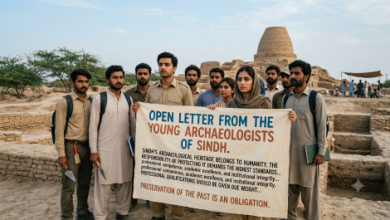
Archaeology is considerably more than just finding artefacts from the past. This is all about preserving our cultural heritage, learning from our past, expanding our knowledge, and leaving a legacy of knowledge to the generations to come.
Instead of focusing on weakening individuals, we should be aiming to strengthen institutions. Our aim shouldn’t be to impede development, but rather to foster an environment where high-quality research and professional brilliance can thrive.
Read: Apologies to Allama Iqbal
___________
 Ali K. Lashari is an Assistant Director (Excavation & Exploration) & Cultural Heritage Advocate, Directorate of Archaeology & Antiquities Wing, Culture, Tourism, Antiquities & Archives Department, Government.
Ayaz Ahmed Mughleri is Assistant Chief Warden, Directorate of Antiquities & Archaeology, Sindh