While swift to oppose external proposals for administrative division, a prominent segment of the contemporary literary community maintains a conspicuous silence regarding the provincial government’s internal misrule.
Sindh’s literary figures have long acted as the region’s moral baseline, using poetry and intellectual resistance to shield provincial identity against external political threats and territorial fragmentation.
By Noor Muhammad Marri Advocate | Islamabad
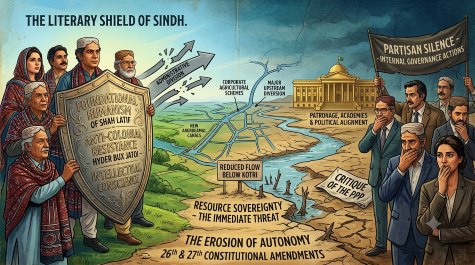
The literary tradition of Sindh has historically served as a shield against political and socio-economic marginalization. From the foundational humanism of Shah Abdul Latif Bhittai to the anti-colonial resistance articulated by Hyder Bux Jatoi, writers and poets have functioned as the moral conscience of the region. Whenever the provincial identity or geographic integrity of Sindh faced existential threats, the literary community rallied public consciousness, transforming intellectual thought into popular resistance. In the contemporary political landscape, their mobilization of civil society against any administrative division or territorial fragmentation of Sindh remains highly commendable.
However, a rigorous analytical appraisal reveals a troubling structural contradiction in modern Sindhi intellectual discourse. While writers actively resist theoretical divisions of the province proposed by external actors, a dominant segment of the intelligentsia maintains an eerie silence regarding internal governance actions that cause far more immediate, material damage. By consistently avoiding direct critique of the provincial ruling party—the Pakistan People’s Party—intellectuals and commentators risk reducing public advocacy to selective, partisan rhetoric.
Historically, Sindh’s survival has relied on resource sovereignty, particularly along the lower riparian stretch of the Indus Basin. Yet today, the construction of six new canals under various corporate agricultural schemes, including downstream diversions, poses an immediate threat to the region’s agrarian ecology. Reduced water flow below the Kotri Barrage accelerates sea intrusion, drowning fertile coastal land in Thatta and Badin and displacing peasant populations. Similarly, the provincial government’s extensive allocation of thousands of acres of public, agricultural, and barren land to corporate entities disenfranchises local sharecroppers and smallholders. Handing over communal heritage under the guise of investment destroys rural economies far more permanently than a redrawn administrative map.
Furthermore, recent legislative shifts—specifically the passage and discussions surrounding the 26th and 27th Constitutional Amendments—represent an alarming centralized reconfiguration of federalism. These amendments threaten the provincial autonomy hard-won through the 18th Amendment, altering judicial frameworks and weakening local legal remedies against central resource allocations. Historically, whenever provincial leadership acquiesced to federal centralism—such as during the implementation of the One Unit scheme in 1955—the region suffered profound economic and political setbacks.
The division of a nation or a province does not occur solely through physical boundaries drawn on a map. It occurs organically when a region’s water is systematically diverted, its ancestral soil is transferred to corporate monopolies, and its constitutional safeguards are eroded with the implicit or explicit consent of its own elected executive. When writers choose to shield the provincial ruling elite from accountability—whether driven by institutional patronage, state-funded academies, or political alignment—they compromise their moral authority. An intellectual tradition that claims to protect the land while staying silent on the policies drying its rivers and privatizing its soil ultimately fails the very people it purports to serve.
Read: Baloch Insurgency: Changing Dynamics
__________________
 Noor Muhammad, Advocate and Mediator, Islamabad