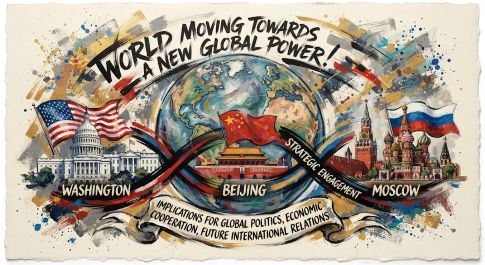
The emerging strategic engagement among Washington, Beijing and Moscow and its implications for global politics, economic cooperation and the future of international relations.
Kalavanti Raja
The reported gathering of US President Donald Trump, Chinese President Xi Jinping and Russian President Vladimir Putin in Shenzhen has revived an important historical comparison with the Yalta Conference of 1945, when Winston Churchill, Franklin D. Roosevelt and Joseph Stalin discussed the post-war international order. However, the world of 2026 is fundamentally different. While Yalta dealt with the political reconstruction of a war-devastated world, today’s challenge is to manage geopolitical rivalries, economic interdependence, technological competition, nuclear security and regional conflicts.
The central question is no longer simply who controls territory, but who influences technology, capital, energy, trade routes, financial systems and the strategic resources upon which modern civilization depends.
The End of Unipolar Dominance
Following the collapse of the Soviet Union in 1991, the United States enjoyed an exceptionally dominant position in international affairs through its military strength, global alliances, technological leadership and influence over international financial institutions. However, China’s economic transformation has significantly altered the balance of global power. Its manufacturing capacity, technological advancement, infrastructure investment and international trade have established it as a major economic force. Russia, despite Western sanctions, retains considerable influence through its nuclear capabilities, energy resources and military strength.
Meanwhile, India, the European Union, Brazil, Saudi Arabia, Türkiye and Indonesia are increasingly pursuing independent economic and strategic interests. The emerging international environment is therefore characterized by multiple centers of influence rather than unquestioned dominance by a single country.
Three Powers, Three Strategic Visions
Trump’s approach emphasizes direct negotiations, economic advantage, military strength and personal diplomacy. Xi Jinping seeks to expand China’s international influence through industrial development, technological innovation, economic connectivity and greater participation in global institutions. Putin’s strategic priorities center on national security, military capabilities, energy resources and recognition of Russia’s international position.
Although their interests and political visions differ, direct engagement among these leaders reflects the importance of dialogue in managing international tensions. Their interaction should be understood as strategic accommodation rather than necessarily a formal alliance.
The New Battlefield: Technology, Energy and Finance
Global competition increasingly extends beyond conventional military confrontation. Artificial intelligence, semiconductors, quantum computing, satellite networks, cyber capabilities, rare earth minerals and advanced manufacturing are becoming essential instruments of national power.
Energy security is equally important. Oil and gas remain strategically significant, while renewable energy, nuclear technology, electricity storage and critical minerals are reshaping global economic relationships. Financial systems, international payment mechanisms, investment flows and the dominance of the US dollar are also becoming subjects of geopolitical debate. Consequently, the future international order will depend as much on technological and economic influence as on military strength.
Europe, Ukraine and the Question of Sovereignty
Europe faces difficult security challenges following the Ukraine conflict. European governments remain concerned that negotiations between Washington and Moscow could affect continental security without adequate European participation. Ukraine, meanwhile, has a fundamental interest in protecting its sovereignty and territorial integrity.
This raises an essential question: can a sustainable international order emerge if powerful countries determine the future of smaller nations without their participation? International law, national sovereignty and peaceful conflict resolution must remain central principles of global diplomacy.
The Global South: A Growing Voice
Countries across Asia, Africa, Latin America and the Middle East increasingly seek independent diplomatic and economic relationships. The expansion of BRICS, China’s Belt and Road Initiative and the growing influence of Gulf economies reflect this transformation.
Their priorities include infrastructure, industrialization, food security, affordable energy, technology transfer, international trade and development finance. Rather than replacing one dominant power with another, many countries seek greater freedom to pursue partnerships according to their national interests.
Pakistan: From Geographical Bridge to Economic Connectivity
For Pakistan, this changing geopolitical environment presents important opportunities. Its geographical position connects South Asia, Central Asia, China and the Middle East, while its Arabian Sea coastline offers potential for regional trade and maritime connectivity.
The China-Pakistan Economic Corridor (CPEC) should be viewed beyond roads and power projects. Its long-term significance lies in connecting industrial centers, ports, logistics networks, energy markets and regional trade routes. Gwadar’s potential depends on supporting infrastructure, industrial development and commercial connectivity.
Pakistan must simultaneously maintain constructive relations with China, the United States, Russia, the European Union and Gulf countries. A balanced foreign policy, supported by institutional stability, industrial competitiveness and economic development, can strengthen its international position. Pakistan must move from being a geographical bridge on the world map to becoming an economically productive bridge between regions.
Humanity and the Future of Global Cooperation
Beyond geopolitical competition, humanity faces challenges that demand collective action, including climate change, water scarcity, food insecurity, pandemics, environmental degradation and technological inequality. Artificial intelligence is transforming employment, education and industrial production while raising concerns about privacy, accountability and economic disparities.
A genuinely progressive international order must therefore prioritize human dignity, sustainable development, economic opportunity and environmental responsibility alongside national security.
A New Balance, Not Another Division
The reported Shenzhen engagement may become an important diplomatic reference point, but its historical significance will depend on practical outcomes: reducing nuclear risks, managing economic confrontation, resolving regional conflicts, respecting national sovereignty and reforming international institutions.
The twenty-first century requires an international system in which military strength is balanced by economic resilience, technological innovation, diplomatic credibility and collective responsibility.
The future cannot be secured by dividing the world into competing spheres of influence or replacing one dominant power with another. It requires cooperation among established and emerging powers, with meaningful representation for smaller nations.
The world does not need another Yalta to divide it. It needs a new international understanding to unite it.
Read: Sindh is Not a Drainage Corridor
____________
 Kalavanti Raja is a social and political activist from Gambat, Khairpur Mirs, with 30 years of work on women’s rights, minorities, and social justice. She has served in Sindhiyani Tahreek and participated in national and international forums across Asia, Europe, and America.. She can be reached at kalavanti.raja@gmail.com