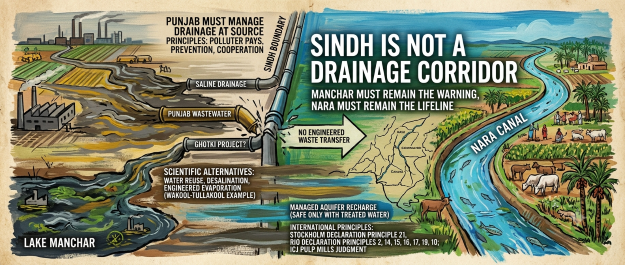
Sindh should manage its own drainage safely and require Punjab to do the same.
Sindh’s farmers, communities and institutions should pursue a peaceful, evidence-based legal challenge to any design threatening Nara or enabling additional cross-boundary waste transfers.
By Kalavanti Raja
WAPDA’s proposed Ghotki Drainage Project has raised a question that Sindh must answer before another freshwater system is endangered: who should bear the burden of agricultural drainage? WAPDA records a Rs156.217 billion proposal. Published criticism describes a 1,067-kilometre network, a stated discharge of 3,183 cusecs and two proposed outfalls into Nara Canal. These reported arrangements require disclosure and independent examination, not acceptance on administrative assurances.
Sindh’s position should be unequivocal: no engineered transfer of Punjab’s wastewater or saline drainage across the Sindh–Punjab boundary. Punjab must manage its drainage within its own jurisdiction through treatment, reuse and scientifically designed disposal. This demand concerns artificial waste transfers, not the natural flow of the Indus or Sindh’s freshwater entitlement. It should become an explicit, enforceable provincial policy.
Nara’s importance explains why this position is necessary. Following an ancient natural watercourse subsequently incorporated into modern irrigation, the approximately 364-kilometre canal serves a command of around 2.3 million acres. Published estimates identify approximately 6.6 million people dependent on its freshwater for irrigation, drinking and domestic purposes. Farmers, tenants, laborers, livestock keepers and rural businesses depend on the economy it sustains.
To contaminate that water would threaten far more than a channel. It would threaten soils, harvests, drinking supplies, employment and household incomes. Sindh has already witnessed this chain of damage at Manchhar. Research links the lake’s degradation to RBOD-I/Main Nara Valley Drain effluent, diminished freshwater replenishment and other pressures. Nara must not become another freshwater lifeline sacrificed to inadequate drainage planning.
The argument must remain accurate. Manchhar’s entire degradation cannot be attributed exclusively to Punjab, and an unverified future connection to Punjab cannot be described as an approved Ghotki project component. Nevertheless, Sindh can insist that the project’s sources and outfalls be disclosed and that any provision enabling additional Punjab drainage to cross the boundary be rejected.
International environmental principles support prevention and responsibility at source. Stockholm Declaration Principle 21 and Rio Declaration Principle 2 articulate responsibility to prevent environmental damage beyond national jurisdiction. Rio Principle 14 discourages transferring activities and substances causing severe environmental degradation or harm to health. Their central message challenges the assumption that pollution becomes somebody else’s responsibility once it moves downstream.
Rio Principle 15 supports precaution against serious or irreversible harm despite incomplete scientific certainty. Principle 16 supports polluters bearing pollution costs; Principle 17 calls for environmental assessment; Principle 19 addresses prior notification and consultation over significant transboundary effects. Principle 10 emphasizes public information, participation and access to remedies. Together, these principles strengthen demands for prevention, transparency and accountability.
The International Law Commission’s 2001 draft articles offer further guidance: Article 3 addresses prevention; Article 7 risk assessment; Article 8 notification; Article 9 consultation; and Article 13 public information. These are draft articles, not a universally binding treaty. Likewise, the Rio Declaration is not itself a treaty, and its principles do not automatically create an interprovincial prohibition.
The International Court of Justice’s Pulp Mills judgment provides firmer support for environmental assessment where proposed industrial activity risks significant adverse transboundary effects, particularly on shared resources. UNCLOS Article 125 recognizes agreed access to the sea, not an automatic wastewater corridor. These international rules concern states; Pakistan’s constitutional and environmental framework remains the principal enforceable basis for Sindh’s case.
Article 9A guarantees a clean, healthy and sustainable environment. Article 155 permits the concerned government to bring qualifying water grievances before the Council of Common Interests. The Sindh Environmental Protection Act, 2014 controls discharges under Section 11, requires applicable assessment and approval under Section 17, and enables protective and restoration orders under Section 21. Sindh should invoke these mechanisms against unsafe proposals.
Scientific alternatives deserve serious investment. Source separation should keep clean stormwater apart from sewage, industrial effluent and saline drainage. Appropriate treatment can support reuse. Reverse osmosis and other suitable desalination processes can recover water, although concentrated brine remains to be managed. Controlled reuse, balancing reservoirs, evaporation basins and salt collection should be compared through independent feasibility studies.
Evaporation systems require sufficient land, dependable containment, storm storage and a plan for accumulated salts. Their size must reflect seasonal inflows and actual evaporation, not optimistic annual averages. The reported 3,183-cusec capacity must therefore be separated into storm peaks and continuous saline flow before anyone claims that local disposal is either impossible or automatically feasible. Those calculations must be public.
A practical example comes from Australia’s Wakool–Tullakool scheme in New South Wales. Constructed during the 1970s and 1980s, it used groundwater interception and evaporation basins to manage saline water locally. Federation University reported in 2023 that it had protected around 50,000 hectares, while emphasizing ageing infrastructure and the need for renewal. The example demonstrates an engineering approach, not a maintenance-free cure.
Murray Irrigation has also described a proposed renewable-energy desalination component to recover useful water from the scheme’s saline groundwater. Its stated potential must not be mistaken for verified operating performance. Nevertheless, the approach is relevant: investigate local interception, containment and water recovery rather than assume a neighboring province must receive the drainage.
Managed Aquifer Recharge provides another option only where treated water, suitable geology and available underground storage coincide. Infiltration basins, recharge trenches and engineered wells can replenish depleted aquifers. Saline or inadequately treated water must never be injected into freshwater reserves, and recharge must not aggravate waterlogging. Every option requires monitoring, realistic costs and a sustainable salt balance.
Sindh’s farmers, communities and institutions should pursue a peaceful, evidence-based legal challenge to any design threatening Nara or enabling additional cross-boundary waste transfers. They should demand the complete feasibility study, environmental assessment, seasonal flow calculations, water-quality results, alternatives analysis and approval conditions. Neither a lined drain nor a financial offer should weaken the proposed boundary prohibition.
The policy must remain consistent: Sindh should manage its own drainage safely and require Punjab to do the same. Treatment, reuse, suitable recharge and engineered evaporation deserve investment where the water originates. Sindh needs freshwater and responsible development, not payment for accepting pollution. Manchhar must remain the warning. Nara must remain the lifeline. No engineered drainage transfer across the boundary.
Read: Beyond the Veil of Perception
________________
 Kalavanti Raja is a social and political activist from Gambat, Khairpur Mirs, with 30 years of work on women’s rights, minorities, and social justice. She has served in Sindhiyani Tahreek and participated in national and international forums across Asia, Europe, and America.. She can be reached at kalavanti.raja@gmail.com