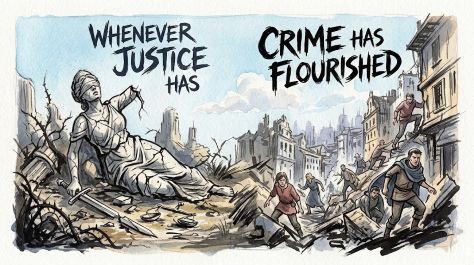
“Whenever justice has faltered, crime has flourished, and we are living with the truth which is highly alloyed, tarnished and pock-marked.”
“Justice needs considered understanding of a crime, for which time and wisdom are required.”
Dr. Jernail S. Anand
We are aware of the justice systems of the world, which deal with crime. When we say justice delayed is justice denied, we accept that the judicial systems of the world can be taken for a ride, and smart men may succeed in delaying justice forever. There are men smart more than courts can contend with. In fact, the preponderance of crime in a society indicates that, in the race between criminals and the law, it is the crime who takes the lead. Law only tracks them down, with uncertain consequences of punishment or acquittal.
Even the most egalitarian and educated societies cannot certify that justice is carried in every case, because, over the time, our faith in institutions which ensure liberty, equality and justice to all is being eroded by men who undermine these institutions in order to stay in power. Apart from this, there is the instant style of justice. In the past, we had ‘eye for an eye’ system delivered justice in full public view. Men convicted of various crimes were executed while the public watched in awe. Punishments by crushing under the feet of elephants have not yet faded from human memory. Whenever justice has faltered, crime has flourished, and we are living with the truth which is highly alloyed, tarnished and pock-marked.
Another explicit way of doing justice is: Revenge. Revenge is the most powerful theme in drama and even our movies which hit the bull’s eye. This is also a form of instant justice, which multiplies the injury, and does not settle the question of crime and punishment in any convincing way. Justice needs considered understanding of a crime, for which time and wisdom are required. In such cases, neither comes into play, and the justice remains under-done.
The Divine Justice
When we turn to divinity, divine justice is not only delayed, but it is not to be seen in one’s life time. It is often said that justice should not only be done, it should appear to have been done. In case of gods, we see worst of people enjoying luxuries of all types. If at all gods punish them for their excesses, it is only in the next world, which nobody has seen. The manifestation of justice being done to wrong doers is absolutely missing from society, sending wrong signals.
In Mahakaal Trilogy, in Lustus: The Prince of Darkness,* gods are surprised why people are going to the devils; while the presence of people in holy places is on the increase, there is a dip in their faith in the power of the gods. In reply to this, it is reported that people have started having doubts that gods are interested in their wellbeing, because whenever they call upon gods, no one comes to their rescue. The evil mongers enjoy the best of the world. It is rarely that a Krishna arrives to punish Kamsa, or Lord Rama is sent to finish Ravana. In ordinary life, for centuries together, it is the evil that flourishes and gods do not respond to the cries of the people. Earl of Gloucester, in King Lear says:
As flies to wanton boys are we to gods,
They kill us for their sport.
[Act 4, Scene 1]As a result of this realization, gods decided to make amends, and appear whenever they are called upon by people in distress. This was a sort of instant justice. People were scared when for their fouls, they were thrashed by invisible hands. They again approached the Divine Kingdom pleading that they may not be judged instantly. It is better, if they are judged at the end of the innings, i.e. after death. So, status quo was restored.
It has to be remembered that the crimes people are indulging in have social ramifications. They are corrupt, and indulge in murders or playing with the integrity of their country. These are societal crimes, but the punishment that is given to them is entirely private, [post death], and no one else knows how they have been treated by gods. Even if they are made to suffer fires of hell, how does it matter to the people whom they have harmed in their lifetime?
Life is the mystery of all mysteries. So is death. Everything is wrapped in mist. How people are charged with various crimes, and how they are punished in hell, it is only a guess work. What is apparent is that the divine system of justice is very tardy. In fact, people often take even the divine law into their hands, and inflict injuries on people who have done harm to them, without waiting for gods to intervene.
In one of my epics, Redemption,** when Nemesis is asked why it is so slow to at the delivery of justice, Nemesis says that when gods take a decision about a man, they have to consider their fouls in the entirety. Justice takes time and this time gap between the act and its reaction is considered the recovery time. If a man does an evil act today, instead of punishing him there and then, the gods prefer to delay the punishment, so that, he may have realization of his crime, regret his action and atone for his crimes. People who commit crimes in the heat of the moment, are seen repenting for them later on. It appears the earthly law is a very small segment of the judicial system of gods, whose network is too large, and kindly too towards men, which slows down the divine reaction. Lord Krishna too says that man has control only on his action, but no control over its fall out which lies with the gods who have to study his actions in their entirety, and decide upon their impact.
What men take with them?
When a man dies, people often ask: what men can take with them? To signify the truth of this statement, people do not attach any pocket to the coffin of a dead man. Certainly he cannot carry any worldly prize to the next world. But this is partially true. A man is not a body. He is a mind, a soul, and an actor, whose actions affect so many around him.
So, when a man dies, it is his body which disappears from public view, but his presence, good or bad, stays behind. This good and bad is what man carries along with him to the next world. The soul that returns to the divine abode is carrying the silt of sin, heavy with crime, and cannot merge with the divine, so long as its dirt is not removed. And, man is sent back to the earth, with a clear brief to do good. But this brief does not last even a few days. Because the first thing that a man forgets when he gains memory in the world, is that he comes from the divine. He starts afresh, a clean slate from which all the wisdom of the previous births has been erased.
*Lustus is a corporate of evil, who takes over from ageing Satan. He challenges gods and wages war against angels in the three books of the Mahakaal Trilogy.
**Redemption is an epic from the Neo-Cosmic Trilogy in which the ideas of Evil are discussed in detail, and Nemesis is called upon to explain why godly systems are so slow in giving justice to evil doers.
Read: Prayer: A Post-Modern View
____________
 Dr. Jernail S. Anand, with 210 books to his credit [20 epics] is a Chandigarh-based top ranking author, whose seminal work ‘Lustus: The Prince of Darkness’ challenges the moral complacency of our era. He is founding President of the International Academy of Ethics, and Laureate of Charter of Morava [Serbia], Seneca [Italy], Franz Kafka [Germany, Ukraine, Czeck Rep] and Maxim Gorky [Russia] Soka Ikeda and Mahakavi Bharati (India) Awards, his name is inscribed on the Poets’ Rock in Serbia. Email: anandjs55@yahoo.com.