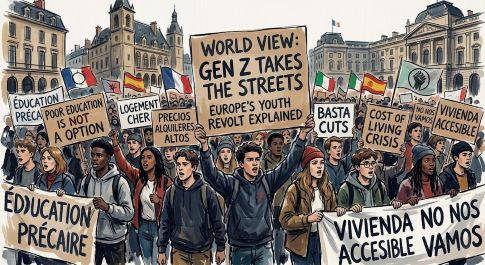
A wave of public unrest driven by young people has swept across France, Spain, Portugal, Italy, Belgium and Albania, as anger grows over poor educational conditions, soaring housing costs and the rising cost of living.
Ramesh Raja
Gen Z is taking to the streets across Europe; from the school gates of Paris to the squares of Madrid and the parliament steps of Tirana. In different languages and with different demands, the message is converging: young Europeans are tired of paying the price for political decisions that put their futures at risk.
This is not one coordinated movement. But a wave of public unrest driven by young people has swept across France, Spain, Portugal, Italy, Belgium and Albania, as anger grows over poor educational conditions, soaring housing costs and the rising cost of living.
France: Where it started
The current cycle began in mid-to-late September in France, when students in the Paris region blockaded school entrances.
The flashpoint was Lycée Saint-Exupéry in Créteil, an underprivileged suburb of Paris, where students protested a shortage of substitute teachers, overcrowded classrooms and inadequate facilities.
Their complaints quickly became familiar across the country: missing teachers, overcrowded classrooms and deteriorating facilities, including mold, broken toilets and classrooms reaching 40°C during heat waves. Hundreds of schools were closed or disrupted as the protests spread.
What started as a high-school action became a national mobilization. A massive day of mobilization brought together not just students but also former yellow vest protesters, teachers, trade unions, farmers and firefighters.
The scale grew fast. The French Interior Ministry reported around 161,500 people joining rallies on one Tuesday alone, while organizers put turnout for a Saturday in mid-October at 550,000 to 800,000. Another national count cited 266,000 marchers, with more than 6,500 arrests since September 28, mostly minors.
Students raised concerns about vacant teaching positions, overcrowded classrooms, lengthy timetables and school buildings no longer suitable for learning but the protests also tapped into a wider cost-of-living crisis and political discontent.
Albania: Corruption, education and calls for resignation
In Albania, student-led demonstrations in Tirana entered their sixth consecutive day on October 18. Protesters demanded Prime Minister Edi Rama’s resignation while raising concerns about education costs, corruption and limited employment opportunities.
The daily protests had been peaceful since they began on October 13 outside the education ministry, shouting “Rama resign!” over tuition fees. In recent days they escalated.
Reports from Tirana described a police station set on fire and 28 people, including 19 police officers, injured, with other outlets reporting over 500 detained and over 120 police injured in clashes. Thousands marched through Tirana on the fourth day, breaking windows and traffic lights on an increasingly violent student-led campaign.
Rama has said he will not resign. “My responsibility is to listen, address legitimate concerns and keep Albania moving forward,” he said in a written statement to Reuters, adding “governments are changed through democratic elections. We had elections last year, not a revolution.”
For young demonstrators, the issue is staying in the country. As one report noted, the protests reflect a desire to build their futures in Albania rather than seek opportunities abroad.
Spain: Tents in Puerta del Sol and a housing storm
In Spain, protesters had already been camping for several days at Puerta del Sol, one of the capital’s most important public squares.
What began as anger over an eviction — the forceful eviction of an 87-year-old woman in Madrid; triggered nationwide protests across Spain with protesters demanding lower rents, an end to evictions, and a ban on investment funds or “vulture funds” buying property.
On October 3-4, around 50 demonstrations were held in cities including Madrid, Barcelona and Valencia. Organizers estimated more than 150,000 demonstrators joined in central Madrid alone, rattling keychains — now a symbol of housing discontent and chanting “Stop the housing racket.”
The backdrop is stark: average rent in Spain has almost doubled in the past 10 years, from 8.20 euros per sqm in 2016 to 15.1 euros this year, with 26% of renters spending an average of 40% of their income on rent.
Portugal, Italy and Beyond: Wages, pensions and the cost of being a student
In Portugal, demonstrators took to the streets over wages, pensions and public services, amid growing anger over the cost of housing; part of the same housing affordability wave hitting Lisbon, Madrid, Amsterdam and Milan.
In Italy, university students are back in their tents, even outside parliament, protesting the rising cost of student life. The movement, which also drew 100,000 protesters in Rome peacefully, centers on the struggle to access grants, tuition fees and everyday expenses.
Belgium has seen student-led protests in Brussels and Liège turn violent, with police deploying tear gas and water cannons, linked to rising household expenses and education fees.
One Generation, Different Flags
Protests have also touched other causes — motor oil refinery workers in Greece over workplace demands — but the core drivers are shared: housing that costs nearly double what it did a decade ago, schools that leak and overheat, jobs that don’t pay enough to stay, and a sense that decisions are made without those who will live with them.
At least five European countries are witnessing protests over various issues, including France over living costs and poor school conditions, Albania over university conditions and job prospects, and Portugal over housing affordability.
As one young Albanian banner put it in Tirana: “EUROPE CAN YOU HEAR US”; a line that summed up the weekend from Paris to Lisbon.
It is not one single movement. The demands vary from country to country. But the message is strikingly similar: young people no longer want to stand on the sidelines while decisions about their future are made without them.
Read: Debt-Laden Pakistan Leads Borrowing Nations
____________
 Hailing from Gambat town of Sindh, Engr. Ramesh Raja, is a Civil Engineer, visionary planner, PMP certified and literary enthusiast with a passion for art and recreation. He can be reached at engineer.raja@gmail.com