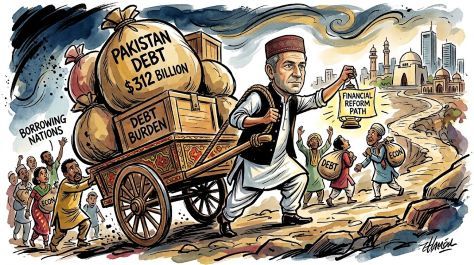
A country carrying a heavy debt burden of $312 Billion has been chosen to help other borrowing nations find better ways forward
By Ramesh Raja
A country carrying a heavy debt burden has been chosen to help other borrowing nations find better ways forward. On 12 October 2026, Pakistan assumed the chairmanship of the Governing Council of the Borrowers’ Platform in Bangkok. Finance Minister Muhammad Aurangzeb accepted the responsibility on Pakistan’s behalf during the IMF–World Bank Annual Meetings.
The Borrowers’ Platform is a United Nations-backed forum supported by UN Trade and Development, known as UNCTAD. It brings developing countries together to share experiences, improve debt management and give borrowers a stronger voice in international financial discussions.
For decades, lenders have coordinated their positions through groups such as the Paris Club. Borrowing countries have often faced their financial difficulties separately. This platform gives them a place to learn from one another, understand borrowing risks and seek technical support.
The initiative followed the Sevilla Commitment adopted at the United Nations financing-for-development conference in 2025. It was launched in Washington on 15 April 2026, with UN Secretary-General António Guterres participating. Egypt initially led the process, with Pakistan as vice-chair. By the first Governing Council meeting in October, 31 developing countries had formally joined.
The platform will not cancel debts or negotiate a joint repayment agreement for its members. Its purpose is practical cooperation: helping countries choose suitable loans, plan repayments, improve financial transparency and find better ways to finance development.
The need is clear. UNCTAD reported at the April launch that 54 countries, home to 3.4 billion people, spent more on debt servicing than on health or education. When governments spend so much on interest and repayments, less money remains for schools, hospitals and public services.
Pakistan’s own situation explains the importance of this responsibility. Reporting on the Finance Ministry’s Annual Debt Review puts its public debt at about Rs86.7 trillion, or $312 billion, at the end of June 2026. This includes roughly Rs59.4 trillion borrowed within Pakistan and about $98 billion in external public debt. Most public debt is therefore domestic borrowing.
The country’s broader external debt and liabilities stood at about $139 billion. This includes foreign obligations of government, the central bank, public enterprises, banks and private businesses. It overlaps with public debt, so the two totals should not be added together.
Pakistan’s foreign lenders include the World Bank, with about $22 billion, the Asian Development Bank and related regional banks with about $17 billion, the IMF with $9 billion, and the Islamic Development Bank with nearly $2 billion. China’s government and banks together account for about $29 billion, while Saudi Arabia accounts for roughly $5.5 billion. Paris Club countries, including Japan, France, the USA and other European countries, hold around $6 billion. Pakistan also borrows through international bonds and Islamic Sukuk. These rounded creditor figures come from the IMF’s June 2025 debt snapshot.
Pakistan also relies on lenders extending repayment deadlines, commonly called rollovers. These provide breathing space, but the debt remains payable. Public debt rose during FY2025–26, even though it became smaller relative to the measured size of the economy.
Pakistan’s priorities as chair include improving debt management, sharing economic reform experiences and exploring new sources of development financing. These efforts could help members make better decisions and reduce the risk of repeated financial crises.
Borrowing can be useful when it supports productive infrastructure, exports and public welfare. Problems grow when new loans mainly keep old payments going. Pakistan’s chairmanship is an opportunity to turn experience into useful lessons. Its success should be judged by better borrowing decisions and more money available for people’s needs.
Read: From Hunting to Cultivated Meat
______________
 Hailing from Gambat town of Sindh, Engr. Ramesh Raja, is a Civil Engineer, visionary planner, PMP certified and literary enthusiast with a passion for art and recreation. He can be reached at engineer.raja@gmail.com