Concrete can accommodate people; it cannot feed them. The government must protect fertile land now, while planning settlements that meet tomorrow’s housing, food and environmental needs.
By Ramesh Raja
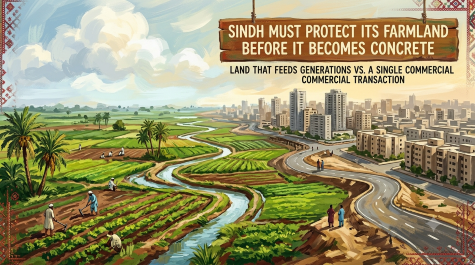
Travel along the National Highway from Hyderabad towards Kamu Shaheed, or the Indus Highway towards Kashmore, and advertisements for housing societies repeatedly interrupt the agricultural landscape. Fields are presented as investment opportunities, their future measured in residential plots. Where fertile soil and irrigation sustain harvests, Sindh must ask a fundamental question: should land that feeds generations be surrendered for a single commercial transaction?
The pressure for housing is real. Pakistan’s 2023 census recorded Sindh’s population at 55.69 million, compared with 47.85 million in 2017: approximately 7.84 million additional people within six years. Each needs shelter, but each also needs food. Planning that accommodates homes by steadily consuming productive farmland addresses one necessity while undermining another. Population growth strengthens the case for protecting agricultural capacity.
Farmland is more than vacant space awaiting construction. It combines soil, water, access, farming knowledge and public investment in irrigation. The Food and Agriculture Organization estimates that land, soil and water underpin 95 percent of our food. Productive soil develops over centuries. Once fragmented into streets, boundary walls and plots, an agricultural landscape becomes difficult and expensive to restore, even when advertised housing remains unoccupied.
The environmental damage extends beyond lost crops. Scientists call the covering of soil with concrete, asphalt and buildings “soil sealing.” It reduces infiltration, restricts exchanges between soil and atmosphere, damages underground habitats and increases surface runoff. Heat accumulates where vegetation disappears. Poetically, we close the earth’s breathing spaces; practically, we weaken the natural systems that absorb rainfall and moderate temperatures.
Other governments have recognized this danger. British Columbia established its Agricultural Land Reserve in 1973 after mounting development pressure threatened scarce farmland. Within the reserve, non-farm use and subdivision are prohibited unless permitted under the governing law. Land ownership therefore does not automatically confer a right to convert fields into housing subdivisions. Agricultural protection is embedded in the approval system.
Japan similarly protects designated agricultural-use zones, where conversion is generally prohibited. Removing land from protection requires conditions to be satisfied, including consideration of alternatives and effects on agriculture. China’s Land Administration Law requires State Council approval to convert permanent basic farmland into construction land. These systems allow specified exceptions, but ordinary development demand cannot simply override designated agricultural protection.
Roads are essential for development, but China demonstrates how engineering can reduce their agricultural footprint. The 50.284-kilometre Changsha–Yiyang Expressway Expansion Project in Hunan, opened on 31 August 2020 as the Changsha–Yiyang section of the Changsha–Changde Northern Expressway, used elevated bridges across cultivated-land sections specifically to minimize farmland loss. According to the provincial government, this reduced farmland occupation by 55 hectares, approximately 136 acres.
Another example is the Fuyin Expressway–Wujing Expressway section of the Xiaogan–Hanchuan–Yingcheng Expressway in Hubei. A provincial Natural Resources Department report dated 17 July 2024 states that bridges accounted for nearly 80 percent of the project. Elevation, together with other design improvements, reduced cultivated-land requirements by 35.86 hectares, including 22.68 hectares of permanent basic farmland. These combined savings should not be attributed to elevation alone.
China’s Ministry of Transport also directs projects to avoid basic farmland, reduce land fragmentation and use bridges or tunnels where appropriate to conserve land. Elevated roads still require foundations and access works, and shading can affect cultivation beneath them. Nevertheless, these examples establish a principle Sindh should adopt: avoid productive fields wherever possible and assess elevated sections where essential infrastructure must cross valuable agricultural areas.
Oregon offers another lesson: every city has an urban growth boundary. Restrictions outside these boundaries protect farms and forests against urban development, while expansion follows a formal planning process. France’s 2021 Climate and Resilience Law established a trajectory towards zero net land artificialisation by 2050, including halving consumption of natural, agricultural and forest land during 2021–2031 against the previous decade.
Sindh should adopt its own enforceable agricultural protection framework. First, map productive soils, irrigated farmland, orchards, drainage corridors and existing settlements. Pending that assessment, suspend fresh housing-scheme approvals on identified prime farmland. Then establish protected agricultural zones where ordinary residential plotting is prohibited. Any exceptional public-interest conversion should require published reasons, alternatives analysis, agricultural assessment and independent scrutiny.
Housing alternatives must be practical and affordable. Priorities vacant urban plots, redevelopment of underused sites and compact neighborhoods served by transport, sewerage and water. Direct public infrastructure and developer incentives towards suitable non-agricultural land. Protecting farmland will fail if governments restrict supply without creating serviced, accessible places where people can realistically live and work.
Selected locations along Sindh’s eastern sandy belt could be assessed for planned settlements and connecting roads. However, desert landscapes are neither empty nor automatically expendable: they support communities, grazing and biodiversity. Water availability, livelihoods, heat exposure and environmental suitability must determine locations. Rainwater harvesting and small storage structures may supplement supplies where feasible, but cannot replace a dependable water budget.
Nevada, a largely arid and mountainous American state covering approximately 286,400 square kilometers and bordering California, Oregon, Idaho, Utah and Arizona, demonstrates how difficult terrain can support economic opportunity. Las Vegas began as a railway town in 1905 and developed over subsequent decades into an international tourism and entertainment center through infrastructure, investment and enterprise. Sindh should draw inspiration from this transformation when planning the future of its extensive eastern desert belt, encompassing Nara and Thar. The provincial government should develop a coordinated regional plan for carefully located towns, cultural tourism, desert resorts, solar energy, educational institutions and suitable industries, supported by reliable roads, digital connectivity and sustainable water supplies. Such development must respect local land rights, protect desert ecosystems and give existing communities a direct share in employment and prosperity. With thoughtful planning, Sindh’s desert landscape could become a source of opportunity, while directing suitable new development away from productive agricultural land.
This policy should also safeguard tenants and small farmers, ensuring that protection strengthens rural livelihoods rather than merely restricting their land rights.
Responsibility must extend across planning authorities, building control, revenue administration and environmental regulators. Publish approved layouts, land-use decisions and satellite-based records of agricultural conversion. Support farmers through viable markets and incentives to retain productive land. Sindh needs a development policy that values the next harvest as seriously as the next housing scheme. Concrete can accommodate people; it cannot feed them. The government must protect fertile land now, while planning settlements that meet tomorrow’s housing, food and environmental needs.
Read: AI Utopia: A World without Human Labor
________________
 Hailing from Gambat town of Sindh, Engr. Ramesh Raja, is a Civil Engineer, visionary planner, PMP certified and literary enthusiast with a passion for art and recreation. He can be reached at engineer.raja@gmail.com