A thoughtful narrative on the subtle trap of living one step ahead of ourselves. Author examines how small, incomplete actions reveal our mental clutter—and why true productivity begins with simple presence.
By Raphic Burdo
Every morning is different. All mornings are different.
Some mornings I wake with the sun peeping through the window. On others, I am awake to welcome it. Sometimes the chirping of birds draws me out of bed. Other times, the alarm has to shake me awake.
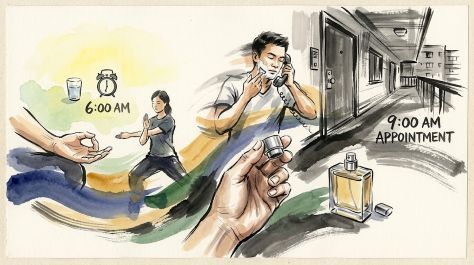
There have been mornings when I have given myself more than a full hour before attending to the demands of the day. First, a glass of water. Then the bathroom rituals. After that, meditation, affirmations, and a slow, mindful reading of my life vision.
Then I move. I walk in place indoors and do light strengthening exercises: push-ups, planks, squats, bridges, flutter kicks, scissors, and movements for my neck, arms, and back. This is followed by deep breathing, reading, and writing. Sometimes I write about a dream from the previous night. Sometimes about a feeling that has stayed with me, or my plans for the day.
Then come shaving, showering, and getting dressed.
Somewhere in between, there is usually a call to my wife or children. My morning is Sarim’s evening abroad, so it is a good time to catch him. There is also a chance to speak to Eshaal before her mother drops her at school by eight. Sometimes I call a friend while shaving or exercising.
These conversations matter to me. With family living at a distance and everyone following a different timetable, one finds these little windows and uses them.
But some mornings become a real mess.
I wake with barely thirty minutes to get somewhere. Everything must then be shortened, combined, or abandoned. The clock begins to govern each movement. Even before leaving the apartment, I feel behind.
That needs to be addressed.
For the purposes of my own morning, the world starts making its demands at eight. I need two hours before that. My alarm, therefore, must go off at six.
But setting an alarm is the easy part. For a six o’clock morning and the eight hours of sleep I want to protect, I must be asleep by ten. That means beginning to wind down earlier still.
I cannot keep borrowing from the night and expect the morning to remain generous.
The morning I am talking about was somewhere between orderly and a mess.
I had to be somewhere at nine.
That was enough to put the whole morning under pressure. I shortened my workout, took a quick shower, and spoke to my wife on the phone while shaving. I was doing several things together, which seemed a sensible way of saving time.
Then I dressed. Ready to leave, I remembered the perfume.
A final touch. A few seconds.
I applied it and stepped out of the apartment. Only then did I realize that the cap of the perfume bottle was still in my hand.
I went back and put it where it belonged.
A small incident. Almost nothing. Certainly not something one would normally consider worth recording. Yet it stayed with me.
I had remembered the appointment. I had exercised, showered, shaved, spoken to my wife, dressed, and applied perfume. A fairly successful morning, judged by the number of things accomplished.
Read: Mindfulness and Multitasking
Except that I had walked out holding the cap.
Somewhere between doing one thing and preparing to do the next, I had failed to finish what I was doing.
I wonder how much of life we conduct like that.
We read a page while thinking about a message. We listen to someone while preparing our reply. We eat while looking at a screen and finish the meal with little recollection of its taste. We enter a room carrying the concerns of the room we have just left.
There is always somewhere else to be. Even when we get there.
That morning, my mind had reached the nine o’clock appointment before the rest of me had finished getting ready.
Of course, a perfume cap can only tell me so much. It cannot establish whether I slept enough or explain why my attention wandered. But finding it in my hand gave me a reason to examine the morning that had brought me to the door.
Had I allowed enough time? Had I rested sufficiently? Why was I trying to extract two activities from every minute?
And what, exactly, had I saved? I had to turn around, go back, and complete an action that would have taken a moment in the first place.
Sleep belongs in that examination. It is easy to draw up an ambitious morning routine and leave the previous night out of the calculation. Wake earlier. Exercise. Meditate. Read. Write. All admirable intentions. But where are the hours to come from?
If I want an earlier morning, I must make room for an earlier night.
Otherwise, I may simply be bringing a tired man to a more impressive timetable.
Robin Sharma’s 20:20:20 formula gives the first hour a clear shape: twenty minutes for movement, twenty for reflection, and twenty for learning. MOVERS brings together meditation, breathing, visualization, exercise, reading, and writing.
I recognize much of my own preferred morning in these frameworks. They give a place to things I value and might otherwise keep postponing.
But I can imagine myself rushing through those too. Meditating with one eye on the clock. Reading to complete the allotted pages. Writing something merely to tick the box.
I could finish the entire routine and still leave with the perfume cap.
Perhaps this is where my attention needs to go: to the way I perform the routine I already have.
When I read my life vision, do I pause over what it asks of me? When I exercise, do I attend to the movement? When I speak to my wife, am I following what she is saying, or merely keeping the conversation going while I get ready?
I do not want to lose those morning calls. I want to give them enough room. A few minutes in which I can listen, speak, and finish the conversation without making the person at the other end compete with a razor and an approaching deadline.
The same applies to the smaller things. Finish shaving. Put the razor down. Apply the perfume. Replace the cap.
Ordinary actions, completed.
There will still be mornings when time is short. Appointments will remain. I have no intention of turning getting dressed into a spiritual ceremony. But I would like to leave home without feeling that I have already spent the first part of the day trying to catch up with it.
That requires some decisions the evening before, a little more room in the morning, and the willingness to do fewer things at once.
I would simply like to be present for more of my own life.
That morning, I returned to the apartment for a very small reason. I put the cap back on the bottle.
For those few seconds, I was doing exactly what I was doing.
Read: Sindhi Devotional Poetry: From Seed to Cosmos
_________________
Raphic Burdo is student of Finance, Entrepreneurship, Public Policy, Psychology and Literature. He writes on the intersection of these subjects. He can be approached at RaphicBurdo@gmail.com