The Forty Years of Poetry
Foreword and Afterword of the book 'Night-Shining White', and the selected of poems

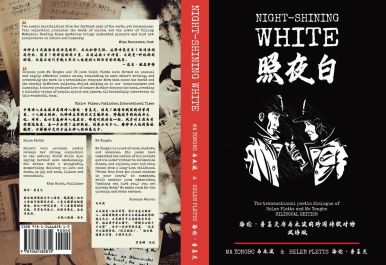
Ma Yongbo’s poetry is my greatest influence, I have written 200 poems and co-translated over 100 poems since February 2024, in these pages you’ll find my own poetic response to his style, and our responses to each other as friends and kindred poetry ‘knights’ on the hard road of poetry.
By Helen Pletts
Ma Yongbo looks at what immediately surrounds him, and yes, at times, it is dark and somber, it emphasizes the short time we have on earth, it includes loss ‘Ode to Mother, 2017’, ‘Looking for Father, 2016’ and even conversations with the dead ‘On seeing Yongping again, 2021’, and ‘A Walk with the Spirit, 1990’ but it is his poetic reference; he does not romanticize, his most life affirming poem, ‘Just be Here, 2017’, is written to his son.

The life he has led is his poetry, every single step he has taken, fully documented in over forty years of poetry. So I am stepping into forty years of his life, completely, face to face with his family even; I meet them alive, the detail of their lives and his last moments with them also become mine (Father, 1990). His lovely sister, so beautiful as a young woman in her dacron shirt, garnering admiring glances at the cinema, her inability to cook well (we have that in common), (Happy Vapour: Elder Sister Xiuqin, 2010). We meet his father, ‘his hands like chrysanthemums’, in ‘Father has grown Old, 1984’, an upright and serious colonel, and his dear mother, from her mesmerizing softness in his infancy ‘The Shelter of Childhood, 2019’, to her strangeness in a real dream, ‘Dancing with Mother, 2017’. If you visit the same house often enough you get to meet most of the family.
His eldest brother Yongping, a poet and a martial artist, and his father teaching him how to survive, as a young man, in an environment as harsh as it gets: coldness, snow, Harbin below zero for half of the year, it has a powerful influence on all their lives. His poetry, miraculously, continues to flourish, and we grow with his phrases, he collects himself in his own jars, through his days as a 17 year old student, at sycamore Campus of Xi’an Jiaotong University, to a Harbin railway engineer, to a professor at Nanjing University (accepting this post meant living 3hrs plane travelling distance from his wife and son), to being recognized as an academic scholar, an internationally revered translator of books, which could easily double as doorsteps, like his over 600,000 copies best seller, Moby Dick, each English word carefully translated into Chinese. He has, single handedly, brought American Postmodern poetry to China, through his translation of the greats, like Williams, Ashbery (Line by line retranslation of Ashbery, 2018) .We shared several jokes about the peculiarity of Ashbery, referenced in my response song (No hesitation on translating Ma Yongbo, 2024) , and how he was even translating Ashbery one Christmas Eve. He loves translation. He’s even paid the price, physically, for sitting so still in a chair, concentrating on translation, he warned me, if you start doing this you will ruin your back. You’ll see the dates on all his poetry, he appears to never take a break from translating, or writing poetry for forty years. Accumulating over 2000 poems, Yes, we enjoyed translating the poems for this book, we have a great sense of humour and we both share the same love for Yeats, Keats, Donne, Blake, Homer. He once sent me photographs of his bookshelf, the English spines were a direct match for many books that have passed through my own hands. I often refer to my friend as a Russian Doll, each individual doll is a layer of a man I strongly look up to. I open the dolls, one after the other, and each one is filled with brilliance.
He communicates with me, steadily and patiently, I get to know his skill tips for translation and I sit for hours. My home gathers dust, my lawn overgrows and I run out of clean socks. And curiously this world of Chinese translation is also a cure for my grief, after the loss of my mother to Covid in 2021(your mother wants to tell you something, 2021) and we connect on this sad page, him losing his elder brother to a sudden brain haemorrhage in 2020. We start from this pain, we say to each other, let’s work together to heal our grief. My grief had led to me having raging tinnitus from PTSD; I had no pieces left to pick up, I missed my mum so much. And even though he had lost his own mum too, years earlier, he feels that same loss strongly every day. So we connect on many things, in a half English, half Chinese landscape, where we have refused to create a third language, me joking once, that translating in this particularly difficult way was like taking an egg out of its Chinese eggshell and just watching it running through your fingers, it happened to me for months (language sits in the eternal shell of meaning, 2024), but I found his patience remarkable although he was most silent regarding any level of success, so I knew I had to keep working harder. When I first heard his real voice in English, I was stunned but it was a key to the rest of all his poetry for me. The simple lines of ‘I have always been in love with you,’ and ‘Somebody loves me, 2023’ were his true voice. I could now hear that same voice in the more complex poems.
Ma Yongbo’s poetry is my greatest influence, I have written 200 poems and co-translated over 100 poems since February 2024, in these pages you’ll find my own poetic response to his style, and our responses to each other as friends and kindred poetry ‘knights’ on the hard road of poetry. He’s the small boy who loves nature, mesmerized at 6, or 7 by larks in a field as a string of silver bells (Must be Larks, 2018), who was bereft, crying at the thought of his father getting cold cutting up logs for their firewood in the freezing winter climate of Harbin (A Walk with the Spirit, 1990), he’s a bold young man who is told to stop writing what he loves, poetry, but who doesn’t, who later has next to nothing in his belly but looks as smart as any other dedicated father can, in a black shirt and suit seeking work. He is a man who thinks of his dear mother, last thing at night, cigarette in hand, in a previous house (Mother’s insomnia, 2010), or even closer, her tucking him in his childhood bed. His memories are the sharp, lived, documented experience, and they run like the reels of a cinema reel, like ‘Cinema, 1987’, but they are genuine, fruitful, they are Ma Yongbo.
Yongbo enjoys an exceptionally high reputation in Chinese literary and academic circles. As the most accomplished poet, translator, and scholar among the generation born in the 1960s, his poetic fame reached its first zenith in the late 1980s. Through persistent cultivation of his craft and sustained pioneering spirit, he has made groundbreaking contributions to the transition of contemporary Chinese poetry from lyricism to narrative. He pioneered core poetic concepts such as “meta-poetry,” “objectification,” and “difficulty writing” in the Chinese context. As the first translator and scholar to introduce Anglo-American postmodern poetry into Chinese, his poetic works and translations have given rise to nearly all Chinese postmodern schools. He stands as a great poet who seamlessly integrates writing, translation, and research into a creative trinity.
However, as a poet dedicated to the translation, research, and teaching of Anglo-American literature for over three decades, he resembles a colossal whale submerged in the depths of creative labour—low-key and silent, unlike the frivolous foam on the ocean’s surface that easily captures attention. His poetry has only recently gained recognition in Anglophone poetic circles. This book of ours marks his debut in the English-speaking world. It also represents a meaningful attempt at collaborative creation between poets of different languages—to overcome the Babel of cultural barriers, and advances the ideal of global literary communion.
(March 27, 2025,Cambridge, UK by Helen Pletts)
____
The Luminous World of All-Embracing Oneness: Reflections on Translating Helen Pletts’ Poetry
By Ma Yongbo
Helen Pletts poetic creation is by no means a mere “writing about nature” or “recording of emotions,” but a poetic system with inherent logic and conscious theoretical awareness. When we strip away the detailed presentation of specific poems, the uniqueness of her poetic pursuit emerges clearly: she reconstructs the perceptual relationship between humans and the world through “natural phenomenology” to dissolve the subject-object opposition between humans and nature; breaks the constraints of linear time via “cross-temporal emotional topology” to construct a folded space where memory and reality converge; and endows simple images with existential contemplation through “the philosophical transformation of everyday metaphors”. These three dimensions collectively constitute the core traits that distinguish her from traditional nature poets.
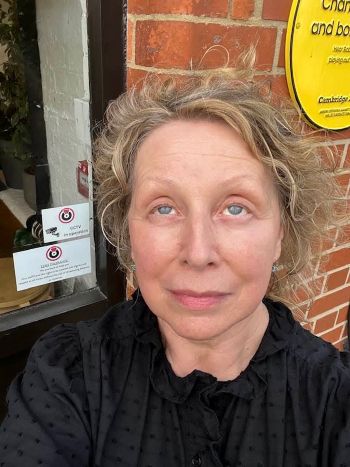
First of all, Pletts poetry harbors a creative logic analogous to Husserl’s “phenomenological reduction”: she refuses to treat nature as an observed object; instead, through immersive investment of perception, she returns humans and all things to an equal dimension of “pure phenomena.” This bears resemblance to the ultimate pursuit of “Unify with the Great Harmony” in classical Chinese poetics—setting aside overly strong subjective consciousness, resorting to impressionistic receptivity, and endowing colors and light with a charm full of affection.
This perceptual reduction first manifests as the de-anthropocentrism of the senses. In her poems, human vision, hearing, and touch are no longer tools for examining nature, but blend with the senses of other living beings in nature. Examples include the sound of jackdaws’ claws scraping plaster (The Feet in the Chimney), the heavy calls of swans swaying in the dark (Above Us, the Swan’s Sound), and the Night-foxes’s mouths full of silver feathers (The Silver Feather Found by a Fox in Darkness). These details are not records of human observations of animals; rather, by amplifying sounds and transferring tactile sensations, they allow readers to experience the world from the sensory perspective of other life forms. She dissolves the binary opposition of “human subject vs. natural object,” placing humans and other creatures within the same perceptual system.
It is precisely because of this perceptual reduction that natural phenomena are endowed with abundant emotions. Pletts has a particular fondness for “silver” (starlight, moonlight, white petals)—these are not mere physical light and shadow, but are invested with tangible emotional qualities. Silver can be the moonlight visitor that tugs at the heartstrings (Her Silver Is Our Visitor), the starry clasp that bears longing (My Mother Is with the Stars), or even the embodiment of faint light for the lonely (suddenly I am the smallest silver in darkness). This “enchantment” is not an imposition of subjective emotions, but is achieved through the amplification of perceptual details. For instance, moonlight turns the tabletop into a white beach (her silver is our visitor): by extending the visual sense, the cold moonlight is endowed with the soft touch of a beach, thus transforming natural phenomena into concrete carriers of emotions. In essence, this approach pulls nature back from being an object of scientific cognition to a phenomenon of life experience, allowing nature to regain the emotional warmth of coexisting with humans.
Secondly, Pletts’s treatment of “emotion, time, and space” exhibits unique “topological” characteristics. The most prominent feature of topology is that it does not focus on the specific metrics of space (such as distance, size, or shape), but only on the “relational structure” of elements within space. In mathematics, a sphere and a cube are “topologically equivalent”—because they can be transformed into each other through continuous stretching and bending (without tearing or gluing), and the connection between points inside them remains unchanged. This feature is reflected in Pletts’s poetry as the “topological equivalence of emotional space.”
She does not pursue a linear narrative of time and space; instead, she takes specific “image anchors” (such as stone eggs, sea glass, and stars) as the core, folding and connecting emotional memories from different times and spaces to form an emotional space that can be traversed freely. The core function of these “image anchors” is the “folding of time and space.” In I Have Left Myself in the Orange of Lobsters, the “white stone egg” serves as an anchor connecting the sea of Corfu and the beach of Southwold: the stone egg in the mother’s hand is both a concrete object on the current beach and a symbolic representation of the mother in memory. Through this anchor, the beach of reality and the beach of memory are folded into the same space, making “all the seas are the same sea”—seas in different geographical spaces achieve emotional identity because of the family affection embodied by the stone egg. This non-linear connection of emotions makes the intensity of emotion the sole organizing principle of space; the boundary between “memory and reality” becomes blurred and merged, allowing emotions to flow freely and overlap into richer layers.
Another uniqueness of Pletts lies in her skill in the philosophical transformation of everyday images (such as water lilies, sea glass, and swifts). She does not use obscure philosophical concepts; instead, through the detailed extension of images, she endows simple everyday objects with philosophical reflections on existence, life and death, and loneliness, forming a kind of “light philosophical expression.” This seems to subtly align with the saying that wisdom is not a bird of prey, but a light butterfly. I am not alone in noticing the ubiquitous spirituality in her poetry—spirituality as light as the wings of a bird in a thermal current, as playful as the morning light and shadow, or as gentle as ink spreading on rice paper. In this regard, her works resonate strongly with the artistic conception of traditional Chinese ink wash paintings: there is no rigid deduction of knowledge, only a breath as delicate as that of a silk moth at midnight, as if the poet is afraid of disturbing the quiet order of all things existing in peace. The poet is adept at objectifying the individual subject and maintains a humble attitude of safeguarding the laws of operation of all natural beings. This is precisely the core concept of ecological holism, which helps bridge the alienation between humans and things caused by traditional subjective philosophy, transforming the relationship between humans and things from one of “utilization vs. being utilized” to a democratic one of mutual fulfillment.
This sense of lightness is also manifested in the “daily dissolution” of philosophical thinking. When addressing heavy themes such as chronic fatigue (Chronic Fatigue), self-alienation (Sea- Glass), and separation between life and death (My Mother Is with the Stars), Pletts never adopts the anxious narrative of existentialism. Instead, she uses the light expression of everyday images to dispel heaviness. For example, the metaphor of “the battery of life running out” transforms a spiritual predicament into a common appliance malfunction—articulating powerlessness while avoiding the weight of anxiety. The line ” my mother is buckle on Orion’s belt” turns the grief of separation into a cosmic connection of stars, endowing sorrow with the tenderness of the universe. This approach allows philosophical thinking to step down from being an lofty theory and merge into everyday life experiences, retaining a certain depth of thought while gaining an approachable warmth.
Although it is unrealistic to draw a definitive conclusion about Helen Pletts poetic pursuit at present, as a translator who has engaged in continuous communication and mutual translation with her for nearly two years, I feel that in an era where all things are falling apart, Helen is attempting to reconstruct a “poetics of connection” in a fragmented age. Her poetry is not a nostalgic eulogy to nature, but a poetic scheme for reconstructing connections—through the equality of senses, the folding of time and space, and the endowment of meaning to the everyday, she helps modern humans rediscover deep connections with nature, with memory, and with themselves, and rebuild a holistic life experience.
(Evening of September 2nd to the early morning of 3rd, 2025 Harbin)
___
Selected poems of Helen Pletts
Things growing where we least expect to find them
As I transplant a delicate mallow seedling from the gravel,
a disturbed grey moth, in miniature,
unexpectedly rises in the soft-pulled roots,
brushes closely against my hair and face
in the wet ground reflecting sunlight, above an underground lake,
dampness in excess feeds scattered seeds on the driveway,
where they thrive, but they are matchless against tyres.
I walk through bright puddles to move them,
claw through the stones, black soil in my fingernails.
caring for every stem, stalk and leaf above ground.
If I dig here, deep enough, I will release a torrent,
tap into the lake and silver will emerge, a river rising.
Sometimes I am tempted to just get a spade and dig through,
letting light into the cavern, letting the water flow free.
____
My mother paints Orinsay
The waves sing to the earth
the only word for this song is water
blue hangs high in the distance
passes the grey rocks forwards
sand carries them their final steps
my mother’s canvas copies the bay
as if this square were a perfect section
borrowed on the points of easel legs
walking wave sound towards me.
____
The march of the slugs and snails on the tarmac
Incessant rainfall weighs down our skies,
the slippery earth, brimful, out-sponged.
The church bell so damp it chimes flat
in the soggy darkness.
The wet road glistens with the slick backs
of slugs and snails in the lamplight.
Slugs measuring their own licked distance.
Vengeful snails, notching up my destruction
—there will be a reckoning for every cracked house,
the shells squeak of disaster underfoot,
I am damned with every step
___
Hawthorn loves
Her white petals float
Hiding her prickle-spikes
The dark winter sticks
Twist open, burst into this
Display of white filigree
Lace about her neck and waist
dangles like misty starbursts,
precursors to red-seed-beads,
that will pop open in a blackbird’s beak
Broken softly, like a gentle kiss unfixes
to a meet a lover’s cheek
The bees will bring their bodies to hers
their tiny black legs as tired of winter
as her black stick dress.
___
You appear
You appear, like the bloody
scrawl of Caravaggio
almost indiscernible,
falling at Salome’s naked feet,
onto a white stone floor.
You appear, like the curious
bestial faces, in the margins
of the Book of Hours, as
the gold spills from their mouths.
You appear in the moth-fluff
of corners, angles I cannot reach,
then juxtapose, high corners
with floorboards.
You appear on steel tracks,
weighted with circumference,
always spinning back.
____
Spring fox on a fen ridge
skirting the hem of turf, spring’s hungry cubs
scatter white swan feathers as a line of snowdrops;
soft white shavings curling on short green blades.
At the edge of the field the tired ears of sugar-beet
flop over tractor trails as spring’s tides fall back to uncover
a soft grey underbelly for the cloven toes of muntjac,
drawn-double, deep in the clay,
they straddle the moon in her muddy cradle
daylight lines the swollen seams
that autumn’s tractors opened.
I once caught my foot in a hoof print in the sunbaked clay
falling face down, swallowing
red blood in my mouth, the root of my tooth
damaged beyond repair, sits in my mouth
still and white as a silver tombstone.
___
If i lived ten lives in any of the worlds, and there are many
if i lived ten lives in any of the worlds
and there are many, needing you would
still pivot on the axis of known,
and the smallest need i have
still be in the center of you
—strung with rough stars
deep in the heady gases
from dead stars that merge
with us.
___
The deer that have been before
It’s instinctive, I unlatch the window
to pass the apple core out into the spring evening,
even though the deer are no more,
their wet hooves hang about in the ivy,
just as before, their fur seeding
rain-droplets, dark matted carpets of brown,
they would lie down in the long grasses,
peep their noses at us, fearless. Still-branches
frame them; their antlers shed like bark,
gaps between stout trees determine
their listening points, where small heads
would rise startled through the hedge
___
Overhead, the swans’-sound
Overhead, the swans’-sound
is heavier in darkness, swung below cloud
head-height with the trees, the rustle is us
craning our necks, ground-smothered, blinded
another dark night saw us drive to the sanctuary,
beaks speak into the air as hundreds,
scatter their banter across reed-blades.
Darkness echoes in our nights, like the foreign countries we knew;
the smokey-grey goats of Kefalonia bustle round the car,
flames drive them forwards from the lit mountainside
men calling, goat bells singing at the pitch that swans
break into song for, fleeing, always fleeing.
____
Flooded wetland
Afternoon air holds double-silver in a single breath
winter wildfowl float on a glass surface
wetlands meander into pathways after the storms
the overflow languishes on a still day
pricked with reeds and bird feet paddling away;
we disturb the shore, mud-smudged.
Should we be here? With so little cover
greylags converge in the center
coots straddle the meter-tufts,
little white egrets find the effort to leave us
bend into the sky, weary
with disturbed, hunched wingspans
their legs hanging like black sticks
match the remnants of winter foliage
___
Selected poems of Ma Yongbo
Reflections on Reading Helen’s Many Poems for Me
Must you insist on stabbing
my body, which is already leaking everywhere
with your Western fountain pen
until it becomes a sieve of holes?
Yet I only sketch you with a soft brush
into spring mountains like ink-dark brows
and autumn waters rippling with sidelong gazes.
The West’s mirage of the East
you’ve draped over my crumbling old house—
layered roofs, stacked floors, an extra storey
suddenly appearing from the empty sky,
yet unable to store my mouldy scrolls and ideals.
Yet I paint you only a water-ink Troy:
its walls are strokes of soaked black,
those galloping or overfed heroes are but tiny graffiti.
Meanwhile, you’ve long sailed away lightly
on an Eastern boat of light
through fallen leaves of generations.
The collars, rain, and darkness you penned
cut sharp as Cambridge’s slanting rooftops.
I rewrite them with my brush
till they soften like rice paper,
can be folded into white Kongming lanterns
soaring higher and higher, until they turn to tangerine stars.
____
“Run, Helen, Run” – A Playful Dedication
I see little Helen darting for poetry—
from village to city, into Cambridge’s halls,
into Anglia Ruskin and Open University,
panting like she is falling down an endless rabbit hole,
chasing a hare that forever escapes.
She abandons Sasha in the cold house—
her long legs stretched out on the sofa
her airplane ears pricking up for any weak sound
she abandons Amber’s pain-crystallised amber
on Mother’s Beach, battered by tides, polished by suns.
she abandons her poetry on the kitchen table
twitching, like silver trout stranded
or hastily scooped up with sand, and tossed into a pot.
I see little Helen darting for others’ verses—
others’ needs overshadow all, friendship becomes the truth
so I say: run, Helen, run!
past Dan Leighton’s Cambridge Poetry launch uproar,
past an art classroom crossed through by a Chinese white horse
past a cemetery of autumn afternoons where poets huddle and read aloud
past yourself, you’ll grow up until you arrive at another Troy
Where flames blaze, heroes clash day and night—
all to let you dash straight into another sky
and laugh at all worldly poems trapped in causal chains.
____
Ode to Mother: Litany of Fire
My mother is cold flame
Mother is flame from the bottom of the sea
Mother is flame of pure-white lily of the valley;
a broken miner’s light, my mother is
a flame of clay
My mother lies lower than death
My mother walks an extra length beyond the end
My mother fails to find her own flame
My mother gives birth to me
like a big flame
shivers on an isolated branch
My mother burns; crosses the threshing ground of a tyrant
My mother is flame of hair
flame of clothes, flame of the crystal sound of ankles
flame of smile with eyes tightly closed
flame of bones delicate like birds
flame of transparent fingernails, skin and fine collar bones
My mother filters through basket-like ribs
from the hollow of a pure silver ring, from a wedding carpet of tongue
filters through a holy grail formed by both hands; a secret auricle,
filters through the chamber of a furnace of black grills
I push her lost grace with my own hands
in the heavy, dark, iron carriage
into the blazing fire
I watch her sleeves blown-full with flames
she is charging holding the shield of her knees
flames rise and burst from every leak between the bones
like a furious baby overdue birth
I see my mother climbing in the flames
up a steep path, leaving behind her countless selves
my mother is a burgundy cello bent and stiff
my mother is a canoe of cedar
is a memoryless young girl, rippling in her forefather’s sky
____
Dancing with Mother
She places my feet on top of her feet in plastic sandals
I am small, looking up at her
we both laugh, spin round and round
unaware that the music has long ceased.
I see tiny beads of sweat glistening on her nose
her cool skirt lightly brushes against my nose
with each turn, I grow a little taller
until I can dizzyingly bury myself in her chest
until I can meet her mischievously glowing eyes
until I am taller than her
while she slowly reverts to a young girl, from about thirty;
we hold hands like classmates, avoid the crowd.
In the dim forest green flares occasionally rise
the river sparkles as it flows into the darkness
leaning against a large piece of darkness, she smokes
suddenly she turns to look at me, smiling,
her smile spreads in ripples, like waves in the night;
her smoking posture resembles that of a runaway heiress
she exhales pungent smoke rings
she puts the remains of the cigarette in my mouth
I cough in the smoke, becoming smaller and smaller.
Once again, I am that four, or five-year-old child,
only she no longer smiles, just gazes back at me through the smoke;
the music resumes, as waves of light from the crystal chandelier
spread out in circles, across the terrace,
towards the forest and the distant mountains.
____
Cosmology in Winter Rain
How long does the universe expand, how much longer can I live?
If it’s still expanding, why haven’t I been stretched out?
The images humans paint on the surface of a balloon
will only get bigger and thinner,
too distorted to recognize.
If this culturally irregular ballooning
causes leaks everywhere, one day we’ll
snap back, a burst balloon
stuck to a child’s face.
In a small fluctuation of cosmic heat death,
we live, contemplating the universe’s expansion,
a group of mice, while the owner is away, under the floor
crawling around, dragging bellies, rattling bones.
How much longer can we live, how long is the universe?
Who’s blowing us up like a balloon,
putting the frying pan of the Milky Way on the wall to cool?
His father came home from work
with a newspaper tube from beyond the river,
in boredom beating on passing things,
there’s news about white dwarfs
but already blurred by a winter rain.
____
I Lost That Child
I’ve lost so much, yet I haven’t found myself.
I lost the sweetness of the child’s fingers in my mouth,
lost the clear astonishment in those curious black-and-white eyes.
The laughter in those eyes, now tinged with mockery,
even that mockery has dissipated, perhaps turned into cataracts.
I even lost the vast continent that gently rolled in those eyes,
and the bowed head of the white horse returning from afar, flames on its back.
I lost the multitude of bodies once present,
only the purity of lips kissed by mother remains.
The steadfast love stirred behind frosted glass by the sound of water,
the freshness of corn being husked, untouched by the old sun’s yellowed teeth.
I lost both the ruins and temples within those bodies.
I lost the couple standing by my side,
and at some point, I lost the hand holding mine,
the tobacco scent lingering on the hand and warmth in the palm lines.
I lost them, speaking from dwindling ashes,
speaking of my inherent fatigue, the grey above my head,
speaking of my fate as if the neighbour next door hangs on a thread.
I lost the fields in the autumn rain
and the silent black sheep at every graveside.
I cover my face with the darkness, returning to the uninhabited home,
the landless country, back to the womb without a mother.
Embracing what little remains of me, holding my breath, living until death.
___
The man in red is reading
The leaves are falling,
the man in red is reading,
he knows that the leaves will fall faster and faster.
Occasionally, he looks up from the page
and looks around blankly.
As long as he reads,
the leaves will continue to fall,
in the surrounding messy background
the streets, benches, and buildings will gradually emerge,
unifying all their minute differences with brown.
He keeps reading,
he keeps growing taller and bigger like a mountain.
He keeps reading until all the leaves fall,
until the snow starts to fall,
and if you pat his shoulder at this time,
he will melt like a snowflake.
___
“Here”
“Here” is a signpost, not really here,
the earth beneath your feet is a vertical, transparent void,
you can only recognise here by its “non-existence”.
You’re familiar with these signs, a street, a road,
the house behind houses, a date, a name,
the sound of poplar leaves brushing each other, and songs
from the last century playing on a radio hanging from a branch.
You can no longer make out their lyrics,
as if they’ve been encrypted at the far end of time,
that’s fine—no words to smudge this perfect balm,
no other you, old, young, or in between,
walking out of this maze of “here”,
to watch a sunset elsewhere,
or see another autumn rain falling in another realm,
another of you, nose buried in a colour-blurred map,
collar wore the wrong way round,
searching for a “here” you’ve been before.
____
A Cat Looks at Me
A cat halts at the foot of the building,
gazing at me, yet appearing to look elsewhere
its ears float above the low bushes.
It maintains a walking posture, never sits down
It looks at me as if I am an unknown body
as if I have no name, no clothes, no identity to be labelled.
My past deeds disappear in the waves at the end of the dam
and the future is just a glance. I stop
this is a real cat after all
not mine, nor anyone else’s
it is its own cat, not a word.
The air between us seems thick and stale
its existence was about to step out of its fur
but stopped all transformation, with a small apology
it no longer converts to my position
but it feels more like a silent blessing, a salvation.
It’s just this ordinary and specific cat
quietly stepping out of the vast and blurry array.
It’s not from the childhood libraries and corridors,
the fables of cats chased or followed by people.
In an instant, my existence is laid bare,
my memories and love become shame.
I become ignorant of good and evil, history and labor
disappear with a gentle flick of its ears.
After all, this is a genuine cat looking at me
it turns me from a person into a human being.
My hollow existence like a frozen posture,
one of us must leave this place first,
leave the other in nameless death.
___
A Whole Afternoon of Terror
Before dusk arrives, skeletal horses
loom outside the darkness, lingering off the road.
I encounter ghosts in the mirror,
the wind sniffs beneath fallen leaves, through a door-crack,
scenting the faint glow of flesh revealed.
Axes, slingshots, cleavers all line the window sill painted blue,
even my stiff six-year-old elbows bear the grain of wood.
The yard’s pale wooden gate is locked, the door to the cottage too,
I stare at every tremble of the wooden gate
and the passing sound of the whistling poplar trees.
Mother hasn’t returned yet, I don’t know how many years
how many winters have passed, I hear the door handle softly turning,
the quiet voices of family members, and the slow movement of a golden lamp.
But I can’t wake up, can’t bolt that door wrapped in a sack.
__________