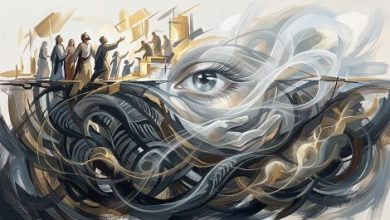
Does history march upward toward reason, or are we doomed to repeat the cycles of fallen civilizations? The answer may lie in reconciling our accelerating objective power with our stagnant subjective wisdom.
Noor Muhammed Marri, Advocate | Islamabad
As I look out over the shifting political and philosophical horizons of our time, my mind often drifts to the great, unresolved debate that has haunted thinkers for millennia. We humans are creatures obsessed with origins and destinations. We look out at a world torn by political turbulence, algorithmic anxieties, and ecological fractures, and we ask ourselves: Are we walking a path that leads upward toward an ultimate realization, or are we simply running in circles, doomed to relive the follies of Rome, Babylon, and the Indus Valley?
History, to me, is never a polite chronicle of steady improvement. It is a profound philosophical battlefield. On one side stand the architects of linear progress, led by the towering intellect of Georg Wilhelm Friedrich Hegel, who saw history as the majestic, unfolding march of Spirit. Hegel argued that world history is the progress of the consciousness of freedom, moving through a relentless dialectic where conflicts and collapses are merely the cunning steps the World-Spirit takes to elevate humanity. To a Hegelian, suggesting that history is merely cyclic is to deny human agency, moral evolution, and the ultimate triumph of reason.
Yet, when I look out at our contemporary landscape—at the staggering concentration of wealth, the moral vacuity of our institutions, and our reckless march toward digital self-destruction—Hegel’s optimism feels profoundly distant. My soul resonates far more with the deep, haunting chords of the cyclical philosophers. Long before modern empires stumbled, Giambattista Vico spoke of the courses and recourses of history, where human societies rise through ages of gods and heroes only to dissolve into isolation, cynicism, and individual selfishness in the age of men, inevitably collapsing back into barbarism.
Arthur Schopenhauer saw history through an even more sobering lens, stripped of any grand plot or divine arc. To Schopenhauer, human beings are driven by a blind, insatiable will. Because desire is infinite and resources are finite, history is simply a monotonous repetition of suffering, conflict, and ambition. We have traded bronze swords for nuclear warheads and algorithms, but the greedy, fearful heart beating inside the human chest remains entirely unchanged. Oswald Spengler crystallized this view, arguing that cultures are living organisms that are born, grow youthfully, build great civilizations, harden into sterile, urbanized societies obsessed with money and technique, and then die. You cannot arrest this biological aging process through sheer wealth or clever engineering.
As an advocate and a mediator, my daily life is spent untangling human conflict, looking into the mechanics of why relationships, contracts, and societies fracture. I see the same patterns repeating in miniature every single day: hubris precedes a fall, communication breaks down when empathy dies, and material accumulation never satisfies a starving spirit. When we apply this to our global civilization, the tension between Hegel’s progressive arrow and Spengler’s cyclical wheel becomes painfully acute. We have built a world of unimaginable objective power spanning quantum computing, bioengineering, and artificial intelligence, yet our subjective wisdom—our capacity for mercy, long-term stewardship, and collective harmony—remains stuck in a tribal infancy.
If history is truly a wheel, then our sophisticated digital civilization is simply climbing the inevitable slope toward its peak, blissfully unaware of the precipice on the other side. We think our wealth and our servers make us immortal, just as the Romans thought their legions and aqueducts made them eternal. Yet, perhaps there is a reconciliation. Perhaps history is a spiral; it moves in circles, yes, but with every rotation of the wheel, humanity passes through the same lessons at a higher level of intensity. The ancient civilizations fell because they exhausted their local soils and social cohesion. Today, we risk exhausting our planetary ecosystem and our cognitive sovereignty to artificial intelligence.
The question is not whether the wheel will turn, but whether we possess the rare, awakened consciousness to step off it. Can our subjective wisdom finally catch up to our objective power? Or are we destined to watch our magnificent tower dissolve into the dust, leaving future archaeologists to wonder how a civilization so dazzlingly rich could have been so profoundly blind?
Read: Mapping the Theater of War
_________________
 Noor Muhammad, Advocate and Mediator, Islamabad