From quiet struggle to international classrooms, a new generation of Thar is writing a different story of Sindh.
They are studying. They are working. They are struggling. They are learning. And slowly, they are changing the definition of what is possible.
By Abdullah Usman Morai | Sweden
Realization is a powerful thing.
Sometimes it happens to an individual. A person suddenly understands what is good for them, what is holding them back, and which direction they should take in life. At other times, realization spreads through a family, a community, a region or even an entire society.
Perhaps one of the most important realizations taking place in parts of Sindh today is the growing understanding that education is not simply a qualification; it is a pathway to a different life.
After living in Sweden for almost two decades, studying at Swedish universities and institutes, taking courses and conducting field research in countries including the UK, France and Greece, and travelling to more than 50 countries, I have had the opportunity to observe people, societies and educational cultures from different perspectives.
Although my original academic background is engineering, my curiosity did not stop there. I studied management and attended courses related to leadership, psychology, anthropology, and journalism. These experiences have taught me something important: development is not only about roads, buildings, industries, or technology. Development begins in the way people think.
And that change in thinking is what interests me most about Thar today.
What Living Abroad Teaches You
When you live outside your own country for many years, you begin to see your own society differently.
You notice things that were invisible when you were living inside the same social environment.
For example, one of the interesting things I have experienced abroad is the friendship between Indians and Pakistanis.
Back home, politics, history, and national narratives can sometimes create emotional distance between people. But outside the subcontinent, an Indian and a Pakistani can become very good friends.
Why?
Perhaps because once you are thousands of kilometers away from home, you realize that you share many of the same struggles.
You miss similar foods. You understand similar family pressures. You laugh at similar jokes. You have similar memories.
And when someone needs help with something practical, there is often an immediate sense of solidarity.
I have also personally found many Punjabi students and professionals I met abroad to be particularly practical, resourceful, and willing to help when it comes to finding information, navigating systems, or solving everyday problems. Of course, this is my personal observation, not a description of every individual.
But there is another interesting aspect of life in international universities.
Religion is generally not the subject around which friendships are built.
You may sit in a classroom with a Muslim, Christian, Jew, Hindu, Sikh, Buddhist, atheist, or someone who simply does not care much about religion.
Nobody needs to introduce themselves by explaining their religious identity before working on a group assignment.
You work together. You discuss ideas. You solve problems. You disagree. You learn. You present your group work.
And gradually, you discover that the person sitting beside you is not primarily a Muslim, Hindu, Indian, Pakistani, Swedish, or anything else.
They are simply your classmates. Perhaps this is one of the quiet lessons that international education teaches us.
The Subcontinent Still Feels Like Home
Yet, despite living among people from all over the world, there is a natural closeness among people from the subcontinent.
As a Pakistani, I have often found myself becoming closer to Indians, Bangladeshis and other South Asians than to people from many distant parts of the world.
There is a simple reason. We often travel along similar roads. We understand the same cultural references. We know what it means when parents ask about studies, jobs, and marriage in the same conversation! We understand the importance of family. We understand the pressure of succeeding. We understand the sacrifices made by parents.
In other words, we are often struggling in the same direction. And that shared journey creates a special bond.
Competence Is Everywhere, But So Is the Need for Hard Work
Over the years, I have met many highly competent students from Pakistan and other parts of the world.
Some are brilliant. Some are exceptionally disciplined. Some seem to know exactly where they want to go. But there are also average students. And there is nothing wrong with being average.
The important question is what an average student does after discovering that they are not naturally at the top.
Some work harder. Some improve gradually. Some seek help. Some change their methods. And some give up somewhere in the middle.
International education teaches you a difficult but valuable lesson: Talent can open the door, but persistence keeps you inside.
You do not always need to be the smartest person in the room. Sometimes you simply need to be the person who refuses to stop.
A New Realization in Thar
This brings me to something I have been observing for several years.
There appears to be a growing realization among many middle-class families in Pakistan, particularly in Thar, Sindh, that education can be one of the strongest routes towards social and economic progress.
This is not merely about sending children to school. Something bigger is happening.
Young people from Thar are increasingly looking beyond basic education and pursuing higher education, professional degrees, postgraduate studies, and international opportunities.
I have met students from Thar studying at universities and institutes in Europe and elsewhere.
Every time I encounter such a student, I feel encouraged. Because it represents something larger than one person’s success. It means a family somewhere in Thar has begun to think differently.
Perhaps a father or mother who had limited educational opportunities is saying: “My child should go further than I did.” That sentence can change the future of an entire family.
The Quiet Success of the Meghwar Community
I have had conversations with several of my Meghwar friends about this changing educational landscape.
One thing we often discuss is how many members of the community have struggled, worked hard, and progressed without making much noise about it.
There was no grand announcement. No need to constantly tell the world. They simply continued. Study. Work. Struggle. Repeat. And eventually, the results began to appear.
That quiet perseverance deserves recognition. Perhaps this is one of the most beautiful aspects of the educational transformation taking place in parts of Thar.
The story is not always dramatic. Sometimes progress happens quietly. A student leaves a village. Enters a college. Gets a scholarship. Moves to another city. Then another country. Completes a degree. Finds a job. Supports the family.
And one day, younger children in the same village start believing that they can do it too. That is how social change spreads.
The Other Face of Thar
For decades, when we discussed Thar, the conversation often centered on drought, poverty, water scarcity, underdevelopment, malnutrition, and other serious challenges.
These problems should not be ignored. Thar still has many difficulties. But a region should never be defined only by its problems.
There is another Thar emerging. A Thar of students. A Thar of ambition. A Thar of scholarships. A Thar of young people dreaming beyond their immediate surroundings. A Thar that wants not merely basic literacy but higher education, professional knowledge, and international exposure.
This, to me, is one of the shining faces of Thar today. And therefore, one of the shining faces of Sindh and Pakistan.
Stop Blame-Gaming, Start Learning
Perhaps this is the point where we need to change our conversation.
We spend too much time asking: Who is responsible? Which government failed? Which institution failed? Which province is ahead? Which community is behind? Who has more resources? Who has less? These questions have their place. But they cannot become permanent excuses.
At some point, we have to ask another question: What are those who are succeeding doing differently?
If students from Thar are finding ways to pursue higher education despite limited resources, perhaps other young people can learn from their determination.
If a student from a remote area can reach a European university, then the geographical distance between a village and an international classroom is not necessarily as great as we imagine.
The road may be difficult. But it exists.
Their Success Is Our Success
There is another important point that we should remember.
A student from Thar studying abroad is not only a student from Thar. Outside Pakistan, that student is generally seen as a Pakistani student. They carry the country’s name. Their success reflects on Pakistan. And within Pakistan, their achievement contributes to Sindh.
This is why we should not divide successful young people into Karachi students, Lahore students, Thar students, rural students, or urban students.
Their success belongs to all of us.
A Pakistani student succeeding in Stockholm, London, Paris, Tokyo or Melbourne adds another positive line to the story of Pakistan.
A Sindhi student succeeding abroad adds another positive chapter to the story of Sindh and Pakistan.
And a young person from Thar reaching an international university challenges an old stereotype about what is possible for someone from a remote and historically disadvantaged region.
The Real Revolution
Perhaps the real revolution in Thar is not taking place only in roads, buildings, or infrastructure. It may be taking place inside homes.
A father decided to spend his limited income on his daughter’s education. A mother encouraging her son to continue studying instead of leaving school for immediate employment.
A young student learning English because they dream of applying to an international university.
A family celebrating a scholarship letter. A village child seeing an older student return home with a university degree and thinking: “Why not me?”
That is where transformation begins. Not with a speech. Not with a slogan. But with a change in expectation.
From Thar to the World
I have travelled through more than 50 countries and met people from many cultures.
I have seen wealthy societies and poor societies. I have seen advanced universities and modest schools. I have seen people with enormous resources fail and people with almost nothing succeed. Again and again, one thing becomes clear: Circumstances matter, but mindset matters too.
Education does not guarantee success. But it expands the possibilities. It gives people choices. It gives them confidence. It gives them access to information. It gives them the ability to question.
And most importantly, it can give the next generation a different starting point.
That is why the educational hunger I see emerging from Thar gives me hope.
Thar has problems. Sindh has problems. Pakistan has problems. But every society also has people who quietly become part of the solution.
Perhaps some of those people are now sitting in classrooms in Stockholm, London, Paris, Berlin, Tokyo, Melbourne and elsewhere.
They are studying. They are working. They are struggling. They are learning. And slowly, they are changing the definition of what is possible.
The shining face of Thar may therefore not be found only in its desert, its culture, its resilience, or its ancient traditions. Perhaps today, one of its brightest faces is its hunger for education.
And when the children of Thar succeed, they do not carry only Thar with them.
They carry Sindh. They carry Pakistan. And wherever they go, their success quietly tells the world:
We came from a place with challenges, but we did not allow those challenges to decide our future. That, perhaps, is the real meaning of progress.
Read: Sindh under the War of Nerves
__________________
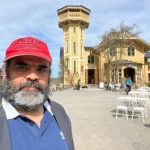 Abdullah Soomro, penname Abdullah Usman Morai, hailing from Moro town of Sindh, province of Pakistan, is based in Stockholm Sweden. Currently he is working as Groundwater Engineer in Stockholm Sweden. He did BE (Agriculture) from Sindh Agriculture University Tando Jam and MSc water systems technology from KTH Stockholm Sweden as well as MSc Management from Stockholm University. Beside this he also did masters in journalism and economics from Shah Abdul Latif University Khairpur Mirs, Sindh. He is author of a travelogue book named ‘Musafatoon’. His second book is in process. He writes articles from time to time. A frequent traveler, he also does podcast on YouTube with channel name: VASJE Podcast.