Benghazi International Book Fair Held
10 Days of Knowledge, Creativity and Encounters between Generations

The book fair witnesses the participation of 75 to 80 publishing houses and cultural institutions from ten Arab and other countries
Souad Khalil | Libya
The fifth edition of the Benghazi International Book Fair was not merely an event devoted to displaying books and new publications. Rather, it provided a cultural space that brought together knowledge, thought, the arts and heritage, opening the door to dialogue among different generations of writers, intellectuals, publishers and readers. It was a scene that reflected the vitality of culture and its ability to renew its presence within society.
Under the slogan “Generations Meet and Visions Renew,” the National Library in Benghazi hosted the fifth edition of the fair from 3 to 12 November 2026. The official opening ceremony took place on the evening of Tuesday, 3 November, while the doors opened to the public on the morning of Wednesday, 4 November, following the postponement of the originally scheduled opening date. The activities continued until Thursday, 12 November.
This edition witnessed the participation of approximately 75 to 80 publishing houses and cultural institutions from ten Arab and foreign countries. This international presence brought considerable diversity to the publications on display, covering literature, intellectual thought, history, science and various fields of knowledge. It also provided readers and researchers with an opportunity to explore different publishing experiences and establish direct contact with publishers and authors.
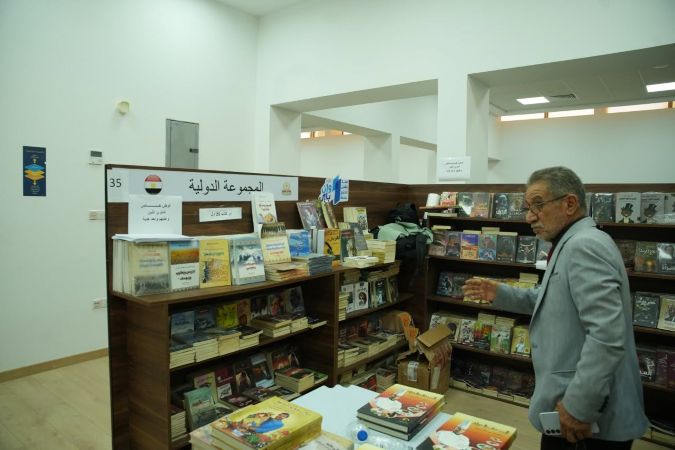 Books, Arts and Cultural Memory
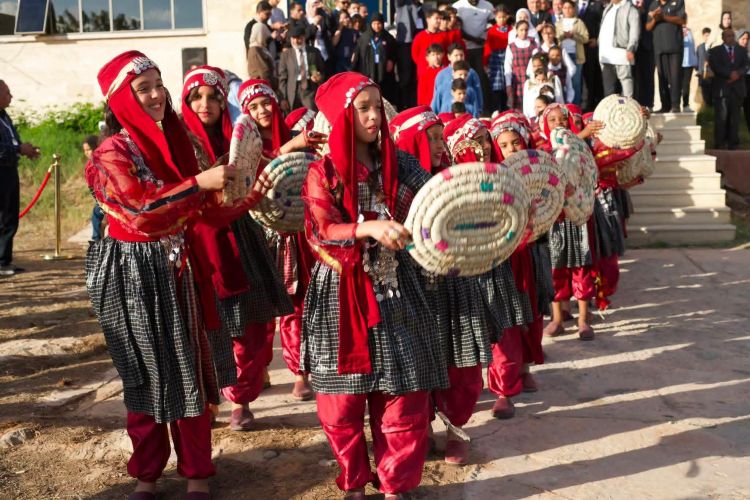
The fair was distinguished by the diversity of its exhibition spaces. Participation was not limited to publishing houses and bookstores; it also extended to cultural and educational institutions, visual arts, traditional heritage collections and spaces dedicated to family enterprises. In this way, books, popular memory, artistic creativity and community initiatives came together in a single cultural setting.
The exhibition space thus became a meeting point where the written word stood alongside images, colors and crafts, while academic knowledge engaged with popular experiences. This reflected the broad scope of culture and the many forms through which it can be expressed.
Given the considerable number and diversity of cultural, intellectual and artistic activities presented during this edition, this article will focus on some of the most significant events and encounters. This selection should not be understood as an attempt to cover every activity hosted by the fair, as the full program would be difficult to encompass within the space of a single journalistic article.
 A Cultural Program Opening New Horizons for Dialogue
The accompanying cultural program was one of the most prominent features of this edition. The Cultural Committee, chaired by Rehab Shneib, sought to present a program that went beyond the traditional format of literary evenings, bringing together established experiences and emerging voices.
The program addressed a variety of subjects, including literature and cultural identity, transformations in the writing of younger generations, the relationship between culture and the economy, the current state of cultural vision in Libya, as well as issues related to digital media, artificial intelligence and their impact on creativity.
The activities included poetry evenings and dialogue sessions featuring a number of writers, intellectuals and literary critics, among them Ghalia al-Daraani, Mohammed al-Meslati, Salem al-Abbar, and critics Tarek al-Shar’a and Saad al-Hamri. Conversations were also held with novelist and academic Saleh al-Senoussi, journalist Sukaina Ben Amer, and Professor Hani Shneib.
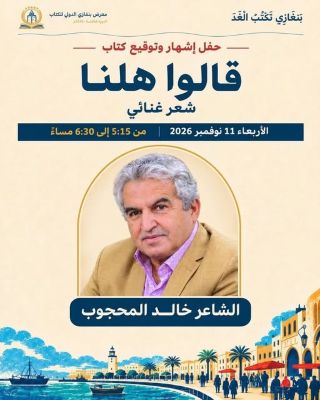
The programme also featured book presentations and signing events, including publications by novelist Salem al-Hindawi and Major General Khaled al-Mahjoub. Other discussions addressed cultural identity and ways of strengthening it through digital media, as well as the Marrakesh Treaty concerning access to published works for blind and visually impaired people.
 The Ministry of Culture: A Dedicated Space for Dialogue
The Ministry of Culture and Knowledge Development also had a special presence at the fair through a dedicated hall that hosted a number of accompanying seminars and cultural meetings. This provided an additional space for discussion and the exchange of ideas among intellectuals, researchers and those interested in cultural affairs.
The Ministry’s activities complemented the general cultural program prepared by the fair’s Cultural Committee. The topics discussed were varied and approached from different perspectives, allowing visitors to follow more than one cultural and intellectual program throughout the exhibition.
This participation also reflected the role of cultural institutions in supporting initiatives related to knowledge and in providing platforms through which writers, artists and researchers can present their experiences and discuss issues concerning culture and creativity. It further strengthened communication between official institutions and Libya’s cultural community.
Thus, the fair was not simply a venue for displaying publications. It developed into a meeting place with multiple platforms and discussions, where cultural initiatives were shared between the organizing committee and the participating institutions.
Artificial Intelligence and the Questions of Creativity
One of the subjects that received particular attention was artificial intelligence, as one of the major transformations currently affecting media, culture and the arts.
Dedicated discussions addressed its ethical dimensions, its relationship with drama, and the future of creative writing in an age of technological development. Participants included Najah Belkassem, theatre and film director Mustafa al-Zawi, and writer Ramiz al-Nuwayseri.
The inclusion of these topics was closely connected to the spirit of the fair’s slogan. It reaffirmed the need for culture to remain capable of responding to contemporary transformations and to provide younger generations with opportunities to understand the tools of their time and engage with them through critical awareness and creativity.
Women, the City and Cultural Memory
The social and historical dimension was also present in the program through a discussion entitled “The Feminine Memory of the City,” which highlighted the contributions of women and their experiences in documenting the history of Benghazi and its social and cultural memory.
The program also addressed the state of journalism and the publishing crisis in Libya, with the participation of Ibrahim Abdelhamid, Mohammed al-Menfi, Ali al-Jaber and Seddik Dawara. The discussion explored the challenges facing the publishing industry and the support and development it requires.
Children… The Readers of the Future
Children were not absent from the fair’s activities. A special space was devoted to them through activities, meetings, storytelling sessions and workshops addressing the relationship between philosophy and childhood, as well as the importance of developing children’s thinking from an early age.
Participants included Saria al-Ati from Tripoli and Hosni al-Hashemi from Egypt.
Music, books and children’s literature were also present as essential elements in shaping the personalities of younger generations and strengthening their relationship with reading and knowledge from their earliest years.
As part of the accompanying cultural activities, the Benghazi Office of Culture and Arts organized a session entitled “Book and Writer,” featuring Jumaa al-Fakhri, Dareen al-Mahdawi and Hamed al-Alwani, moderated by journalist Hanaa al-Sharif. The meeting explored the guests’ creative experiences, professional journeys and publications, and included poetic readings and recitations.
 The Fair as a Space for Cultural Communication
The importance of book fairs cannot be measured solely by the number of participating publishing houses or the volume of sales. Their real value also lies in the opportunities they provide for interaction between writers and readers, publishers and creators, and in the windows they open onto different cultures and experiences.
From this perspective, the Benghazi International Book Fair represented an opportunity to strengthen communication between cultural institutions and readers, while highlighting the role of the printed book at a time when digital publishing is expanding rapidly and reading habits and ways of accessing knowledge are changing.
The presence of the arts, popular heritage and community initiatives alongside books also gave the fair a character that went beyond commercial activity. It became a cultural and social space where memory, creativity and knowledge intersected.
Logos Hope… From the Book Fair to the Floating Library
Among the notable cultural developments accompanying the conclusion of the fifth edition of the Benghazi International Book Fair is the anticipated visit of the international book vessel Logos Hope. The ship is scheduled to return to Benghazi on 30 December 2026, where it is expected to remain until 7 January 2027, before proceeding to the city of Derna from 8 to 13 January 2027. This visit represents an important cultural occasion for both cities.
The vessel houses a floating library containing thousands of titles in Arabic and English, covering literature, science, the arts and general knowledge. Its crew includes people from more than sixty nationalities, making the ship a space for cultural exchange and communication among different peoples, rather than simply a travelling book exhibition.
The visit is particularly significant in the context of the cultural activity taking place in Benghazi, especially since a delegation from the ship visited the fifth edition of the International Book Fair and met with representatives of cultural institutions and publishers. During this visit, the delegation acquired a number of works by Libyan writers and authors to be included in the ship’s library. This will allow these publications to accompany the vessel on its international journeys and reach readers in different parts of the world.
Another noteworthy initiative was the announcement of a book about the city of Benghazi, to be published in both Arabic and English. The book is produced by the Peace Centre and written by researcher Faraj Najm. It aims to introduce the city’s history, culture and landmarks, serving as a cultural ambassador for Benghazi and accompanying the ship on its international stops.
The arrival of Logos Hope in Derna will also provide the city’s residents with an opportunity to experience the floating library and will give the visit an additional cultural and humanitarian dimension, particularly as another destination on the vessel’s journey through Libya.
In this way, the movement of books and cultural exchange will not come to an end with the closing of the fair. Instead, it will continue through a maritime journey carrying Libyan publications towards wider horizons and opening a window for Libyan cities to connect with the world through knowledge and culture.
The Closing Day… A Message of Support for Books and Culture
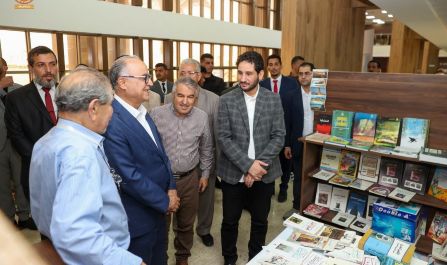
On the final day of the fair, Thursday, 12 November, the event gained additional significance with the visit of the President of the House of Representatives, Engineer Al-Salihin Abdelnabi, accompanied by the Second Deputy Speaker of the House, Mr Misbah Douma, to the exhibition halls at the National Library.
They were received by Khaled al-Mahjoub, Chairman of the Fair’s Higher Committee; Bashir al-Najeh, General Supervisor; and Dr Saleh al-Shalmani, Director General of the National Library.
During the visit, they toured the exhibition halls and viewed the publications and cultural contributions presented by the participating institutions. Their visit conveyed a message affirming the importance of supporting cultural institutions, books, writers and publishers, as well as strengthening the presence of reading and knowledge within society.
The visit also reflected the President’s interest in books as a fundamental pillar in building awareness. It was not limited to touring the exhibition spaces; he also purchased a number of books, a symbolic gesture highlighting the importance of reading and the role of books as a source of knowledge and reflection.
With the conclusion of the fifth edition, the impact of the fair does not end with the passing of its ten days. Cultural events leave behind much more than commercial activity: they leave encounters, ideas and cultural friendships, while opening new horizons for communication between writers and readers.
Through the diversity of its participants and its cultural program, the Benghazi International Book Fair sought to make the book a meeting point between generations, connecting cultural memory with the questions of the present and the aspirations of the future.
Perhaps the most important lesson to emerge from this edition is that culture is not a seasonal event, but an ongoing project that requires care, encouragement and sustained support. It needs institutions that believe in the role of knowledge, publishers who receive the support they need, and readers who find in books a constant companion.
For when generations meet around a book, visions are renewed, and culture continues to build bridges between the past, the present and the future.
Read: A Garden from the Forests Within
_____________
 Souad Khalil, hailing from Benghazi Libya, is a writer, poet, and translator. She has been writing on culture, literature and other general topics.