A Garden from the Forests Within
When Science Becomes Poetry and Nature Becomes a Language of Feeling

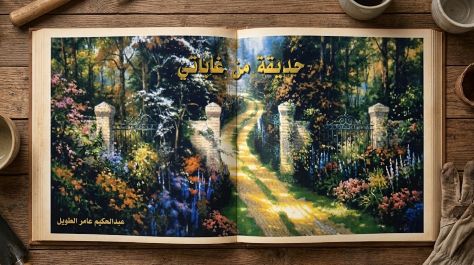
A Critical Reading of “A Garden from My Forests,” a Poem from A Handful of Pink Atoms by Abdulhakeem Amer Tweel, Poet and Nuclear Engineer
Souad Khalil | Libya
Nature in poetry is not merely a backdrop that adorns words, nor simply an abundance of colours, scents, and flowers. In many poetic experiences, it becomes a way of discovering the self and a means of rebuilding the relationship between human beings and the world. From this perspective, we can approach the poem “A Garden from My Forests,” in which the poet opens a window onto a world where scientific knowledge coexists with aesthetic sensibility and local plants intertwine with human dialogue, transforming the garden into a space for discovery and contemplation.
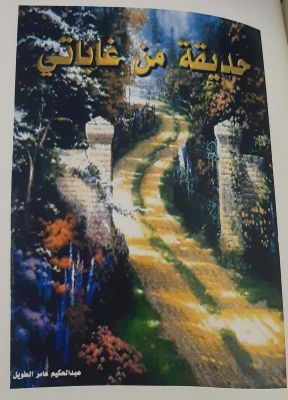 From the title onward, the poet presents us with a construction that deserves closer attention. A garden suggests a carefully selected space in which different elements coexist in an arrangement inviting contemplation, whereas a forest evokes expansiveness, diversity, and interconnectedness. When the garden becomes part of “my forests,” it appears to be a chosen space within a larger inner world: a fragment the poet reveals, while other areas of experience, memory, and feeling remain hidden behind it. Thus, the title is no longer merely a name for a natural place; it becomes a possible entry point for reading the self as a multilayered world.
From the Hardness of Uranium to the Delicacy of Flowers
The poem begins with a dialogue in which the female speaker addresses the poet in terms that evoke strength, sharpness, and fear:
“She said: ‘You are as hard as a stone of uranium!
Sharp… like a laser sword!
“And frightening… like the kiss of a prickly pear leaf!”
A forest of prickly pear flowers will scorch you,
And a bundle of laser stems will illuminate you.
Fissionable uranium will set your heart ablaze,
With the help of the garden iris: come!”
Images draw their material from the worlds of science and technology, placing the poetic persona within a framework suggestive of hardness and danger. Yet the poet does not respond to this description with a direct justification. Instead, he replies with an invitation that carries a different significance:
“I said: ‘Come in and enter my soul.’”
Here, the direction of the dialogue changes. Whereas the judgement had previously come from the outside, genuine understanding now becomes conditional upon entering the inner self. According to this movement, the self is not something that can be reduced to a first impression; it is a world that requires closeness and discovery.
This transition gains significance through the contrast between the preceding images and the world the poet subsequently opens up. Scientific terms that suggested hardness and threat give way to plants, flowers, and fragrances. From this opposition emerges an aesthetic paradox: a person may appear hard on the outside while preserving within a diversity of feelings and details that outward appearances alone cannot reveal.
This does not mean that every flower must directly symbolise a particular psychological trait. Rather, the arrangement of the images allows us to read the garden as a means of revealing another aspect of the personality—one that becomes visible only when another person is allowed to draw near.
Libyan Nature: From Local Names to Poetic Imagery
One of the poem’s most distinctive features is its attention to Libyan plants, evoking them through their names, characteristics, colours, and fragrances. The plants mentioned in the text are not anonymous natural elements; they are specific living things associated with local knowledge and an experience rooted in place.
The significance of this choice lies in the cultural and environmental specificity it gives the poem. Nature here is not a general scene that could belong to any geography. Rather, it is a world bearing the features of the Libyan environment, with its familiar names, popular knowledge, and sensory details.
A plant’s local name is not merely an alternative label. It may carry collective memory, testify to the relationship between people and their surroundings, and preserve knowledge accumulated through use, observation, and experience. When this vocabulary enters poetry, it acquires a dual function: it documents something of the memory of a place while providing the poetic imagination with material from which to construct its images.
From this perspective, the poem can be viewed as an attempt to broaden the scope of poetry so that it encompasses not only abstract emotions and familiar images, but also the details and knowledge of the local environment. Libyan nature is not present merely as decoration; it becomes integral to the experience the poet shapes.
Colour and Fragrance: The Poetics of the Senses
The text draws upon sensory details associated with the colours of flowers, the scents of plants, and their distinctive characteristics. These details make the garden imaginable and give readers the sense that they are approaching a tangible world rather than an abstract idea of beauty.
When poetry invokes the senses, it does not simply tell us that something is beautiful; it attempts to make us experience its effect through the imagination. A scent, for example, becomes more than a characteristic of a plant when it evokes a memory, a place, or a previous experience. Similarly, a colour can create an emotional response without necessarily becoming a fixed symbol.
The distinctive quality of these images emerges from their combination within a single context. The botanical names give the scene specificity; the scents and colours lend it sensory presence; and the dialogue provides its human dimension. In this way, the garden transcends its status as a collection of plants and becomes a multilayered experience in which knowledge, observation, and feeling intersect.
Nevertheless, the density of detail raises a legitimate artistic question: when does description enrich a poetic experience, and when does it become an informative digression? An accumulation of sensory details may deepen the scene and give it variety, but it requires an internal rhythm that sustains the movement of the text and prevents the images from turning into a list of adjacent descriptions.
This question does not diminish the value of the poetic experience. Rather, it helps identify its strengths and clarify the relationship between the abundance of natural material and the need to organise it artistically.
The Nuclear Engineer in Dialogue with the Poet
The presence of terms such as uranium and laser at the beginning of the poem opens the door to reflection on the relationship between scientific training and poetic writing. When a scientific term enters a literary text, it does not necessarily lose its original meaning; instead, it acquires additional possibilities through context, comparison, and suggestion.
In this poem, the language of technology stands alongside the language of plants. Terms associated with hardness and danger meet words evoking delicacy, fragrance, and colour. The significance of this juxtaposition lies not simply in the unusual combination of two different worlds, but in the way it broadens the horizons of poetic imagery.
Science provides some of the images, nature provides others, and the imagination organizes the relationship between them. We may therefore read the contrast between scientific knowledge and the natural senses as an element of the poem’s construction, rather than merely an external feature associated with the poet’s profession.
Critical fairness, however, requires us not to attribute every linguistic choice to the poet’s professional background. Establishing that his scientific training constitutes a consistent feature of his work would require comparing this poem with other poems he has written. What we can say here is that the text draws upon clearly identifiable scientific terms and places them in dialogue with botanical and sensory vocabulary, thereby creating a space in which knowledge and imagination interact.
Between the Poem and the Botanical Glossary
“Come in and enter my soul.
Here… the bitter almond will not greet you,
Nor the electricity of the medlar fruit,
Nor the thorns of the western rose,
Not even the blackness of its cheeks.
For the sides of its winding paths are paved with, Peganum harmala
And its skies are illuminated by rue blossoms,
Rejoicing in the tickling touch of the marjoram’s cap…
”The pages accompanying the poem include explanations of some of the plants mentioned in the text, discussing their local names, characteristics, colours, fragrances, and uses. This aspect adds informational value to the work, enabling readers to discover plants whose names or properties they may not know.
Yet the presence of these explanations raises a question about the nature of the work itself: are we reading a poem that draws on botanical knowledge to expand its imagery, or a project that combines poetic writing with environmental documentation?
The two aims can coexist within a single experience, but each follows its own logic. Botanical information seeks precision and explanation, whereas poetic imagery works through suggestion, compression, and multiple layers of meaning. When the two functions complement one another, the text can offer both the pleasure of reading and the acquisition of knowledge. If explanation overwhelms the poetic movement, however, readers may feel that the emotional rhythm has come to a halt in favour of documentation.
It would therefore be preferable not to pass a general judgement on the poem simply because explanatory notes are present. Instead, we should examine how the verses relate to the accompanying information and whether that information deepens the reading experience or serves a separate explanatory function.
The Garden as an Image of the Self
Perhaps what brings all these elements together most effectively is the possibility of reading the garden as an image of the human inner world. The invitation to enter the self-precedes the presentation of the botanical world, establishing a connection between the imagined place and the person who opens it to the woman addressed in the poem.
Nevertheless, this world should not be reduced to a simple equation in which every plant represents a specific psychological trait. The interpretive power of poetic imagery sometimes lies in its ability to retain multiple meanings rather than submit to a single explanation.
The choice of a garden drawn from forests may express the very act of selection. The poet does not reveal everything he possesses; instead, he presents one aspect of his world and allows the other person to discover what lies beyond it. In this sense, poetry becomes a form of communication: an invitation to draw closer, move beyond first impressions, and discover what outward appearances conceal.
This interpretation accords with the movement of the dialogue in the passages available to us, but it remains open to further development in light of the complete poem, particularly if the later verses reveal changes in the relationship between the speaker and the person addressed.
When Nature Becomes a Human Language
“A Garden from My Forests” offers rich material for a reading in which nature intersects with knowledge, the local environment with imagination, and scientific imagery with sensory imagery. One of its points of interest is its evocation of Libyan plants through their names and distinctive details, placing them within a dialogue that moves from external judgement towards an attempt to discover the self.
The value of this approach extends beyond the evocation of nature’s beauty. It also lies in the possibility of transforming local knowledge into literary material and making details that may seem familiar in everyday life part of a poetic experience worthy of contemplation.
The central artistic question remains how to balance the abundance of botanical knowledge with the movement of poetry, and descriptive precision with the breadth of suggestion. Knowledge gives the text its distinctive character, but imagination is what transforms that knowledge into poetry. Natural elements provide the garden’s substance, but the relationships established between them give it meaning.
In this sense, the garden can be understood as more than a space filled with flowers and plants. It becomes a possibility for discovering the self through the world and recognizing nature’s capacity to carry human experience—when the eye of the knowledgeable observer meets the sensibility of the poet, and the details of a place are transformed into a language of feeling.
The expression “my forests” also conveys a sense of emotional possession. This is not an abstract, universal forest, but the poet’s own forests: a private world from which he draws his images and vocabulary.
Second: Dialogue as an Entry Point into the Relationship
The garden the poet creates from his forests is not necessarily a complete or static garden; rather, it is a world open to multiple interpretations. The closer readers come to it, the more they discover that every plant may carry a possible meaning, every image may hold a feeling waiting to be perceived, and the deepest forest may not be the one stretching beyond us, but the one we carry within ourselves.
Read: A Handful of Pink Atoms
__________
 Souad Khalil, hailing from Benghazi Libya, is a writer, poet, and translator. She has been writing on culture, literature and other general topics.