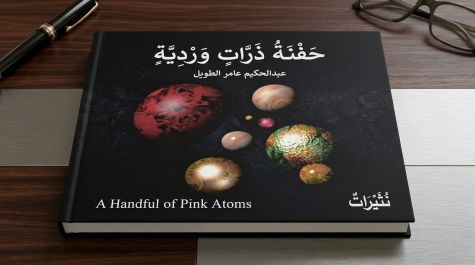
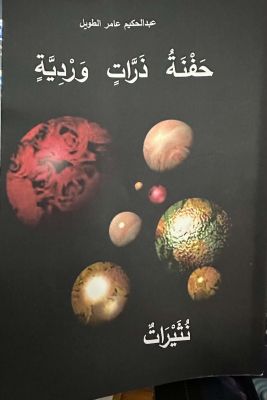
In A Handful of Pink Atoms, the Libyan poet and nuclear engineer Abdelhakim Al-Tawil bridges the divide between reason and imagination. Blending scientific terminology with rich poetic imagery, his work transforms cosmic phenomena and digital systems into mirrors for memory, love, and loss. Here is a close reading of how two of his poems transform the language of science into the language of the heart.
Souad Khalil | Libya
When I opened the pages of the poetry collection A Handful of Pink Atoms by critic and poet Abdelhakim Al-Tawil, I did not feel that I was simply facing a book of poetry that I would read and then close. Rather, I felt that I had entered a private space where things that at first seem far apart intersect: science and imagination, reason and dream, word and color, reality and what we search for beyond reality.
 There was something in the poems that caught my attention each time: an image, a word, a question, or that vague feeling some texts leave within us without our knowing exactly how it found its way there. I would read the poem and then return to it with a different eye, as though it had not said everything on the first reading, as though there were another layer within it waiting for us to approach it quietly.
Perhaps this feeling was not unrelated to the personality of the poet himself. He is a nuclear engineer, professionally belonging to a world of precision, laws, and calculations. Yet when he enters the world of poetry, he opens the doors to imagination and gives language the freedom to go beyond the boundaries of the equation. Perhaps this is why the title A Handful of Pink Atoms seemed to me so significant: it brings together, in its words, a term belonging to the world of science and a color belonging to the world of dreams and emotions.
In his introduction to the collection, the poet gives the reader some of the keys to his experience and reveals his relationship with writing and the world from which these texts emerged. Yet what I find most beautiful about the book is that these keys do not close off the meaning or impose a single path on the reader. The poems soon become independent of their introductions and begin to shape their own world.
As I read, I found myself moving between different states: from contemplation to wonder, from dream to questioning, and from worlds close to science and knowledge to worlds deeply human. The paintings accompanying some of the poems were not separate from this feeling either. At times, they seemed to be the other side of the poem, as though the poet was not satisfied with expressing what he wanted through words alone, and therefore searched for a color, a space, and an image for it as well.
For this reason, I do not want to approach A Handful of Pink Atoms merely as a poetry collection to be read from beginning to end. Rather, I see it as an experience that calls for pausing before some of its texts and approaching them one by one, in order to discover what they conceal behind their expressions and images.
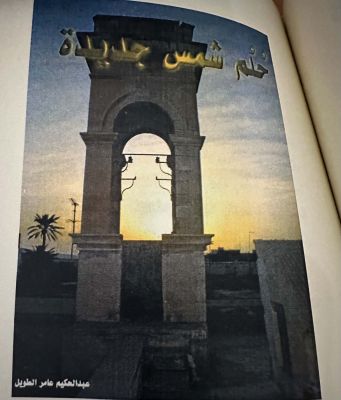
And so my journey with this collection began… from one poem, or one prose state, as the poet calls it, to another; from a word to a color, from a question to a dream. I have tried to capture something of what these “pink atoms” have left within me. I will be reading most of the poems in this collection because they provoked me and made me want to delve into them and explore their depths. I will begin with the poem “The Dream of a New Sun.”
In this poem, I felt that I was not reading a passing dream, but entering a space suspended between dream and wakefulness; a space in which the poet tries to give things another chance at life before reality reasserts its authority once again.
From the opening:
“Spend the love and the seeds,
And let the universe’s down tremble with passion,
Or the birth of a dream of a new sun.”
The dream appears as a project of salvation, and as a new birth that does not belong to the poet alone, but extends to the universe around him. He does not dream of something small or personal; rather, he searches for a “new sun”—for a light capable of rearranging the world after a long darkness.
This vision becomes broader when the poet invokes the sky, the stars, the seas, and the sunset. The cosmic elements in the poem are not merely a backdrop for the poetic image; they become beings that participate in the same dream. The sky is bestowed, the stars are discovered, and the sunset becomes a mountain, as though the poet were recreating nature according to what the heart wishes to see.
Perhaps this cosmic tendency in the poem anticipates a particular significance if we remember the poet’s profession alongside his poetry. His scientific background seems to open before his imagination a space of energy, transformation, and the universe. When he says, “a sun that melted hearts,” the verb melted draws our attention. It does not function merely as an emotional metaphor; it also carries an implication of energy and transformation. Likewise, the presence of meteors, stars, and galaxies does not seem strange coming from a poet accustomed to looking at the world from a scientific perspective. Yet he re-creates this world through the language of poetry.
Here, the engineer meets the poet: science gives imagination its breadth, while poetry transforms cosmic knowledge into human feeling.
Then comes the beautiful and painful transformation at once: the dream becomes an inner state.
“A sun that melted hearts,
Turned the others into meteors…
And fragments of stars…
And remnants of distant galaxies.”
Here, the sun is no longer merely a source of light; it becomes a force capable of melting hearts and transforming what was once whole into fragments and remnants. Thus, light in the poem carries two faces: the face of salvation and the face of burning. This duality is one of the aspects of the text that struck me most.
Time, too, is strongly present. When he says:
“A dream stopped the beating of the heart for a minute,
And its clock stopped for years,”
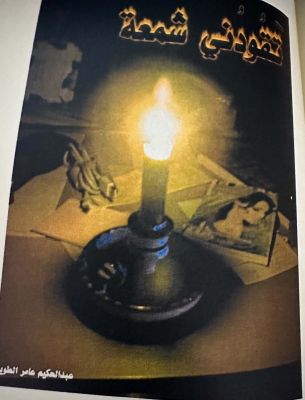 We encounter a striking poetic paradox: a single minute of dreaming can stop hundreds of years. It is as though real time is not measured by hours, but by what it leaves in the heart. A single moment may be broader than an entire lifetime.
But what I find most beautiful about the poem is that the poet does not allow the dream to remain complete. However expansive the dream may become, it carries within itself the seed of its own collapse. Hence the return:
“Then the dream quickly returned to its ancient tomb!”
As though the dream had been unable to escape its past. It returned to the old places, to what had accumulated in memory, to that part that light had been unable to erase.
Even the image of the grave that appears at the end of the passage overturns the entire scene. After the sun, the stars, and the seas, we suddenly find ourselves facing death. After the vastness of the universe, the space suddenly narrows into a grave. It is as though the poem moves along a wide arc that begins with the universe and ends with the human being and his destiny.
As for the language, it relies more on imagery than on direct narration. The poet does not tell us, “I am sad, I have lost, I dream of a better world.” Instead, he makes us see his sadness through the sun, meteors, stars, galaxies, seas, sunset, the grave, and the butterfly. This is what gives the text its contemplative dimension.
What struck me most is the appearance of the butterfly near the end. By its very nature, the butterfly is a symbol of transformation, lightness, and rebirth, yet here it appears within a context burdened by death and memory. It therefore seems like beauty’s final attempt to remain alive in a world that has begun to collapse.
In another poem entitled “Just an Icon,” I felt, while reading it, that the poet does not treat the “icon” merely as an image on a screen, but gives it another life within memory. The title itself carries a striking paradox: the word “just” suggests reduction and minimization, while “icon” carries presence, symbolism, and a reference to something capable of opening an entire world behind it.
From here the question begins: How can it be merely an icon when, in the poet’s consciousness, it becomes memory, presence, and a restless confusion that refuses to settle?
From the very beginning, the poet enters a world in which the electronic image intersects with human experience. The icon does not remain a static image; it becomes a presence that evokes emotions and awakens memory. Here, technology begins to transcend its direct meaning and becomes another language of love, longing, and absence.
As I read this text, I cannot ignore the poet’s professional background. His scientific training seems to have left its mark on the way his poetic imagery takes shape. A mind accustomed to dealing with precision, systems, energy, and transformation enters the poem not to present a scientific discourse, but to give imagination new tools.
Perhaps what is most beautiful about his experience is that he does not place science in opposition to poetry. Instead, he allows the two to meet within the image. Thus, the scientific or technological concept is transformed into emotion, and language belonging to the world of machines becomes a language that speaks of the heart and memory.
For this reason, technological and computer-related terms appear throughout the poem: the digital file, the password, installation, the keyboard, the processor, and operating systems. Yet the poet does not use them in a coldly technical manner. Rather, he recharges them with emotion until the computer itself becomes a metaphor for the human being.
When he says:
“In a remote digital file, I kept her,”
The “file” is no longer merely a place for storing an image. It becomes a repository of memory, a place in which the poet tries to preserve a presence he fears losing.
Then comes the phrase:
“But… I forgot her password!”
Here, technology becomes one of the poem’s most beautiful metaphors. The memory exists, the image exists, the file exists, but the poet has lost the key to access them. The “password” becomes a symbol of the distance that time has created between the human being and his past. Not everything we preserve can be retrieved, and not everything that remains in memory can be accessed whenever we wish.
The poet then takes this poetic game even further when he invokes:
“The processor of my memories”
And
“My operating systems.”
Here, the interaction between science and poetry reaches its peak. The processor is no longer a technical component inside a device; it becomes the mind that carries memories. Operating systems are no longer electronic programs, but become a metaphor for the poet’s inner life.
And when he says:
“I stole from the flicker of my memory processor
And disrupted the operation of all my systems!”
The other presence is no longer merely a stored image. It becomes a force capable of disturbing the entire inner system of the self. Love here resembles a beautiful malfunction that the poet cannot repair: it enters memory, rearranges it, and then leaves its owner unable to return to his original state.
It is precisely here that the poet’s skill in transforming a technical term into an emotional image becomes apparent. He does not borrow the language of computers merely for strangeness or novelty; he makes it part of the psychological structure of the poem: the file is the past, the password is the key to access, the processor is the mind, and the operating systems are the human being’s inner state.
This use of technology becomes even more meaningful when placed within the context of the poet’s scientific background. This does not mean that we should interpret every image in the poem scientifically. Yet his scientific training provides us with a key to understanding his inclination toward the vocabulary of energy, systems, transformation, and precision.
He takes what he knows from the world of science and allows it to pass into the world of poetry in a different form. Thus, science becomes part of his imagination rather than the direct subject of his poem.
It is also striking that the poet does not allow technology to destroy the beauty of the image. Amid the modern terminology, there remains a wide space for imagination, imagery, and human sensitivity. It is as though the poet wants to say that, no matter how advanced our tools become, human beings remain powerless before certain memories and emotions. A machine can preserve an image, but it cannot preserve the feeling that existed behind it.
From here, the title of the poem becomes more profound: “Just an Icon.”
 It is “just” an icon on the surface, but it is not merely a thing in the poet’s consciousness. Behind it lies a memory; behind the memory lies a relationship; and within that relationship lies a world of emotions. Thus, the icon is transformed from a small image on a screen into a window through which the self looks out upon its past.
I feel that the beauty of the poem lies precisely in this contradiction: an intensely modern language carries intensely ancient emotions. Love, longing, and absence are feelings that humanity has known since ancient times, but the poet gives them the language of his own era—the language of the screen, the file, the processor, the password, and operating systems.
Thus, technology in “Just an Icon” does not become merely a linguistic ornament; it becomes a new poetic medium for expressing the human being. And the poet, with his scientific and cultural background, is able to bring together two worlds that may seem far apart: the world of equations, systems, and energy, and the world of the heart, memory, and love.
Perhaps the most beautiful thing the poem leaves within us is this: a person can keep the image of someone he loves in a file, protect it with a password, and store it on a device, but he cannot control what that image does when it awakens inside him.
And here, “Just an Icon” is no longer merely a poem about an electronic image. It becomes a poem about memory when it turns into a system we cannot stop, and about love when it slips into the depths of the human being and restarts everything he thought he had switched off.
In these two poems, “The Dream of a New Sun” and “Just an Icon,” it seemed to me that A Handful of Pink Atoms is a collection that does not surrender to a single reading. Each poem opens a new door into a world where knowledge intersects with imagination, science with feeling, and light with absence.
In the first, the dream becomes a search for a new light, but it also carries within it the meaning of burning and loss. In the second, the vocabulary of technology becomes a language of memory, love, and longing. Between the two, the beautiful interaction between the poet’s scientific background and his poetic sensibility emerges clearly: science does not appear in his texts separated from poetry; rather, it becomes image, metaphor, and feeling.
What I have read here is only the beginning of this journey. The remaining poems still carry their questions, images, and layers that deserve to be explored. Perhaps the most beautiful thing this collection leaves us with is that some poems do not end when we reach their final line; they begin there… inside the reader.
Read: Oral Heritage: Folk Oral Art
____________
 Souad Khalil, hailing from Benghazi Libya, is a writer, poet, and translator. She has been writing on culture, literature and other general topics.