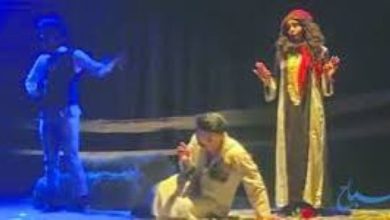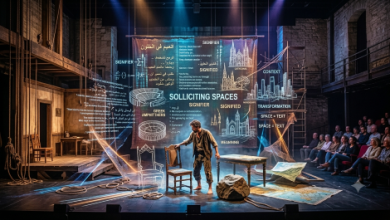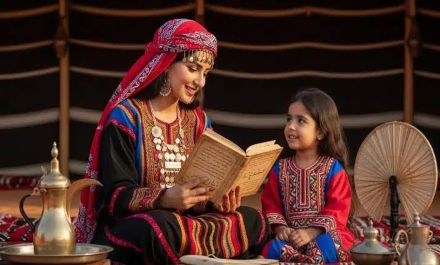
Folk oral art is one of the most important forms of cultural expression through which communities preserve their collective memory across generations.
Souad Khalil | Libya
Folk oral art is one of the most important forms of cultural expression through which communities have preserved their collective memory across generations. It embodies human experience in its symbolic and imaginative forms, and through it systems of values, beliefs, and social representations are shaped. The folk tale, or what is known as the khurrafa, lies at the heart of this art as a text open to interpretation, transcending the boundaries of entertainment to construct profound meanings connected to collective consciousness and its intellectual and symbolic structures.
This study addresses the problem of dealing with oral narrative heritage, between the stage of collection and description on the one hand, and the stage of analysis and interpretation on the other, in light of modern approaches to the analysis of folk narrative, including symbolic, linguistic, structural, and hermeneutic approaches. It also raises fundamental questions concerning the nature of the khurrafa: Is it a text that can be read independently of its oral performative context, or is it a living ritual whose meaning can only be completed through the performer, the narrator, and the recipient?
The study also examines the anthropological and social dimension of the folk tale as a mirror reflecting transformations in the collective mind and the mechanisms through which it confronts fear, poverty, and injustice. It explores how the collective imagination resorts to fantasy and myth as symbolic spaces through which reality can be resisted or reinterpreted. In this context, the question of identity between stability and renewal emerges, together with its relationship to folk heritage amid contemporary cultural and social transformations.
Accordingly, this paper seeks to reread folk oral art as a living intellectual structure, rather than merely as static heritage material: a semantic field open to major questions concerning identity, consciousness, and the cultural history of society.
The fairy tale and the khurrafa have not yet moved beyond the stage of collection to a stage of contemplating their elements and exploring their worlds, subjecting them to the prevailing approaches in the analysis of folk narrative, such as the symbolic-linguistic approach concerned with interpretation, meaning, and coherence; the symbolic hermeneutic approach concerned with the metaphorical use of heritage; and the procedural hermeneutic approach concerned with the linguistic and structural dimension.
I point this out because research into matters of folk heritage remains closer to popular material than to research material that examines the accumulated layers of an anthropological nature, which are closely connected to the social sciences concerned with the development of social structures and their material and symbolic environments. It also concerns itself with folk narrative and the psychological spaces to which it points, without explicitly stating their causes, which are linked to the network of customary and religious concepts that dominate the social mind and provide it with justifications that protect collective behavior and frame it within a particular historical period.
 The Algerian writer Ayache Yahiaoui says that the khurrafa is neither an innocent rabbit nor something without claws. Its danger derives from the fact that it is an inward-looking symbol, open to what I call the “empty space”—that is, the argument or justification—through which new values opposed to injustice, poverty, and fear may emerge. Whenever the circle of this empty space expands, the space of the popular imagination expands with it, and the popular imagination turns to the roots of the social unconscious, drawing upon them and taking refuge in them for a period of time, until circumstances change and the realities on the ground disappear.
In other words, whenever the social mind feels surrounded by danger, it returns to its childhood and to its mythology, expressing its inability to bring about change in the present phase. Whenever the social mind is given a richer, broader, and safer space in which to express its genius, it turns away from superstition and becomes an active participant in the world of change, in accordance with its convictions and its taste. It then seeks to emerge from isolation and self-withdrawal and opens itself to a diverse civilizational dialogue that brings it into contact with the outside world.
The Absence of Interpretive Thought
In this section, the writer refers to a symposium previously held in the city of Fujairah on folk heritage. He draws upon several theories and refers to Dr. Abdulkhaleq Abdullah’s book The Cultural Movement in the UAE, in which it is stated that intellectual production, intellectual activity, interest in philosophy, and scientific research are all absent and have no real presence in the current cultural life of the United Arab Emirates.
The question, therefore, is: Why is there a complete absence of thought from cultural life in the UAE? Is the social environment responsible for this absence? Is historical development in growth and development responsible for the absence of intellectual writings? Or is the absence of intellectual activity due to a lack of awareness of its importance?
He concludes by saying that the absence of thought, intellectual and philosophical creativity, and scientific research is an Arab phenomenon before it is an Emirati or Gulf phenomenon, with the exception of the countries of the Maghreb.
He adds that he deliberately presents this view in order to say that research conclusions concerning folk heritage, and the khurrafa in particular, have exaggerated their focus on the values of generosity, courage, and altruism. Oral narrative, which constitutes a rich material filled with symbols, myths, and signs produced by the collective social mind and stored within the unconscious—preserving the struggle of values and ideas and the frustrations of history—goes beyond the common Bedouin values prevalent in the familiar moral heritage within the Arab social fabric.
What I mean here is that an attentive reader’s exploration of the use of supernatural elements, the disruption of temporal balances, the cancellation of the rationality of distances, and the phenomena studied by vitalist approaches, structural approaches, and other systems within the oral narrative text reveals a symbolic burden that transcends conventional moral values. This burden cannot disclose its symbolic indications except through contemplating the elements of the overall narrative scene and understanding the nature of the relationships that connect them, as well as the causes behind the linguistic material, its structures, and its charged meanings that move toward ambiguity and concealment.
There is a deliberate symbolic subtlety here, as well as an aesthetic rhetorical subtlety aimed at producing pleasure and wonder. I use the word “subtlety” deliberately because popular genius employs its weapons through an indirect language founded upon a density of contradictory meanings, multiple clues, and an intention that may appear unintentional.
The discerning researcher is required to be deeply knowledgeable about the reservoir of linguistic meaning and to be experienced in the twists and turns of its social, historical, and aesthetic implications, derived from the very cultural environment of the text. Otherwise, the language of the narrative will surpass him and take him in one direction while he goes in another. This is where the distortion resulting from uninformed interpretation begins.
Separating the Narrated from the Narrator
I would also like to point to another serious problem that raises a number of procedural questions:
Can an oral narrative text be studied as though it were a written text, independently of the narrative ritual? Can the narration be separated from the narrator? Can the sound effects, the manner of storytelling, and the place be separated from the narrated text?
In other words, is the khurrafa a scene or a text? Does the function of the narrator in the folk tale constitute a creative structural element that can be considered independent of the narrated text, or is it an essential element inseparable from and integrated into the creative process of the text?
To what extent is the researcher studying the theme of the khurrafa entitled to transfer it from the context of hearing to the context of seeing, and to remove it from its social and familial ritual—where narrator and recipient share a high degree of psychological harmony—and place it within the ritual of reading, which deprives the khurrafa of one of its most important characteristics: its oral nature?
I believe that the researcher must be aware of the danger involved in transforming the khurrafa into a written text. This danger lies in destroying its capacity for cumulative addition through its narrators across generations. One of the most important characteristics of popular culture in general, and of the khurrafa in particular, is its ability to absorb additions that intensify its dramatic dimension, as well as the additions and changes that affect names and designations according to the social, geographical, and environmental climate in which it is narrated.
This capacity has contributed to the khurrafa’s ability to reproduce and branch out. We can observe partial overlaps and similarities between one khurrafa and another within the same environment, as well as between narratives originating in widely separated environments.
However, the danger I am referring to would disappear in one particular case: if we were convinced that the age of the khurrafa had ended, and that the age of its anonymous and creative narrators had also come to an end. Such a conviction would lead us to bid farewell to popular genius as it makes its way toward its final resting place.
This would be justified on the grounds that modern societies are no longer occupied with the supernatural or the pleasure of storytelling because of the emergence of visual, audio, and written media, and because the social mind has moved from a primitive stage of inward withdrawal into a closed environment toward a modern, open stage in which its concerns have multiplied, its horizons have expanded, and its references and preoccupations have changed.
Despite the logic of this argument, I believe that transferring the khurrafa from the world of storytelling into the world of reading involves an injustice founded upon a technical displacement that eliminates the function of the narrator and the ritual of storytelling, both of which are essential components of the very concept of the khurrafa. It also limits its capacity for reproduction and branching, to which I referred earlier.
 Identity: Stability or Renewal?
Perhaps one of the most pressing necessities in the study of local folk heritage is to examine the imagination that drives events, generates images, and transforms them in ways that leave the recipient captivated by a magical world resembling the narratives of surrealist literature.
Examples of this can be found in the tales The Pebble of Patience, Lutf, The Almond Cracker, and The Enchanted Cat, among a collection of folk tales prepared for publication by researcher Ahmed Rashid.
There is also the following account narrated by Hamda bint Humaid Al Hamli:
“When the sun went down, we were afraid to approach the barayeh, the abandoned places, because sorcerers and jinn were believed to be there. I remember that one day I went out carrying a jumair, a container filled with garbage, intending to throw it into the sea. Suddenly, I saw a small boy running, running, running, and then throwing himself into the sea. I ran to find out what had happened to him, but he quickly disappeared into the depths of the sea.”
She continues:
“One day, I went to visit my sister after the evening prayer. On my way, I saw a woman sitting there. Before I could approach her, I was suddenly surprised to see her flying through the air. My sister was sitting some distance away outside her house. When she saw the scene, she came running toward me and asked whether I had seen a woman flying. I answered yes. We had often seen her.”
The writer says:
These two folk tales remind me of what some eyewitnesses from the Shihuh people of the Jabal region told me about the cave of Sut bin Jalmoun, which is said to be inhabited by jinn, from which sorcerers fly in the form of water. Even today, the popular narrative continues to believe that this cave is a regional center where jinn and sorcerers from India, Persia, East Africa, and the Arabian Peninsula gather.
They also remind me of what the popular memory of Ras Al Khaimah tells about Nad Bu Tabl, a small hill in the Khor of Ras Al Khaimah inhabited by jinn. However, the writer Abdullah Al Tabour decoded the figure of Bu Tabl in a historical novel that he wrote and prepared for publication.
Perhaps these tales, along with others such as Umm Al Duwais, Baba Darya, Khattaf Rafay, and Umm Al Sibyan, no longer need merely to be collected and published. Serious research into folk heritage must move beyond the repetitive descriptive approach toward investigating phenomena and their roots in ancient and primitive cultures, dismantling the moral and intellectual structures that drive the events of the khurrafa, and seeking an objective equivalent for them connected to the economic, customary, and intellectual balances prevalent within society.
I say this because folk heritage is not a collection of medals with which a society boasts in museums. Rather, it is a history charged with conflict and crowded with contradictions. It is the history of a society’s emotions, morality, philosophy, and its view of the world around it and within it.
The value of studying this history lies in discovering who we are and what accumulated layers govern our thoughts and behavior. For social thought that does not question itself, contemplate itself, and explain itself is closed and troubled thought, incapable of confronting and challenging the new ideas emerging in the world.
Without elevating folk and cultural heritage to the level of this kind of modern research, society will remain bound to an old identity created by its ancestors, yet unable to make any essential contribution to it. Identity is not a fixed network of final concepts; rather, it is constantly renewed through the vitality of society and its aspiration toward renewal.
In this regard, Dr. Abdulkhaleq Abdullah writes in his book The Cultural Movement in the UAE, on page 59 that the successive material and structural transformations witnessed in recent years have led to new cultural, behavioral, and intellectual transformations within Emirati society. In the course of its development and transformation from a traditional society into a modern one, Emirati society has produced a number of modern concepts, convictions, and assumptions that move beyond the habits, traditions, and traditional values with which people in the UAE had previously been familiar.
This critical perspective suggests that identity can only reside in a museum when a society itself has become extinct. A living society, eager for development, is one that reads its memory and turns heritage consciousness into a weapon and a tool for engaging with its age, while reviving its latent historical vitality.
For this renewal to be effective, there must be an informed courage capable of examining memory and searching for mechanisms that remain capable of producing action beyond the philosophy of compromise and burial that afflicts Arab societies, which enter the age of globalization shackled, hesitant, dazzled, and lacking confidence in their own abilities.
Here lies the utmost importance of studying the problematic nature of cultural history.
Read: The Arab Heritage and Psychology
__________
 Souad Khalil, hailing from Benghazi Libya, is a writer, poet, and translator. She has been writing on culture, literature and other general topics.
(All images provided by the author)