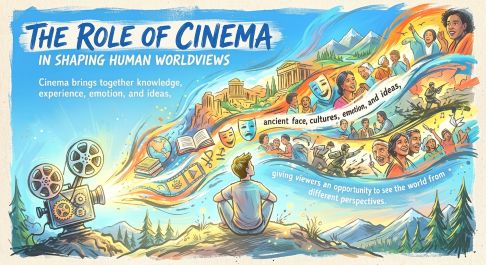
Cinema is not merely a form of entertainment that fills our free time. It brings together knowledge, experience, emotion, and ideas, giving viewers an opportunity to see the world from different perspectives.
Sayfulloeva Umida Fayzulloevna | Uzbekistan
Today, people encounter an enormous amount of information every day. Books, articles, social media, videos, podcasts, and many other forms of media have made knowledge more accessible than ever. Among these forms of communication, cinema holds a unique position.
Films are often viewed mainly as a form of entertainment or a way to spend free time. However, their role can extend far beyond entertainment. By combining images, sound, music, dialogue, acting, and editing, cinema can present information not only through words, but also through visual and emotional experience.
For this reason, films can influence how people understand events, relate to characters, and view certain issues. Cinema does not shape a person’s worldview alone, but it can become a powerful part of the process.
Making Knowledge Visible: Cinema and Children’s Understanding
One of the clearest examples can be found in animated films created from folk tales and legends.
When we explain abstract ideas such as good and evil, honesty and dishonesty, or courage and fear to children, words alone may not always be enough. Young children are still developing their ability to understand abstract concepts, so they may find it difficult to fully grasp the deeper meaning of a story simply by listening to it.
Animation can make these ideas more concrete.
Through the actions of characters, their choices, and the consequences of those choices, children can observe the difference between right and wrong. Colors, facial expressions, movement, music, and sound can further strengthen the emotional meaning of a scene.
In this way, a story is no longer simply something a child hears. It becomes something the child can see, feel, and experience.
Cinema, therefore, does not merely repeat a story. It transforms the story into a visual experience.
From Frames to Emotion
This process is not limited to children. Adults also receive and interpret information through images and emotions.
The power of cinema lies partly in the way several forms of expression work together.
A frame establishes what we see.
A camera angle influences the perspective from which we see it.
Lighting and color create atmosphere and mood.
Music and sound strengthen the emotional impact of a scene.
An actor’s facial expressions and body language can communicate feelings without words.
And editing connects separate images and helps shape the way viewers understand a sequence of events.
As a result, viewers do not simply watch a film. They also interpret and emotionally respond to it.
This emotional experience is one of the ways cinema can influence human thought. What we see and feel on screen can remain in our memory, raise questions, and sometimes encourage us to reconsider the way we understand a particular subject.
Understanding Complex Ideas through Film: The Example of Interstellar
Christopher Nolan’s Interstellar provides an interesting example of how cinema can make complex ideas easier to imagine.
Concepts such as space, time, gravity, and black holes can be studied through scientific books and encyclopedias. These sources may provide more detailed and precise information, but for some learners, such concepts can be difficult to visualize.
A film can approach these ideas differently. Through visual effects, sound, music, acting, and storytelling, Interstellar connects scientific concepts with a human story.
The audience does not simply observe ideas about space. They also experience the fear, hope, separation, and difficult choices of the characters.
This demonstrates one of cinema’s distinctive strengths: a film can turn information or an abstract idea into an experience that the viewer can imagine and emotionally connect with.
This does not mean that a fictional film can replace scientific sources. Rather, it can make complex subjects more accessible, create curiosity, and encourage viewers to explore them more deeply.
Cinema in the Age of Fast Information
Young people today live in an increasingly fast-moving information environment. Short videos, quick news updates, and visual content have become an important part of everyday media consumption.
This development has both advantages and disadvantages.
Short and visual formats can make certain information easier to understand in a limited amount of time. At the same time, content that is constantly shortened and simplified may leave less room for deeper analysis and reflection.
Therefore, the question should not simply be “books or films?”
The more important question is what kind of content we create and how we use it.
Historical films, documentaries, science films, and meaningful fictional works can introduce viewers to unfamiliar subjects, encourage curiosity, and raise questions that may lead to deeper learning.
Cinema can therefore complement other forms of learning rather than compete with them.
Cinema as a Conversation with Society
The influence of cinema can also extend beyond the individual viewer. Films can create opportunities for society to discuss important issues.
Through cinema, filmmakers can explore social problems, personal struggles, historical memory, cultural identity, inequality, war and peace, family relationships, and the challenges faced by young people.
Sometimes statistics can show us how large a problem is. A film, however, can show us what that problem may feel like in a person’s life.
A meaningful film does not simply say, “This is a problem.” It can lead the viewer to ask:
“What if this were my life?”
Such a question can become a starting point for empathy and deeper reflection.
Cinema Is More than Entertainment
Cinema is often seen as a way to relax, escape from everyday life, or simply enjoy a story. These functions are certainly valuable. However, limiting cinema to entertainment means overlooking much of its potential.
Every film presents a particular world to its audience. Through its characters, conflicts, choices, and consequences, it can introduce viewers to experiences they have never encountered themselves.
A historical film can encourage people to look at the past from a different perspective. A documentary can introduce them to realities they knew little about. A social drama can help them consider the experiences of people whose lives are very different from their own.
In this sense, cinema can become a unique form of sharing knowledge, experience, and ideas.
Watching a film, therefore, does not necessarily mean simply “losing time.” Depending on the film we choose, that time can become an opportunity to gain knowledge, experience new perspectives, and think about the world in a different way.
Conclusion: From Frames to Thought
Cinema is not merely a form of entertainment that fills our free time. It brings together knowledge, experience, emotion, and ideas, giving viewers an opportunity to see the world from different perspectives.
We may learn about an event by reading about it, but a film can allow us to see it, imagine it, and feel its human dimension.
Of course, cinema is not the only force that shapes a person’s worldview. Family, education, culture, personal experience, and the surrounding environment all play important roles. Yet the influence of cinema should not be reduced to entertainment. A meaningful film can encourage us to learn something new, understand another person’s experience, question what we already believe, or look at a familiar issue from a different perspective.
Ultimately, the value of a film lies not only in what it shows us, but also in what it makes us think about after the screen goes dark.
A frame can become the beginning of a thought.
From frames to thought — this is the journey through which cinema can reach the human mind and contribute to the way we understand the world.
Read: Cinema – Dynamic Language of Human Existence
____________
 Sayfulloeva Umida Fayzulloevna, hailing from Bukhara, Uzbekistan is a 2nd year student at Bukhara State University, Faculty of History and Law. Alongside her academic studies, she has actively pursued her passion for the performing arts. She completed one year of systematic acting training at Bukhara Children’s Music and Art School during which she developed skills in acting, stage performance, and expressive reading. She has performed on various stages.