
Flawed Policies Stifle Sindh’s Educators
World Teachers' Day and Sindh's Lagging Education System

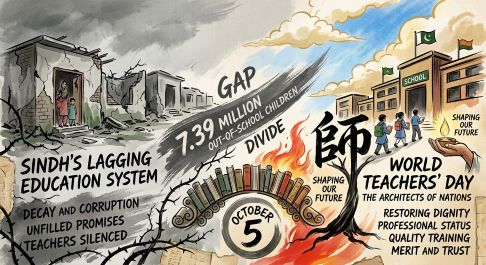
On World Teachers’ Day, Sindh’s education crisis demands honest reflection over symbolic praise. Despite policy reforms, systemic corruption, digital failures, and administrative neglect continue to erode the dignity of teachers and deny millions of children basic learning opportunities.
By Fida Hussain Malik, Ghotki
The teacher is the architect of any nation. Beyond their specific profession, teachers serve as foundational pillars in building society. Every year on October 5, World Teachers’ Day is observed globally. UNESCO initiated this day in 1994 to commemorate the adoption of international standards regarding the status of teachers. This year, UNESCO has designated the theme of World Teachers’ Day 2026 as “With Teachers: 60 Years of Protecting the Profession, Raising Its Status and Shaping Our Future.”
In our culture, a teacher is revered as a spiritual guide who shapes raw potential into a complete human being. However, several critical questions arise: Does a teacher in Sindh truly enjoy this honor and standing? Is our education system structured so that teachers can fulfill their roles with peace of mind and dignity? At its core, World Teachers’ Day offers an opportunity not merely for garlands, speeches, and cake-cutting, but for a candid assessment of our education system.
No objective observer can deny that Sindh’s education system has been deteriorating for decades. According to the Pakistan Institute of Education (PIE) report for 2023–24, 7.39 million children aged 5 to 16 in Sindh—representing 44% of this age demographic—are out of school. Of these, 3.95 million are girls, meaning 49 out of every 100 girls are deprived of education, compared to 39% of boys. The Sindh report of the 2023 Census puts this figure at 7.82 million (over 46%), with 6.6 million children having never attended school. In rural Sindh, 60% of all children—and 68% of rural girls—remain out of school. UNICEF reports that Pakistan as a whole has 25.1 million out-of-school children, ranking second highest in the world.
Even today, many public schools in Sindh remain non-functional or exist solely on paper. In numerous active schools, a single teacher is forced to instruct six grades simultaneously in a single classroom. Many facilities suffer from dilapidated infrastructure, lack boundary walls, and lack basic amenities such as clean drinking water and toilets. Furthermore, a substantial portion of the 14,343 schools damaged or destroyed in the 2022 floods still await reconstruction and repairs.
Although the literacy rate in Sindh has risen, progress remains sluggish. According to the Pakistan Bureau of Statistics (PBS), Sindh’s literacy rate was 31.45% in 1981, rising to 45.29% in 1998, 54.57% in 2017, and 57.54% in 2023. Over the 25-year period between 1998 and 2023, literacy increased by only 12 percentage points, while the 6-year period from 2017 to 2023 saw a gain of less than 3 percentage points.
Female literacy in Sindh stood at 21.64% in 1981 and reached 50.21% in 2023. Rural female literacy, which was just 12.23% in 1998, rose to 27.52% in 2023; nevertheless, nearly three out of every four rural women remain illiterate today. Urban Sindh boasts a literacy rate of 72.26%, while rural Sindh lags at 38.14%, highlighting a stark divide. The Pakistan Economic Survey 2025–26 reports Sindh’s overall literacy rate at 58% for 2024–25, compared to 68% in Punjab and 63% nationally. The survey further highlights that female literacy in Sindh stands at 47% overall, dropping to 24% among rural women.
In recent years, the Sindh School Education Department took a commendable step by recruiting over 90,000 teachers purely on merit through Sukkur IBA testing in 2021. However, concurrent administrative reforms and digital systems introduced in the name of transparency and efficiency have often created new hurdles for educators on the ground.
Under the cluster policy, smaller primary schools have been annexed to central hub schools, transferring financial and administrative control to central headmasters. While intended to devolve authority, this move stripped local primary school heads of autonomy while placing an unsustainable burden on central headmasters. A single headmaster must now manage their own school, oversee up to ten satellite schools, and handle complex accounting duties, leaving the policy mired in operational confusion.
Similarly, on January 15, 2026, an online e-transfer system was launched for primary and junior teachers to curb nepotism and bribery. However, Phase 1 was immediately marred by irregularities surrounding over 2,000 transfer orders, and Phase 2 was halted due to severe technical glitches. Teachers frequently report that administrative bottlenecks persist; obtaining basic documentation such as no-dues or no-inquiry certificates from district offices often still requires illicit payments. Instead of eliminating corruption, the system has merely shifted its mechanics.
Centralized decision-making has further compounded these challenges. Posting and transfer authority has been moved away from district and divisional officers to central bureaus in Karachi. Unfamiliar with local logistics, centralized authorities frequently post teachers—particularly female staff—miles away from home in areas lacking public transport or security, exposing them to safety risks and robberies. Consequently, the centralized model results in severe imbalances, leaving some schools overstaffed while others remain closed for lack of a single teacher.
Attendance monitoring has followed a similar pattern. Following biometric verification machines, the facial-recognition FRAMS application was introduced on a pilot basis across six districts on August 17, 2026. While accountability is essential, system implementation has been troubled. Over 10,000 teachers struggled to register due to poor connectivity in remote areas, incorrect location logging, and system errors. Teachers assigned to official duties outside their schools are frequently marked absent, risking salary deductions. On September 25 alone, a system glitch incorrectly marked 2,650 out of 4,200 teachers absent, underlining significant technical instability.
Financial management remains equally problematic. The government’s initiative to disburse direct funds to over 35,000 schools via the School Specific Budget (SSB) was intended to address localized needs. In practice, late disbursements near the close of the financial year, coupled with commission demands from district treasuries and vendors, severely eroded these budgets. As highlighted in the Sindh Assembly by Opposition Leader Ali Khurshidi, nearly half of the allocated funds were siphoned off by administrative corruption before reaching schools. Rather than investigating systemic graft within financial offices, oversight bodies like the Anti-Corruption Department have targeted headmasters over routine paperwork, penalizing educators while failing to address root causes.
Beyond structural issues, teachers face unwarranted public humiliation and operational burdens. Instructors are regularly assigned non-teaching duties, including census logging, election duty, polio campaigns, and field surveys, only to face scrutiny for lost classroom hours. Unofficial surprise raids by non-educational officials—often filmed and broadcast on social media to humiliate staff—violate the dignity of the profession. Headmasters are held accountable for infrastructure, sanitation, and enrollment despite receiving neither adequate funding nor administrative authority. Furthermore, delayed promotions, withheld salaries, cumbersome pension processing, and a lack of continuous professional development foster widespread frustration. Notably, over 150,000 primary school teachers in Sindh continue to be denied a structured service framework, pushing teacher associations toward public protests.
This environment is further aggravated by unauthorized individuals claiming to be journalists who enter school premises with cameras to harass and attempt to extort money from teaching staff. Sensationalized and unverified footage shared online damages the reputation of dedicated educators without providing them a fair right of response.
Instead of refining reform policies, public narrative often scapegoats teachers for systemic failures in education. Policy planners, resource managers, construction contractors, and hiring authorities remain absent from public debate, while teachers bear the sole blame. This dynamic erodes student respect and deters talented young candidates from joining the profession. While absenteeism among a minority of teachers must be addressed, penalizing the entire profession remains counterproductive. A healthy learning environment can only exist when educators are treated with trust and respect.
Global comparisons illustrate the link between teacher status and educational achievement. According to the Varkey Foundation’s Global Teacher Status Index, nations like China and Malaysia—where teachers command social status comparable to medical professionals—achieve strong student outcomes. Top-performing education systems, such as Finland and South Korea, maintain high entry standards, provide competitive compensation, and grant educators pedagogical autonomy while minimizing bureaucratic burdens.
Addressing Sindh’s educational challenges requires targeted, systemic adjustments:
Clarify Cluster Management: Define explicit roles under the cluster policy, grant localized authority to primary headmasters, and ensure timely budget releases.
Audit E-Transfer Operations: Conduct an independent review of the e-transfer system, address technical flaws, enforce anti-bribery measures, and make all transfer decisions transparent.
Devolve Postings and Attendance: Shift transfer authority and attendance management back to the district level to better align decisions with local security, transport, and staffing needs.
Fix Attendance System Errors: Suspend salary deductions linked to FRAMS or biometric glitches until registration, signal coverage, and official leave integrations are resolved.
Streamline Direct School Funding: Disburse the School Specific Budget at the start of the fiscal year, simplify accounting mechanisms, and eliminate corrupt commission practices at the treasury level.
Target Systemic Corruption: Redirect anti-corruption investigations toward administrative offices siphoning school funds rather than harassing local teaching staff.
Protect Classrooms from Unauthorized Interference: Restrict non-educational officials from conducting unscheduled public inspections, ensuring administrative issues are handled through proper departmental channels.
Curative Measures against Harassment: Prohibit unauthorized media access in classrooms and take legal action against extortion or defamatory content targeting educators.
Reduce Non-Teaching Duties: Limit administrative, survey, and electoral assignments so teachers can focus primarily on instruction.
Ensure Career Progression: Resolve long-standing time-scale cases, streamline promotion cycles, and digitize pension processing.
Address Out-of-School Metrics: Set targeted district goals to enroll out-of-school children—particularly rural girls—and prioritize the reconstruction of flood-damaged schools.
Enforce Licensing and Training: Strictly apply mandatory teaching credentials and establish structured, continuous in-service training programs.
Legislate Teacher Rights: Draft provincial legislation safeguarding teachers’ rights in line with international recommendations, resolve backlogged time-scale benefits, and respect the right to peaceful assembly.
Include Educator Voice in Policy: Engage teacher representatives and professional associations directly when formulating educational policy and structural reforms.
Digital dashboards and metrics cannot substitute for fundamental institutional support. Sustainable educational reform in Sindh will be achieved not by penalizing teachers, but by providing them with the authority, resources, security, and respect necessary to perform their crucial work.
Read: Beyond Top Ranks in Sindh Education
_______________
 Fida Hussain Malik is a primary school teacher in Ghotki, Sindh.


