What MD CAT Top-20 and CSS 2025 Lists Cannot Tell Us About Sindh’s Education System
By Dr. Nisar Ahmed Solangi
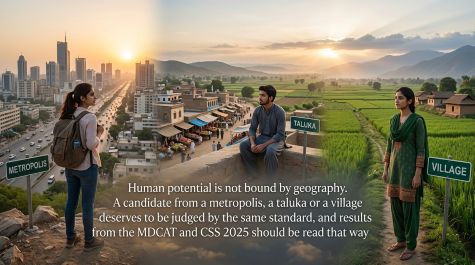
Human potential is not bound by geography. A candidate from a metropolis, a taluka or a village deserves to be judged by the same standard, and results from the MDCAT and CSS 2025 the should be read that way or otherwise?.
This year’s results have nonetheless unsettled Karachi-domiciled candidates among the MDCAT top 20 and as well as among the CSS 2025 qualifiers. The city has the province’s densest concentration of universities, experienced teachers, private schools and coaching academies. It draws students from every district of Sindh and from across the country. Karachi belongs to no single language or class; it belongs to all of us.
It is fair, then, to ask why such a concentration of resources did not translate into top placings. But the answer should not be asserted before it is established. Four explanations deserve examination.
The first is preparation. Karachi’s resources may be producing more coaching and test-taking technique than actual learning.
The second is institutional: curricula, teaching standards and board examinations may not prepare students for competitive assessment.
The third is the design of the tests themselves, and whether they measure what schools teach and are administered consistently.
The fourth is the least discussed. Seat-distribution rules including that of FPSC which shape who appears on a merit list, and any serious reading of these results must account for them.

A MDCAT top-20 and CSS 2025 list is also a narrow lens. It captures the extreme tail of a distribution, and a single year’s tail can shift by chance alone. It says nothing about the median student, the pass rate, or the many districts and institutions that rarely reach a merit list at all. Whether the outcome reflects genuine decline or ordinary variation can be settled only by wider evidence: such as pass rates and score distributions by district, results by institution, and multi-year trends. Until that data is published and examined, claims about “the failure of districts including Karachi” or “the failure of Sindh” are conjecture.
The success of candidates from Sindh’s smaller towns and rural districts should be welcomed on its merits. It is not an anomaly to be explained away. It shows that talent is widely distributed and that guidance and opportunity can unlock it. Where anyone doubts a result, the doubt should be substantiated with data, not insinuation. By the same logic, Karachi’s students should not be written off on the strength of one year’s numbers.
The contest, in other words, is not Karachi against the rest of Sindh or vice versa. The real question is whether the province’s education system, from primary school to professional entry, reliably identifies and develops its ablest young people wherever they live. Our stake in that question is simple: that the children of Sindh receive a sound education, advance on merit, and become doctors who can protect public health and civil servants who can improve governance.
That calls for self-scrutiny of our schools, our teaching standards, our examination processes and the way we prepare students for real competition. Criticism is necessary, but it must rest on research. In matters of education, evidence should outweigh emotion, analysis should outweigh assertion, and results should be judged on merit rather than regional pride.
Read: Too Much for the Few, Too Little for the Many
___________________
Dr. Nisar Ahmed Ali Nawaz Solangi is a distinguished Public Health Specialist with over 28 years of experience in primary healthcare, health management, and policy development. Throughout his career, he has served in leadership capacities, He holds MBBS from the University of Sindh and a Master of Public Health from Griffith University, Australia. Currently, he lives in Saudi Arabia.