

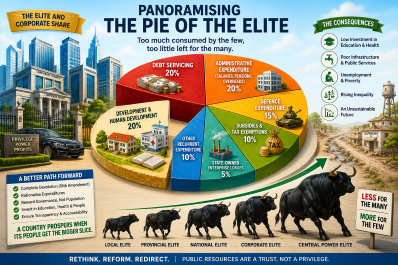
Pakistan’s fiscal crisis is often described as a problem of a shrinking pie. More accurately, it is a problem of a shrinking developmental pie.
- Large segments of national resources are absorbed by institutional obligations before they can be invested in people.
- The burden ultimately falls on ordinary Pakistanis. Higher indirect taxes, petroleum levies, utility tariffs and inflation become the mechanisms through which fiscal imbalances are transferred to households.
Dr. Nisar Ahmed Solangi
The annual debate over Pakistan’s budget invariably revolves around one question: who gets what share of the national revenue? This year, however, an equally important question has been pushed into the background. Before arguing over the division of the pie between the federation and the provinces, Pakistan must first ask how much of that pie actually reaches its citizens.
The controversy surrounding the provinces’ decision to contribute Rs1.2 trillion towards the federation’s “strategic needs” has once again placed the National Finance Commission (NFC) Award under scrutiny. To make room for this contribution, provincial governments have trimmed their Annual Development Programs, delaying or scaling back projects in education, healthcare, infrastructure and local development. Although the arrangement has been described as an extraordinary fiscal measure, it sets a precedent that effectively reduces the provincial fiscal space without formally amending the constitutional protections embedded in the NFC framework.
Yet focusing exclusively on federal-provincial resource sharing risks missing the larger story. Pakistan’s fiscal challenge is not merely about how the pie is divided; it is about how much of it is consumed by entrenched institutional structures before development spending even begins. Whether resources remain in Islamabad or are transferred to provincial capitals becomes a secondary issue if both tiers of government devote an overwhelming share of public finances to maintaining administrative machinery rather than improving the lives of citizens.
Recent research lends weight to this concern. The World Bank’s report, Strengthening Fiscal Federalism in Pakistan, together with Dr Ashfaque Hasan Khan’s study, NFC Award and Population as a Parameter, points to structural weaknesses that extend well beyond the mechanics of revenue distribution. Both studies suggest that Pakistan’s fiscal architecture has evolved into a system where incentives often favour institutional expansion over public welfare.
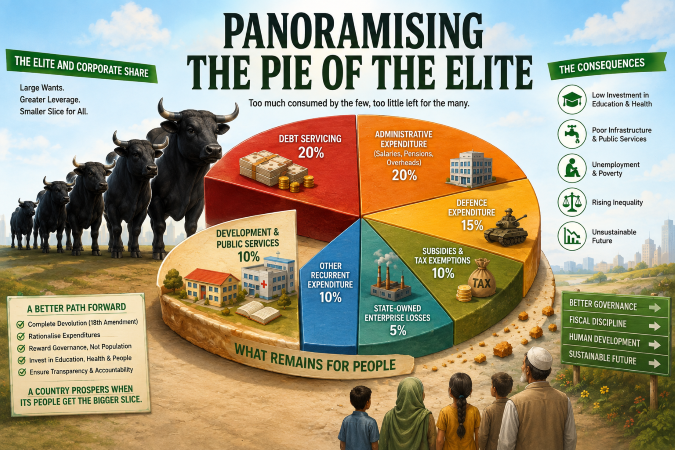 The World Bank notes that, despite the Eighteenth Amendment, several ministries and departments that were meant to be devolved continue to function at the federal level. Maintaining these overlapping structures entails recurring expenditure on salaries, pensions, office establishments and administrative overheads, adding to the burden on an already constrained budget. Devolution, a constitutional commitment intended to improve efficiency and accountability, remains incomplete.
The provincial governments fare little better under scrutiny. The World Bank estimates that a substantial majority of the additional resources transferred to provinces following the Seventh NFC Award was absorbed by salaries, pensions and other recurrent administrative costs rather than by investments in education, healthcare or essential public services. Increased transfers, therefore, did not translate proportionately into improved human development outcomes.
This pattern exposes a deeper problem that cuts across all levels of government. Pakistan’s fiscal debate often portrays the federation and the provinces as competing claimants to a limited pool of resources. In reality, both operate within a political economy where institutional consumption frequently takes precedence over citizen welfare. Administrative expenditure continues to grow while development spending becomes what remains after recurrent obligations have been met.
The consequences are reflected in Pakistan’s social indicators. Public expenditure on education remains among the lowest in the region, while health spending falls well below the average for countries at comparable income levels. These chronic under investments have predictable outcomes: overcrowded classrooms, under-resourced hospitals, inadequate primary healthcare and weak human capital formation. The developmental pie shrinks not because the economy produces too little, but because too much is committed elsewhere before it reaches the sectors that determine long-term national prosperity.
The debate over the NFC formula itself also deserves closer examination. Population continues to dominate resource allocation, creating incentives that are increasingly difficult to justify. Dr Ashfaque Hasan Khan argues that a formula overwhelmingly weighted towards population discourages demographic stabilization while failing to reward governance, fiscal discipline or improvements in human development.
International experience offers useful lessons. India’s Finance Commission gradually reduced the weight assigned to population and introduced greater emphasis on income disparity, demographic performance, environmental conservation and fiscal responsibility. The objective was not to penalize larger states but to encourage better governance and more sustainable development outcomes. Pakistan need not replicate another country’s model, but it cannot ignore the incentives embedded within its own.
Equally troubling is the growing compression of fiscal space caused by debt servicing. Interest payments now consume a substantial portion of federal expenditure, leaving progressively fewer resources for development. Combined with rising pension liabilities, expanding administrative costs and persistent losses in state-owned enterprises, the result is a budget in which productive public investment is increasingly squeezed.
The burden ultimately falls on ordinary Pakistanis. Higher indirect taxes, petroleum levies, utility tariffs and inflation become the mechanisms through which fiscal imbalances are transferred to households. Meanwhile, the quality of public services improves only marginally, reinforcing public skepticism about the effectiveness of government spending.
This is why the debate should move beyond percentages in the NFC Award. The more pressing challenge is the quality of public expenditure. Rationalizing administrative structures, completing constitutional devolution, strengthening local governments, reforming pension systems, improving transparency in public finances and broadening the NFC criteria to include fiscal effort, governance, environmental sustainability and demographic performance deserve as much attention as the vertical distribution of revenues.
Pakistan’s fiscal crisis is often described as a problem of a shrinking pie. More accurately, it is a problem of a shrinking developmental pie. Large segments of national resources are absorbed by institutional obligations before they can be invested in people. Unless expenditure priorities are fundamentally reordered, adjustments in revenue-sharing formulas will merely redistribute scarcity rather than promote development.
The true test of fiscal federalism is not whether Islamabad or the provinces secure a larger share of the divisible pool. It is whether public finance ultimately serves the citizen. Until that question moves to the center of Pakistan’s fiscal discourse, the smallest share of the national pie will continue to belong to those for whom it was intended in the first place.
Read: The Black Bull of Authority
_________________
Dr. Nisar Ahmed Ali Nawaz Solangi is a distinguished Public Health Specialist with over 28 years of experience in primary healthcare, health management, and policy development. Throughout his career, he has served in leadership capacities, He holds MBBS from the University of Sindh and a Master of Public Health from Griffith University, Australia. He is a dedicated polymath committed to the intersection of ancient civilization and emerging technology. He is deeply engaged in the study of the Indus Valley Civilization—focusing on its maritime history, trade networks, and egalitarian governance. Currently based in Saudi Arabia, Dr. Solangi is a tireless advocate for the digital preservation and global dissemination of the Sindhi language and culture. He is actively involved in pioneering initiatives on social media” Our Digital World”. By bridging the gap between historical heritage and digital innovation, he aims to create a new paradigm for cultural representation in the AI era.


