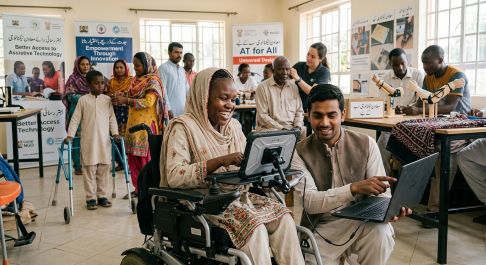
Assistive technology includes products such as wheelchairs, hearing aids, prosthetic limbs and other devices that help people with disabilities.
- The UN resolution has given Pakistan an opportunity to build on its international leadership by strengthening access to assistive technology at home. The challenge now is to ensure that the commitment reaches the people who need these devices most.
By: Amir Murtaza
Pakistan has secured an important development at the United Nations, with the General Assembly adopting by consensus the first-ever resolution specifically focused on access to assistive technology.
The resolution, titled “Access to Assistive Technology,” was adopted on September 2 during the 80th session of the UN General Assembly. It calls for greater international cooperation to make assistive products and services more affordable and accessible, particularly in developing countries.
Assistive technology includes products such as wheelchairs, hearing aids, prosthetic limbs and other devices that help people with disabilities, older people and others maintain independence and participate more fully in society. The World Health Organization estimates that more than 2.5 billion people worldwide need one or more assistive products, while access remains very limited in many poorer countries.
The resolution also recognizes that access to assistive technology is connected to wider issues such as education, employment, health, social protection and participation in community life. It encourages countries to improve national planning, procurement, financing, research and data, while ensuring that assistive technology is considered during humanitarian emergencies and disasters.
Pakistan’s initiative also has a personal dimension. The resolution was drafted and negotiated with the involvement of Counsellor Saima Saleem, Pakistan’s first visually impaired career diplomat and a user of assistive technology. Her participation brought direct experience of the challenges faced by people who depend on such devices in their daily lives.
The UN development comes at a time when Pakistan is also expanding efforts to improve access to assistive devices at home.
In Sindh, the Department of Empowerment of Persons with Disabilities (DEPD) has taken important steps to expand access to assistive devices, working with NGOs and other partner organizations to reach people who need wheelchairs, hearing aids, prosthetic limbs and other forms of support.
This approach is significant because it combines government resources with the local presence and community connections of partner organizations. Rather than relying only on government offices to reach people, the program enables organizations working within communities to help identify those in need and facilitate the delivery of devices.
The Sindh government’s continued investment in this area deserves recognition. By supporting a structured partnership with civil society organizations, DEPD has demonstrated how public resources can be translated into practical support for persons with disabilities, including people living in communities where access to government services can be more difficult.
The experience also offers a useful lesson for disability inclusion across Pakistan: when government commitment is combined with community-level outreach, support can reach people more directly and with greater dignity.
However, providing devices is only one part of the challenge. The cost of assistive products remains a major barrier, particularly for families who cannot afford to purchase them privately. WHO identifies high costs, limited availability, procurement difficulties and inadequate funding among the major barriers to access.
For Pakistan, the UN resolution therefore provides an opportunity to look beyond distribution programs and consider longer-term solutions. These could include stronger public financing, better procurement systems, support for local production, improved repair and maintenance services, and policies that make essential assistive products more affordable.
People working with persons with disabilities say the importance of these devices is often much greater than their physical value. A wheelchair, hearing aid or prosthetic limb can determine whether a person is able to attend school, reach a workplace, move independently or participate in community life.
As one practitioner from the Social Research and Development Organization (SRDO), involved in disability inclusion work in Sindh, observed, the real test will be whether the commitments made at the international level lead to easier and more affordable access for people at the local level. At the same time, the continued efforts of the Sindh Government to remove barriers faced by persons with disabilities and promote equal access to services are an important step towards building a more inclusive society where people with disabilities can participate with greater independence and dignity.
The UN resolution has given Pakistan an opportunity to build on its international leadership by strengthening access to assistive technology at home. The challenge now is to ensure that the commitment reaches the people who need these devices most.
Read: Children Belong in Families, Not Institutions
_____________
 Amir Murtaza is a social sector researcher. He can be reached at amirmurtaza1@hotmail.com.