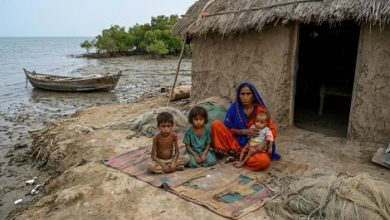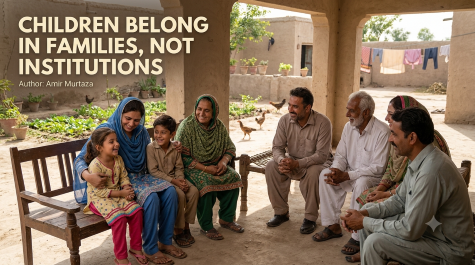
We need a child protection system that first asks what can be done to keep a child safely within their family.
- When that is not possible, we should look to grandparents, relatives, kinship care, foster care, and other family-based alternatives.
Amir Murtaza
I have spent a number of years working in child protection and social development in Pakistan. During this time, I have worked with various individuals and groups, including children, families, child care institutions, government departments, and organizations. Over the years, my understanding of children in alternative care has evolved. I have come to believe more strongly that the question is not simply how we can make orphanages better.
The bigger question is: why does a child need to live in an institution in the first place?
My recent conversations with people working on care reform internationally have also helped me think more deeply about this issue. Their experience with care reform in different countries and their focus on family-based care have reinforced something I have increasingly seen in Pakistan: children need families and communities, not simply food, shelter, and a bed in an institution.
This does not mean that every child can immediately return to his or her family. It means that we need to make every reasonable effort to understand the child’s situation and support the family before institutional care becomes the answer.
The Misconception of the “Orphan”
Pakistan has a number of child care institutions and orphanages. Many are established with good intentions and provide food, education, and shelter to children. Many people donate to them because they genuinely want to help children who they believe have no family support.
But the word “orphan” is often used too broadly.
A child may have lost one or both parents, but that does not necessarily mean the child needs to grow up in an institution. There may be a mother, father, grandparent, aunt, uncle, or another relative who could care for the child if the family received the right support.
Poverty is one of the primary reasons children become separated from their families. So are displacement, disability, family conflict, domestic violence, lack of access to education and health services, and the absence of community support. These pressures can make institutional care appear to be the easiest solution when, in fact, the family may simply need targeted assistance.
This is where Pakistan needs to change its thinking. Instead of asking, “Which orphanage can take this child?” we should first ask:
“What support does this child and family need to stay together safely?”
Family-Based Care as the Priority
I do not believe that every child living in an institution can simply be sent home. That would be irresponsible. Some children may not be able to return safely to their parents. Some may have no suitable family member available, and others may require temporary alternative care. In such situations, we need safe and appropriate family-based options, including kinship care and foster care.
Institutional care should be a last resort, not the first response.
A child needs more than food, clothing, and education. Children need attachment, strong relationships, individual attention, and a sense of belonging. Research and international experience have repeatedly raised concerns about the developmental, emotional, and social consequences of growing up in institutions.
This is why care reform is not simply about closing orphanages. It is about building a system that strengthens families and gives children safe alternatives when they cannot remain with their parents.
Understanding Children Currently in Care
There is another difficult question that we often avoid: What about the children who are already living in orphanages?
We cannot discuss care reform only in terms of preventing future institutionalization. We also need to understand the children who are already inside the system.
-My recent work has led me to look more closely at the individual circumstances of children living in institutional care. I have been trying to understand why each child entered care, what happened to the family, whether parents or relatives are still available, what the family’s circumstances are, and what support they might need.
The primary purpose is to understand:
What does the child want?
Is reunification safe and in the child’s best interests?
Could kinship care be possible?
Is another form of alternative care more appropriate?
Only after answering these questions can we begin to think about what should happen next.
Perhaps some children will eventually return to their families. Others may move to kinship care or another suitable family-based arrangement, while some may need to remain in alternative care. The number of children who return home should not be the only measure of success. The broader goal is to understand the system from within and learn what is possible in Pakistan.
Individual Care Plans and Aftercare
One issue that concerns me is the absence—or weak implementation—of individual care plans in many care settings. Every child has a different history, different needs, and different hopes for the future. A standardized institutional program cannot replace an individualized plan for each child.
Furthermore, an individual care plan should not end when a young person reaches the legal age of leaving care. It should gradually transition into an aftercare and independent living plan. Before a young person leaves care, we should already be preparing them in areas such as:
Education and vocational skills
Employment and financial inclusion
Housing and health
Emotional well-being and social support networks
Leaving an institution at 18 (or another legally defined age) does not automatically make a young person independent. If we expect young people to live self-sufficiently, we must prepare them for it.
My work with care leavers has made this clear. Young people leaving institutional care often face challenges that are invisible while they are inside the system. Once they leave, they may have no family home to return to, limited financial resources, weak social networks, and very little support in finding work or continuing their education.
The idea is simple: leaving care should not mean being left alone. Their voices must be part of care reform; we should not design systems for care leavers without listening to care leavers themselves.
Addressing the Root Causes and Reimagining Charity
If we want fewer children to enter institutions, we must address the reasons families struggle to care for their children in the first place. A poor family should not lose a child simply because it cannot afford school fees, food, medical treatment, or safe housing.
This requires stronger social protection and community-based services. Families may need financial assistance, counseling, disability support, education, health services, livelihood opportunities, or help during a crisis. Sometimes, a relatively small amount of timely support can prevent a family from reaching the point where institutional care feels like the only option.
This is where government, civil society, and the private sector must work together.
This may be the most difficult part of care reform in Pakistan. Many orphanages depend heavily on charitable donations. People donate because they genuinely want to help. However, we need to consider whether our charity is always producing the best long-term outcome for the child. If donations continuously encourage more children to enter institutions, we may unintentionally strengthen the very system we are trying to reform.
This does not mean that all institutions are bad or that the people running them have poor intentions—the majority of individuals in these settings care deeply about children. The issue lies within the system itself.
We need to gradually redirect resources and attention toward:
Family strengthening
Kinship and foster care
Community-based services
Aftercare programs
Charity should empower families to remain together wherever safe and possible, rather than making institutional care the easiest option.
Systemic Oversight and Local Context
Recent cases involving allegations of the illegal movement or adoption of children have served as a stark reminder of the risks created by weak systems and limited oversight. For instance, the case involving Sarim Burney attracted national attention and raised serious questions about child protection, adoption practices, and the handling of vulnerable children.
Whatever the final legal findings in individual cases may be, such situations compel us to examine the systems surrounding children separated from their families. Every child entering alternative care should have a clear record, an individual plan, regular reviews, and proper oversight. Institutions should not operate in isolation from the broader child protection framework. There must be clear accountability regarding:
Who the child is
Why the child entered care
Where the family is located
What efforts have been made to support the family?
What the future plan is for the child
However, Pakistan cannot simply copy another country’s model of care reform. Our social structures, extended family networks, levels of poverty, legal frameworks, religious and cultural values, government systems, and charitable traditions are unique. We must learn from international experience while developing contextualized solutions that work specifically for Pakistan.
Moving Forward: Practical Steps
Care reform requires trust. If institutions feel that reform simply means closing their doors, they may resist the conversation. We need to work alongside them and build a shared understanding that the goal is not to assign blame, but to improve the system surrounding vulnerable children.
While care reform sounds like a monumental task, we do not have to overhaul the entire system overnight. We can begin with practical steps:
Improve the intake processes for alternative care.
Strengthen family tracing and reunification support.
Develop and enforce individual care plans.
Invest in formalizing kinship and foster care options.
Expand community-based family support services.
Establish comprehensive aftercare plans for care leavers.
Include care leavers in policy discussions.
By understanding the situation on the ground, listening to children and families, and making small, practical changes, we can gradually influence the wider system.
Pakistan does not need more children growing up without families simply because their households are poor or unsupported. We need a child protection system that first asks what can be done to keep a child safely within their family. When that is not possible, we should look to grandparents, relatives, kinship care, foster care, and other family-based alternatives.
When a child has already experienced institutional care, our responsibility does not end when they leave. We must help young people build independent lives with dignity.
After more than two decades of working in child protection, I am convinced that care reform is not about one organization, one donor, or one government department. It requires a fundamental shift in how we view childhood, poverty, family support, and institutional care.
We should stop asking how many children our institutions can accommodate. We should start asking how many children we can help grow up safely in families.
That is the direction Pakistan needs to take.
Read: Fast-Track Community Safeguards for Kids
__________________
 Amir Murtaza is a social sector researcher. He can be reached at amirmurtaza1@hotmail.com.