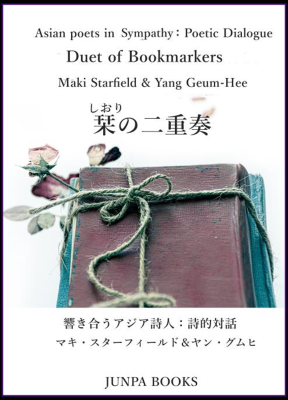
A Tribute to Maki Starfield and Yang Geum-Hee On the Publication of Duet of Bookmarks (栞の二重奏),
(A Japan–Korea Collaborative Poetry Collection by Poets Maki Starfield and Yang Geum-Hee)
By Im Sol Nae
A Tribute to Poet Maki Starfield
There are poets whose greetings arrive before they do—like the first light of a distant star.

When I first encountered the poetry of Maki Starfield, I could not escape the impression that she was not a poet who merely wrote within the grammar of the earthly world, but one who translated the grammar of the cosmos into human language. If the seventeen syllables of a haiku are a single drop of dew, then the brief breath of a three-line poem is like the Milky Way momentarily reflected within that drop. To contain such vast dimensions of time and space within so concise a form is never merely a matter of technique. It is the density of being itself, the weight of silence attained through long contemplation.
As I returned to her representative poem, Oneness, I found myself closing the book again and again. The line, “I am you, and you are also me,” is less a declaration than a quiet affirmation. Without argument or persuasion, she calls to us from a place that only those who have walked a long road can ever reach. Her voice belongs neither to lyricism nor to abstraction. Rather, I would call it “meditation expressed through poetry.” Meditation closes the eyes, yet her poems allow us to behold the world more clearly with our eyes closed than with them open.
Her poem Inspiration is especially remarkable for the way it restores a sensibility that literature seemed to have forgotten long ago. Poetry was once, in the truest sense of the word inspiration, the place where the spirit gently passed through human consciousness. Yet as modern poetry gradually surrendered that sacred space to knowledge and irony, such moments of visitation became increasingly rare. Maki Starfield fearlessly summons this lost sensibility back to life. Her language possesses the courage to speak of the sacred without embarrassment. Perhaps this courage is precisely the virtue contemporary poetry most urgently needs to recover.
I lingered just as long over her poem Here Is a Country Without War. This is not a painting of an unattainable utopia but a map leading us toward the country that already exists within ourselves. The poet does not search for peace in the outside world. Instead, she understands peace as a state of being and quietly places signposts along the path that leads toward it. It is not the peace proclaimed by politicians but the peace whispered by a poet. And I believe that such whispers endure far longer than any loud proclamation.
 Her journey as both painter and bridge-builder in international literary exchange is inseparable from her poetry. Beginning with her award at an Italian haiku competition in 2008, the sequence of works—including Duet of Dots, Trio of Crystals, and Duet of Islands—is far from an accidental series. Rather, it is the steady expression of her conviction that poetry is not something completed in solitude but something fulfilled through dialogue and mutual response. Her achievements—including the Guido Gozzano Prize, the JUNPA New Poet Award, and the Creative Award of the Naji Naaman Literary Prize—as well as her editorial work for Poetic Bridge: Ama-Hashi and JUNPA BOOKS, all testify that another name for Maki Starfield is “a builder of bridges.”
This new volume, Duet of Bookmarks (栞の二重奏), is itself a bookmark placed upon that bridge.
A bookmark is not merely an object that marks the page where we stopped reading. It is a quiet promise that one day we shall return to that very place. The duet created by Maki Starfield and Yang Geum-hee resembles two poets placing each other’s names between the pages of their books like cherished bookmarks. Though separated by language, by the sea, and by the different rhythms of their lives, they have each reserved a place within their poetry where the other may always return.
I believe this collection will add a small yet inextinguishable star to our divided world.
May the poetry of Maki Starfield continue to illuminate the dawns of countless readers beyond every border and every language. Each night we read her poems, we reconcile ourselves—little by little, almost imperceptibly—with the universe itself.
A Tribute to Poet Yang Geum-Hee

Those who know the winds of Jeju understand them well. They are never violent, yet they never retreat. Whenever I read the poetry of Yang Geum-Hee, I feel as though I am standing before those winds. There are no thunderous words, no raised voice. Yet if one remains there long enough, something within is quietly washed clean. This, in the end, is what true poetry does: without fanfare, it gently transforms us into different human beings.
The title of her poetry collection, The Wind and Water Do Not Fight, is itself already a proverb. Wind and water—two ever-flowing forces—do not collide but simply pass through one another. Because they do not contend, they are not wounded; because they are not wounded, they endure. I believe that within this simple phrase lies the essential sentence of Yang Geum-Hee’s poetics. She responds to the world not with the language of struggle, but with the language of flow. Yet this flow is by no means submission. It is the oldest and most enduring form of resistance, and she understands this truth more profoundly than anyone.
In “The Light That Illuminates the World,” the light she contemplates is not an abstract or philosophical light. It is “the light that has barely survived,” visible only to those who have lived through dark times. Because it is not dazzling, it is all the more trustworthy. The hope of which she speaks is not a cheap consolation, but the warmth that slowly seeps forth only after long and patient healing along the grain of old wounds. Thus, when her light touches the back of the reader’s hand, it does not sting—it comforts.
In “Prayer for Peace,” her language finally moves beyond the language of politics into the language of prayer. What, then, is peace? She does not seek it in treaties or declarations. Instead, she begins with the quiet work of mastering the hatred that resides within one’s own heart. It is precisely this inward turn that forms the most precious foundation of Yang Geum-Hee’s literary world. To redirect the gaze that has long been fixed outward back toward the inner self—this is the gentle awakening her poetry offers to contemporary Korean literature.
As both poet and cultural leader, the path she has walked is itself a prose poem. Since making her literary debut through the monthly literary journal Simunhak (Poetry Literature), she has served as the second President of the Korean Association of World Literature, Vice President for Culture and the Arts at the Korean Institute for Peace and Cooperation, President of Jeju PEN, and Chair of the Jeju Branch of the Korean Poetry Literature Writers Association. Through these roles, she has demonstrated that literature is not completed within the solitude of a study, but in the living space between people.
Her service as a Distinguished Scholar of the International Academy of Ethics and her receipt of an Honorary Doctorate from the International Forum for Creativity and Humanity (IFCH), Kingdom of Morocco, further testify to the depth with which she has reflected upon the meeting point of literature, ethics, and peace.
Through her poetry collections Happiness Account, Ieodo, Nests of Birds, and her essay collection Happy Companion, her voice has already reached readers in more than twenty linguistic and cultural spheres, including those of the United States, China, Russia, Greece, Italy, and Taiwan. This is not merely the achievement of translation; it is evidence of the universality and enduring vitality of her poetry. How can words drawn from the profoundly local landscape of Jeju travel so far across the world? The answer lies, perhaps, in the simple fact that she has always remained deeply faithful to the smallest lives and the nearest realities.
This collaborative volume, Duet of Bookmarks (栞の二重奏), is a meaningful harmony born from the meeting of Yang Geum-Hee’s lifelong meditation on humanity, nature, and peace with Maki Starfield’s cosmic imagination. If one sings in the language of the stars, the other responds in the language of the wind. If one points toward the heavens, the other digs a well deep enough to hold the sky. Different registers ultimately converge into a single harmony. That, to me, is the true meaning of this duet.
May Yang Geum-Hee’s poetry continue to share with the world the wisdom of a life that, like the winds and waters of Jeju, does not quarrel. May her language of prayer for peace continue to resonate for many years to come.
Read: The Poetic Light Between Two Poets
__________________
 Poet Ms. Im Sol Nae is the 6th President, Korean Association of World Literature and World Ambassador, International Academy of Ethics. She has continued her active literary career since making her debut through the monthly literary magazine JayuMunhak in 1999. She has published six collections of poetry, including The QR Code of a Leaf, Amazon, That Transit Station, The Cry of an Awakened Amazon, Hong Nyeo, and many others. In addition to her literary achievements, she has gained wide recognition as a professional poetry reciter at numerous national events organized by the Ministry of the Interior and Safety. Her major appearances include Memorial Day commemorations, Righteous Army Day (June 1), the opening poetry recital for the Seoul City Hall Stream Project at the Grand Theater of the Sejong Center for the Performing Arts, the annual commemorative ceremony at Injeongjeon Hall of Changdeokgung Palace hosted by the Korean Imperial Household Culture Foundation, and the 120th memorial ceremony for Empress Myeongseong held at her birthplace. She also founded the Korean Federation of Poetry Recitation Associations to broaden the cultural foundation of poetry recitation in Korea.
In 2011, she traveled for twenty-five days along the Tea Horse Road with avant-garde artists from around the world, drawing profound artistic inspiration from the journey. Poems inspired by this experience were later transformed into various musical genres, including jazz, traditional Korean vocal music, classical singing, and Korean art songs, and were presented through the Tea Horse Road Concert.
Her literary and artistic accomplishments have been recognized through numerous honors, including the Yeongnang Literary Award, the Korean Literary Critics Association Award, the Lyric Poetry Literary Award, the 22nd Poet’s Poet Award, selection as a Sejong Excellent Book in 2014, and the 8th Buddhist Literary Writers’ Award.
Poet Im Sol Nae is regarded as one of the leading artistic poets in contemporary Korea, expanding the boundaries of modern Korean poetry through her innovative fusion of poetry, recitation, music, and performance art. She served as the 6th President of the Korean Association of World Literature and currently works as a World Ambassador of the International Academy of Ethics.
Her representative works, including “Metamorphosis (羽化),” “Blue Butterfly,” “Becoming Godmother of Victoria,” “The Fireflies’ Shawshank Redemption,” “Three Souls,” “The Scarlet Light Universe” and “Sumbi Sori (Breath of the woman Diver)” have been translated and introduced in many countries around the world, including the United States, Spain, Italy, Greece, Russia, India, Nepal, Albania, Vietnam, Kyrgyzstan, and Jordan.