A New Opportunity Must Begin With Community Rights and Development
When Land Gives Resources, People Deserve Prosperity
By: Ramesh Raja
A Historic Discovery Near Gambat, Khairpur
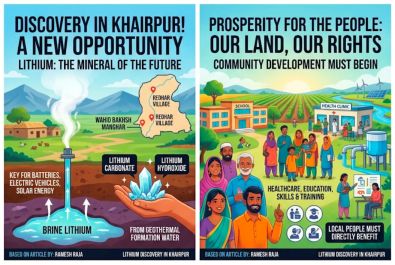
A significant development has emerged from District Khairpur, Sindh, where the presence of lithium has been reported in underground geothermal formation water near Wahid Bakhsh Manghar village, close to Redhar Village in Taluka Kingri, approximately 7 km from Gambat. This news has created excitement because lithium is considered one of the most important minerals for the future of modern technology.
Lithium is a key material used in batteries for electric vehicles, mobile phones, laptops, solar energy storage systems, and many other advanced technologies. Around the world, countries are investing heavily in lithium exploration and processing because the demand for clean energy and electric transport is increasing rapidly.
However, this discovery is still at the exploration and evaluation stage. More scientific studies, resource assessment, pilot extraction, and economic feasibility analysis are required before commercial production can begin.
What is Lithium and Why is it Important?
Lithium is a special mineral that is very light in weight but has a very high ability to store energy. Due to this unique quality, it has become known as a “mineral of the future.”
The modern world is moving towards electric vehicles and renewable energy. Electric cars need powerful batteries, and lithium is one of the main ingredients of these batteries. Solar and wind energy systems also require large batteries to store electricity for use when sunlight or wind is not available.
Because of these uses, lithium has become a strategic resource like oil and gas were in the past.
How Lithium is Found in Nature
Lithium is generally found in two main forms.
The first is hard-rock lithium, where lithium exists inside special rocks called pegmatites. These rocks are usually found in mountainous and hilly areas. Countries such as Australia and China produce lithium from these types of rocks.
The second form is brine lithium, where lithium is dissolved in underground salty water. In countries like Chile and Argentina, lithium is extracted from underground brine deposits.
The reported Khairpur discovery belongs to the second category. It is not a mountain rock mine. Instead, lithium is associated with deep underground formation water that can be processed to recover lithium.
The Khairpur Location and Geological Importance
The reported lithium-bearing area is located around Wahid Bakhsh Manghar near Redhar Village, Taluka Kingri, District Khairpur. The area lies in the fertile plains of Sindh near Gambat and is known for agriculture and rural communities.
Unlike lithium deposits found in mountains, this discovery is linked with deep geological formations beneath the ground. Khairpur already has a history of oil and gas exploration, where deep wells have been drilled to study underground formations. Such geological knowledge can help in understanding the possibility of extracting lithium from underground water.
From Underground Water to Battery Material
Finding lithium in underground water does not mean the lithium is ready for use. A long scientific process is required.
First, underground water containing lithium is brought to the surface through wells. The water is then tested in laboratories to measure the amount of lithium and other minerals present.
After that, special extraction technology is used to separate lithium from other salts and impurities. The final products are usually:
* Lithium Carbonate (Li₂CO₃), which is widely used in lithium batteries.
* Lithium Hydroxide (LiOH·H₂O), which is used for high-performance electric vehicle batteries.
Only high-purity lithium products have significant commercial value.
 Global Lithium Production and Market Value
At present, Australia is the largest producer of lithium from hard-rock mines. Chile and Argentina are major producers from brine resources, while China is the largest user and one of the biggest processors of lithium materials.
The price of lithium changes according to global supply and demand. Battery-grade lithium carbonate and lithium hydroxide are valuable products and can generally trade in the range of thousands of dollars per ton. The real economic benefit comes not only from finding lithium but from developing the ability to process it into high-quality battery materials.
Environmental Responsibility
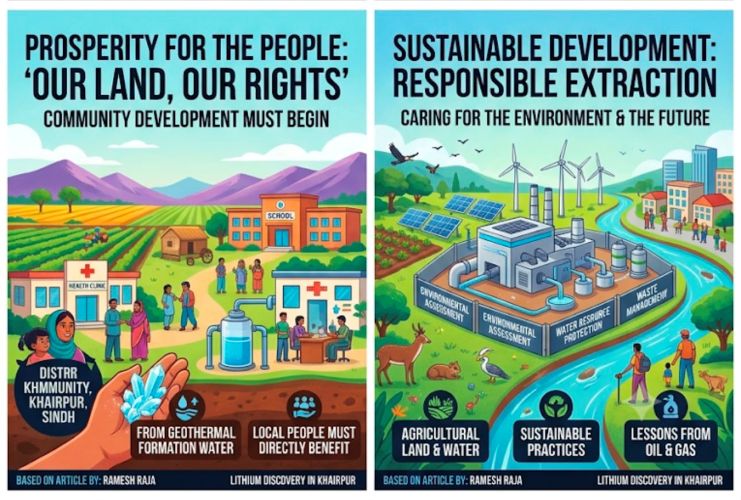
Every natural resource development project has environmental responsibilities. Lithium extraction must be carried out carefully to protect people and nature.
For a project like Khairpur, important environmental issues include:
* Protection of underground water resources
* Safe management of chemical waste
* Protection of agricultural land
* Regular environmental monitoring
* Sustainable use of natural resources
A detailed Environmental Impact Assessment should be completed before large-scale production. Development should not damage the environment that supports local communities.
The Rights and Welfare of Local Communities
The people living around Wahid Bakhsh Manghar, Redhar, Gambat, and Kingri have a direct connection with this land. They have lived there for generations and are the first communities connected with this natural resource.
International best practices show that communities affected by natural resource projects should receive benefits through:
* Better education facilities
* Scholarships for local students
* Health centers and medical services
* Clean drinking water schemes
* Skill development programs
* Employment opportunities
* Community infrastructure projects
Although mineral resources are generally owned by the state under national laws, responsible development requires that local people should not be ignored. They should become partners in progress.
Lessons from Oil and Gas Development in Sindh
Sindh has been a major producer of oil and natural gas for many years. However, many communities in producing areas have expressed concerns that resource extraction has not always brought enough visible improvement in their lives.
People have raised issues regarding:
* Lack of quality schools
* Limited healthcare facilities
* Poor infrastructure
* Water shortages
* Insufficient employment opportunities
The lithium discovery provides an opportunity to learn from past experiences. A new approach should be adopted where local communities receive direct and meaningful benefits from the resource found in their area.
A Model for Future Development
If lithium extraction in Khairpur proves commercially successful, it should become a model project for Pakistan. A dedicated community development program can ensure that the surrounding villages benefit through education, healthcare, employment, and infrastructure.
A transparent mechanism involving government authorities, technical experts, project companies, and local representatives can help ensure fair development.
Conclusion: A Resource Should Bring Prosperity
The reported lithium discovery in Khairpur is a promising opportunity for Sindh and Pakistan. Lithium can support the future of electric vehicles, renewable energy, and modern industries.
But the success of this discovery should not only be measured by tons of lithium produced or financial income generated. Its true success will be measured by whether it improves the lives of the people living around the resource area.
The people of Khairpur should see this discovery as a hope for better education, better healthcare, better employment, and a brighter future.
A natural resource becomes truly valuable when it brings prosperity not only to the nation but also to the communities whose land and environment are connected with it.
Read: From the Bypass to the Blueways
_____________________
 Engr. Ramesh Raja is a civil engineer and managerial/ planning professional who also contributes as a freelance writer on technical matters. He may be reached at engineer.raja@gmail.com