Shrinkflation: When the Packet Gets Smaller but the Consumer Pays More
OPEN YOUR EYES: YOU’RE PAYING MORE FOR LESS – LESS IN THE PACKET, MORE FROM YOUR POCKET
By Ramesh Raja
Inflation has become an unavoidable reality of everyday life in Pakistan. The prices of food, electricity, fuel, transport, medicines, education and household necessities have risen so frequently that consumers have almost become accustomed to checking prices before purchasing even the most ordinary items. Yet there is another, quieter form of inflation that often escapes public attention. It does not necessarily appear on the price tag and may not be immediately visible to the consumer. The packet remains familiar, the brand remains the same and sometimes even the price remains unchanged, but the quantity inside has quietly become smaller. This phenomenon is known as shrinkflation.
The Hidden Face of Inflation
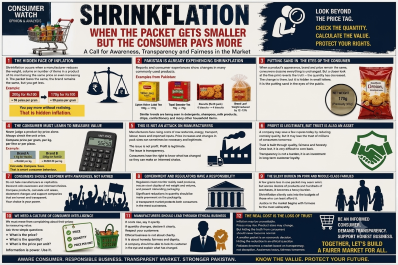
Shrinkflation occurs when a manufacturer reduces the weight, volume or number of items in a product while maintaining the same price or, in some cases, increasing the price as well. Unlike conventional inflation, where the consumer immediately sees a higher price, shrinkflation can remain hidden behind familiar packaging and familiar prices. A product that once contained 200 grams and cost Rs100 may be reduced to 170 grams while continuing to sell for Rs100. The consumer may therefore believe that the price has remained stable, but in reality the cost per gram has increased from 50 paisa to approximately 59 paisa, representing a substantial rise in the effective price. The consumer is consequently paying more without necessarily realising it. When such reductions occur across tea, biscuits, bread, detergents, toiletries, snacks and other frequently purchased goods, the cumulative impact can become significant for household budgets. Shrinkflation is therefore not simply about a few grams disappearing from a packet; it represents a less visible erosion of purchasing power.
Pakistan Is Already Experiencing Shrinkflation
The issue is not merely theoretical in Pakistan. Reports have documented changes in the quantities of several commonly consumed products. Branded tea, for example, has been reported in reduced pack sizes, including changes such as 190 grams to 170 grams and 95 grams to 70 grams, in some cases accompanied by price increases. Consumers have also raised concerns about biscuit packets containing fewer pieces than previously, while retaining familiar retail price points. Similar changes have been reported or discussed in relation to bread, detergents, shampoos, milk products, confectionery, chips and other fast-moving consumer goods. Such changes must, however, be examined carefully because a reduction in pack size is not automatically evidence of unethical conduct. Manufacturers face genuine increases in raw-material, energy, transportation, labour, packaging and taxation costs, and changing the size of a product can sometimes be a legitimate business response. The real question is whether consumers are being given clear and sufficient information about the change so that they can make an informed purchasing decision.
Putting Sand in the Eyes of the Consumer
There is a familiar expression in our society for deliberately making something difficult to notice: putting sand in someone’s eyes. Shrinkflation can create precisely this impression when a product’s appearance remains almost unchanged while its contents are quietly reduced. The colours, logo, shape, branding and general appearance of the packet remain familiar, so consumers naturally assume that the product itself remains essentially the same. Yet a closer examination of the small print may reveal that the quantity has declined. A packet that once contained 200 grams may now contain 170 grams; a biscuit packet may contain fewer pieces; a loaf may weigh less; or a bottle may hold a smaller volume. The consumer may continue buying the product based on familiarity and brand loyalty without realizing that the value received has changed. This is where ethical business practice becomes important. A manufacturer has the legitimate right to change the quantity or packaging of a product, but the consumer has an equally legitimate right to know clearly what has changed. Transparency should not require the consumer to become a detective.
The Consumer Must Learn to Measure Value
The Pakistani consumer now needs to look beyond the price printed on the packet and develop the habit of measuring actual value. The important question should not simply be how much a packet costs, but how much the consumer is paying for each gram, kilogram, litre or individual piece. A product priced at Rs500 for one kilogram is not necessarily more expensive than another priced at Rs450 for 800 grams. When calculated on a kilogram basis, the second product actually costs Rs562.50 per kilogram. Such simple calculations can expose differences that remain invisible when consumers compare only the prices of packets. Net weight, volume and unit price therefore deserve much greater attention in everyday shopping. Retailers and supermarkets can also contribute by displaying unit prices clearly, while consumers can protect themselves by comparing quantities as carefully as they compare prices. In an inflationary economy, understanding value is becoming as important as understanding price.
This Is Not an Attack on Manufacturers
A responsible discussion of shrinkflation should not become an indiscriminate attack on manufacturers, entrepreneurs, businessmen or capitalism. Businesses operate under difficult economic conditions and face rising costs of raw materials, electricity, fuel, wages, transportation, taxation and imported inputs. Currency depreciation can further increase production costs, particularly for industries dependent on imported materials and machinery. No business can indefinitely sell its products below the cost of production, and legitimate price adjustments are therefore an unavoidable part of economic activity. Manufacturers also provide employment, generate investment, pay taxes and contribute to economic growth. The issue is not whether manufacturers should make profits. They should. The real question is whether those profits are being achieved through efficient and innovative production or through practices that make it unnecessarily difficult for consumers to understand what they are buying. Capitalism depends upon competition, and meaningful competition requires informed consumers. A market functions more fairly when buyers have enough information to compare products, prices and quantities.

Profit Is Legitimate, But Trust Is Also an Asset
There is nothing inherently wrong with profit. A healthy economy needs profitable businesses capable of investing, employing people, developing new products and surviving difficult economic conditions. But profit is not the only asset a company possesses. Trust is equally important, although it does not appear on a balance sheet in the same way as cash or machinery. A customer who trusts a brand may continue purchasing its products for years because of perceived quality, consistency and fairness. If that customer repeatedly discovers that the quantity of a familiar product has been reduced while the packaging and price remain deceptively familiar, confidence gradually begins to disappear. Once consumers start believing that a company is constantly finding ways to give them less while charging them more, even legitimate future price increases may be viewed with suspicion. Responsible manufacturers should therefore understand that transparency is not a burden imposed upon business; it is an investment in long-term consumer confidence. A company may save a few rupees today through an obscure packaging strategy, but losing the trust of millions of consumers can cost far more in the long run.
Consumers Should Respond With Awareness, Not Hatred
The public has every right to question practices that appear unfair or misleading, but consumer frustration should not turn into hatred against manufacturers, businessmen or capitalism as a whole. Such a response would obscure the actual problem and create unnecessary hostility. The stronger response is informed consumer pressure. Consumers can compare competing products, calculate unit prices, examine changes in net weight, choose alternatives and report genuinely misleading practices to the relevant authorities. Social media can also be used constructively by documenting changes in product weight and price and presenting verifiable comparisons rather than spreading emotional accusations or unconfirmed claims. A photograph showing an old packet beside a new packet, together with the respective quantities and prices, can often communicate more effectively than an angry allegation. When consumers become knowledgeable and organised, companies receive a clear signal from the market. Consumer choice is one of the most powerful mechanisms within a competitive economy, and manufacturers that consistently provide better value and greater transparency can ultimately benefit from that informed market.
Government and Regulators Have a Responsibility
Consumer awareness alone cannot address the problem. Government departments and regulatory authorities also have an important responsibility to ensure that consumers receive accurate information. Pakistan needs stronger and more visible consumer-protection mechanisms capable of monitoring widely used products and identifying practices that may mislead buyers. Net weight and volume should be displayed clearly and prominently on packaging rather than being buried among other information. Where there is a significant reduction in quantity, regulators should examine whether the change is being communicated adequately and whether the overall presentation could create a misleading impression of continuity. The objective should not be to prevent businesses from changing product sizes or responding to economic pressures. Rather, regulation should ensure that consumers are not deprived of the information necessary to make an informed choice. Effective consumer protection ultimately benefits both sides of the market because it protects consumers from unfair practices while encouraging honest manufacturers to compete through quality, efficiency and value.
The Silent Burden on Poor and Middle-Class Families
Shrinkflation becomes particularly serious when viewed from the perspective of ordinary Pakistani households. A reduction of 20 or 30 grams may appear insignificant when considered as a single transaction, but the situation changes when the same pattern is repeated across dozens of products and hundreds of purchases. Low-income and middle-class families already have to allocate limited incomes among food, electricity, transport, education, healthcare and other necessities. When the quantity of regularly consumed products gradually declines, families may not immediately recognise that their purchasing power is being eroded. A slightly smaller packet of tea, fewer biscuits in a pack, a lighter loaf of bread, a smaller detergent pack or a reduced volume of shampoo may each appear trivial in isolation. Together, however, such reductions can represent a significant additional cost over a month or a year. This silent burden deserves greater attention because it affects precisely those households that have the least flexibility in their budgets.
We Need a Culture of Consumer Intelligence
Pakistan needs to develop a stronger culture of consumer intelligence rather than remaining limited to general complaints about rising prices. Consumers should learn to ask not only what a product costs but also how much product they are receiving for that money. The three basic questions should be simple: what is the price, what is the quantity and what is the price per unit? Schools, universities, newspapers, consumer organisations and civil-society groups can play an important role in developing this awareness. Newspapers could periodically publish comparisons showing how the weights and prices of commonly used products have changed over time. Digital applications and social-media platforms could also be used to record and compare product prices and quantities. Such information would turn ordinary consumer complaints into documented evidence. Evidence is much more powerful than anger because it enables consumers, regulators and manufacturers to understand exactly what is happening in the marketplace.
Manufacturers Should Lead Through Ethical Business
Manufacturers themselves can play the most important role in ensuring that shrinkflation does not become a source of consumer distrust. If production costs rise significantly, companies should be prepared to explain the situation honestly. If a product has changed from 200 grams to 170 grams, the consumer should not have to discover the difference accidentally after purchasing it. Clear communication can make an enormous difference. A manufacturer that openly tells its customers that production costs have increased and that the company has therefore changed the quantity and price may face criticism, but it demonstrates respect for its consumers. Customers may not welcome the increase, but they can understand the economic reasoning behind it. Ethical business is not about preventing companies from earning profits. It is about ensuring that the pursuit of profit remains compatible with honesty, fairness and consumer dignity. A responsible company should be able to explain its commercial decisions openly rather than relying on consumers not noticing them.
The Real Cost Is the Loss of Trust
Ultimately, shrinkflation raises a much larger question than the weight of a packet or the price of a box of biscuits. It raises the question of what kind of market economy Pakistan wants to build. A healthy market should encourage companies to compete through quality, innovation, efficiency, service and genuine value. Consumers should be able to make purchasing decisions based on reliable information, while manufacturers should be able to earn legitimate profits without resorting to practices that obscure important changes in their products. Inflation may sometimes be unavoidable, production costs may rise and product sizes may have to change, but consumer ignorance should never become a business strategy. The packet can become smaller and the price can become higher, but the manufacturer’s responsibility to inform the consumer must remain unchanged. The public does not need to hate manufacturers or reject capitalism; it needs to become aware, informed and demanding of transparency. When consumers understand what they are paying for, businesses are encouraged to compete on genuine value. When manufacturers respect their consumers, profitability and ethics do not have to stand on opposite sides.
A smaller packet is an economic decision. Hiding the reduction from the consumer is an ethical question. Pakistan must ensure that the first remains a legitimate business choice without allowing the second to become a normal business practice.
Read: Lithium Discovery in Khairpur Sindh
______________________
 Engr. Ramesh Raja is a civil engineer and managerial/ planning professional who also contributes as a freelance writer on technical matters. He may be reached at engineer.raja@gmail.com