A September journey from Stockholm to Mariefred, Gripsholms Castle and Nyckelviken with Inayat Ali Abbasi, a friend from Sindh
By Abdullah Usman Morai | Sweden
There is always a special kind of happiness in meeting someone who has travelled from Pakistan to Sweden, particularly when that person comes from Sindh. Perhaps it is because, even after living abroad for many years, certain words, accents, memories and ways of looking at the world immediately create a familiar connection. A stranger can become an old acquaintance within minutes when a shared place appears somewhere in the background.
September 2026 brought one such meeting when Inayat Ali Abbasi visited Europe. His journey included several countries, including Italy and Denmark, and during his stay in Sweden we had already had a few opportunities for conversation, informal meet-ups, and kacheri. But there was still something missing: a proper day outside Stockholm.
So we decided to spend a day visiting Gripsholms Castle in Mariefred, followed later by Nyckelviken in Nacka.
It turned out to be much more than simply visiting two places.
It became a day of roads, Swedish countryside, history, water, wildlife, travel stories, photography and, eventually, a good desi dinner.
A Traveller from Sindh
I picked up Inayat from Dalagatan Hostel in Stockholm. The September weather was almost perfect for a road trip. It was neither too cold nor too warm, and there was no rain to disturb our plans. The kind of weather that makes you want to stay outside a little longer.
One thing I quickly appreciated about Inayat was that he was a seasoned traveller.
Some people travel frequently but remain dependent on others for every small arrangement. Inayat was different. He knew how to search for accommodation, how to book transport, what to look for when visiting a new place and, perhaps most importantly, how to enjoy travelling without becoming overly rigid about plans.
He had travelled through different parts of Europe, including Italy and Denmark, and had developed the confidence that comes from navigating foreign countries independently.
Our conversations naturally moved beyond sightseeing.
We talked about travelling, Europe, life abroad, people, cultures, and the ways in which living in foreign lands changes one’s understanding of life. I found his thinking broad and flexible. He was also very accommodating about timing, which made the day easier to arrange.
That flexibility matters when two travellers are exploring together.
A journey becomes enjoyable when there is no constant argument about what time to leave, how long to stay somewhere, or whether an unexpected stop is worth making. We simply started driving.
 Stockholm to Mariefred
From Stockholm, the road gradually carried us away from the urban landscape.
The beauty of travelling by car in Sweden is that the journey itself becomes part of the destination. You don’t simply move from one tourist attraction to another. You watch the landscape changing outside the window.
Buildings have become fewer. The countryside is open. Trees dominate the horizon. Small settlements appear and disappear.
There are fields, forests, lakes and quiet roads where traffic seems almost secondary to the surrounding landscape.
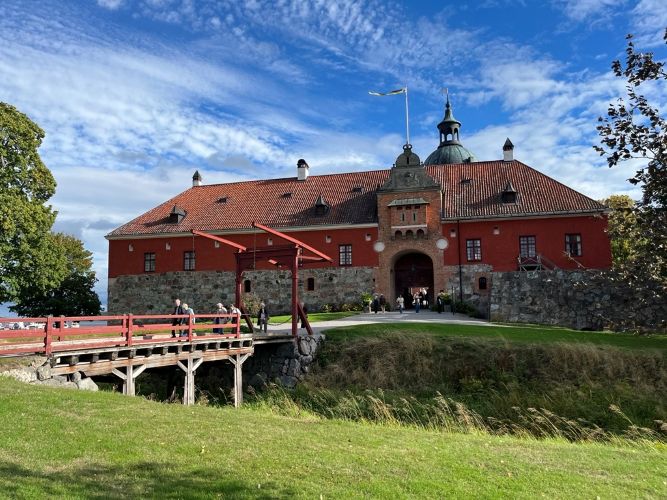
After a little more than an hour, we arrived in Mariefred, a picturesque small town in Södermanland, on the shores of Lake Mälaren. And there it was, the reason I had wanted to bring Inayat here.
Gripsholms Castle: A Royal Landmark beside the Lake
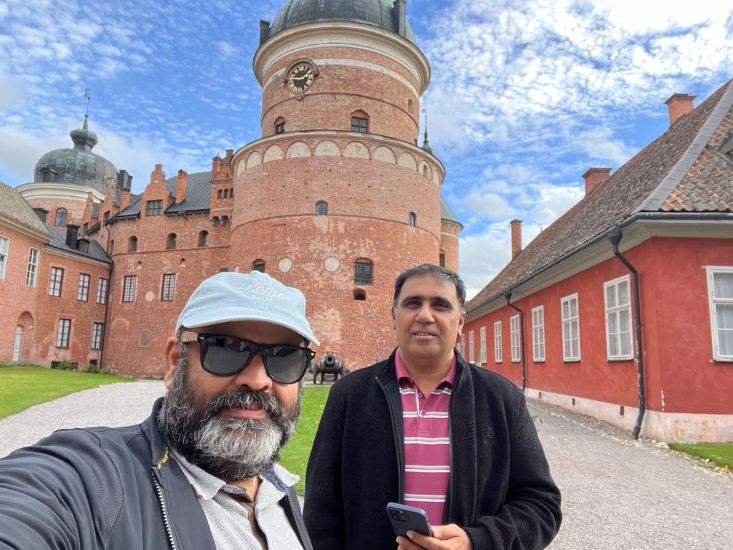
Gripsholms Castle is one of Sweden’s best-known historic castles. Its origins go back to the late medieval period, while the present castle is strongly associated with King Gustav Vasa, who began rebuilding the fortress in the 1530s.
From a distance, the castle looks almost like something from a historical painting.
Its red-brick walls, rounded towers, and position beside Lake Mälaren create an impressive combination of architecture and nature.
But before we even reached the castle, another sight caught our attention beside the road entering Mariefred.
Around fifteen to twenty wild deer were grazing at a distance. They were completely absorbed in their own world, calmly eating grass.
It was one of those small moments that makes a trip memorable. There were no tickets, no guide, and no special attraction involved. Just deer grazing peacefully in the Swedish countryside.
Coming from a part of the world where encounters with wildlife can carry a very different meaning, I always find such scenes fascinating. Here, nature often seems to exist alongside everyday life.
Crossing the Little Bridge
To reach the castle, we crossed a small bridge over a stream. The setting was peaceful, almost theatrical.
The water moved quietly underneath us while the castle stood ahead, its brick walls reflecting centuries of Swedish history.
The use of brick gives Gripsholms Castle a distinctive character. It doesn’t have the pale stone appearance associated with some European castles. Its red and earthy tones feel closely connected with the Nordic landscape around it.
We walked around the castle first, taking in its exterior from different angles. Then we went inside.
Walking Through History
Inside Gripsholms Castle, the atmosphere changes.
Outside, you see the castle as a magnificent building. Inside, you begin to understand that it was also a place of power, residence, politics, and royal life.
The rooms contain historic interiors, furniture, paintings and portraits. The castle is also famous for its extensive portrait collection, including representations of Swedish kings, queens and other important figures.
As we walked from room to room, history stopped feeling like something confined to textbooks.
 It was hanging on walls. It was sitting in furniture. It was visible in the architecture and decoration. It was in the portraits of people who had lived centuries before us.
There are also photographs and representations connected with Sweden’s Royal Family, providing a link between the country’s historical monarchy and its modern royal tradition.
For a visitor, this creates an interesting experience: one moment you are looking at medieval and Renaissance history, and the next you are reminded that Sweden still has a royal family today.
We wandered through the rooms without rushing. Perhaps that is one of the best ways to visit a historic place.
Instead of trying to remember every date, you allow the building to speak for itself.
There is also a gift shop inside, where visitors can buy souvenirs and small reminders of the castle. Naturally, we looked around there too.
Mariefred and Lake Mälaren
But for me, Gripsholms Castle is never only about the castle. Its real charm comes from the entire setting.
The castle stands beside Lake Mälaren, and the lake transforms the surroundings into a landscape where architecture and nature seem to have been designed together.
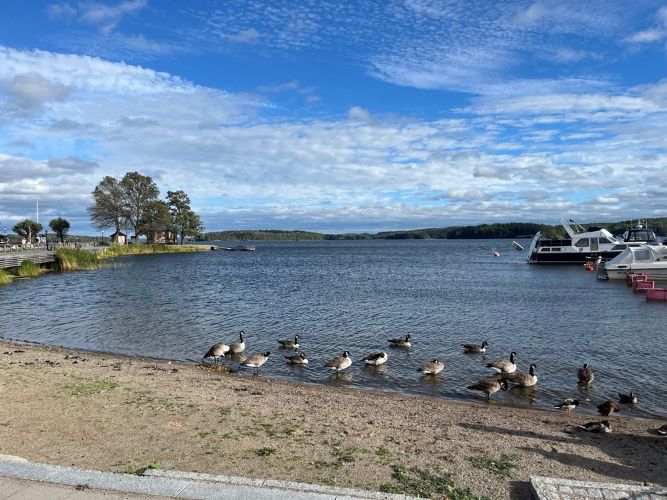
From the waterfront, we could see parts of Mariefred, including the church tower rising in the distance. Boats moved across the water. Ducks floated nearby. The castle stood behind us. And the lake stretched quietly before us.
There was even a wooden platform extending a little into the water, giving visitors a chance to stand closer to the lake and enjoy the view.
At one point, we noticed a newly married couple with their family. They were having a photography session beside the lake.
It seemed like the perfect setting for wedding photographs.
A historic castle. A peaceful lake. Greenery. Boats. The small town in the background. And the open Swedish sky above. We watched them for a while and continued our walk.
Then I noticed one of the smallest details in the entire landscape. Leaves were floating on the surface of the water.
Some appeared to be water-lily leaves, or perhaps lotus-like aquatic vegetation. I am not entirely sure of the exact species, but their presence added something special to the scene.
Sometimes it is not the grand monument that stays in your memory. Sometimes it is a few leaves floating quietly on water.
 Flowers, Greenhouses and Butterflies
Near the castle, there is also a greenhouse area where flowers are grown and displayed. We walked through the area and enjoyed the flowers. And then came another pleasant surprise. Butterflies.
They seemed to appear almost suddenly, moving among the flowers and adding another layer of life to the surroundings.
It was one of those places where you could easily spend much longer than expected. The day was moving slowly, but not because we were doing nothing.
We were doing what travelling is supposed to allow us to do: observing.
A Father Teaching His Daughter to Fish
Later, we continued walking beside the water. There we saw another simple but beautiful scene. A father was teaching his daughter how to fish.
He was guiding her, encouraging her, and showing her what to do. The little girl appeared to be learning with concentration and excitement.
I found the scene strangely touching. Travel often teaches us to notice things that we might otherwise overlook.
A castle tells us about kings and history. A lake tells us about geography and nature.
But a father teaching his daughter to fish tells us something much more universal: how knowledge, patience and affection are passed from one generation to another.
We continued our walk, and before leaving Mariefred, we treated ourselves to ice cream.
A castle visit followed by ice cream beside a Swedish lake seemed like a perfectly reasonable combination.
Then it was time to return towards Stockholm. But the day wasn’t over.
 From Mariefred to Nyckelviken
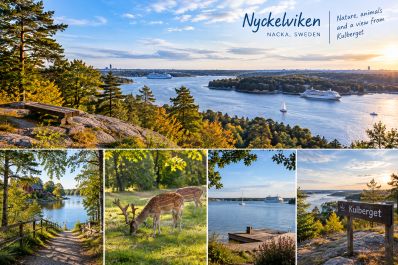
We had decided to make another stop at Nyckelviken in Nacka.
Nyckelviken is one of those places that demonstrates how fortunate Stockholm is to have nature so close to the city.
You can spend much of the day exploring historical and rural landscapes outside Stockholm and still return to another peaceful natural area within the metropolitan region.
By the time we reached Nyckelviken, the light had begun to change. The afternoon was gradually turning into evening. We walked around the area, enjoying the scenery and seeing animals nearby.
The landscape felt different from Mariefred, but the same Swedish quality remained: forest, water, open spaces and a sense that nature was never very far away.
Kulberget: Stockholm from Above
One of the highlights of Nyckelviken was Kulberget, a hill offering a beautiful view over the surrounding water and landscape.
We climbed up and stopped to enjoy the panorama. From there, boats moving across the water looked small against the wider landscape.
It was one of those views where you naturally become quiet for a moment.
The water below. The greenery around us. Boats move slowly. Stockholm’s wider landscape stretching beyond.
And, depending on the route and season, large passenger ships connecting Stockholm with other Baltic destinations can be seen passing through the waters.
Cruise ships serving routes between Stockholm and places such as Helsinki and Tallinn add another dimension to the view.
Standing on the hill, I thought about how these waterways have connected people for centuries. The same water that makes a landscape beautiful is also a highway.
People travel across it for holidays, business, family visits, and simply for the pleasure of travelling.
For someone like Inayat, who had been moving through several European countries during this trip, it seemed particularly appropriate.
 When Evening Brings the Cold
As the evening progressed, the temperature began to drop.
It was not freezing, but after spending many hours outside, we could feel the chill. We decided it was time to say goodbye to Nyckelviken.
There is something satisfying about ending a day outdoors at exactly the right moment not when you are completely exhausted, but when you feel that you have experienced enough.
We got back into the car and headed towards Stockholm. But another kind of journey was waiting for us.
From Swedish Nature to Desi Dinner
Our final destination was Chilli Masala in Solna.
Dr. Imran Jamali and our mutual friend Sinem, who was visiting from Istanbul, Turkey, were already waiting for us.
After a day of Swedish castles, lakes, forests, deer, butterflies, ducks, and boats, we suddenly found ourselves sitting down for a desi dinner. And somehow, it felt perfect.
There is something special about eating South Asian food after spending an entire day exploring Europe.
The contrast makes both experiences more enjoyable. During the day, we had walked through Swedish history. We watched deer grazing in the countryside. We had stood beside Lake Mälaren. We had admired Mariefred. We had climbed a hill in Nacka and watched boats passing through the Baltic waters.
And now we were sitting around a table sharing familiar food and conversation.
The Swedish landscape outside had been beautiful, but the warmth of familiar company was equally important.
 A Day That Was More Than a Day Trip
Looking back, our journey from Stockholm to Mariefred and then to Nyckelviken was not particularly complicated.
There was no long flight. No expensive expedition. No difficult hiking trail No dramatic adventure. Yet it became one of those days that remains in memory. Perhaps because good travel is not always measured by distance. It is measured by what happens along the way.
It was about meeting someone from Sindh in Sweden and discovering that a shared background can create an immediate connection even thousands of kilometers from home.
It was about finding in Inayat a fellow traveller who understood the freedom and flexibility that travel requires. It was about a road through the Swedish countryside. It was about fifteen or twenty deer quietly grazing in a field.
It was about the red-brick walls of Gripsholms Castle and the stories hidden inside them. It was about Mariefred’s church tower appearing in the distance. It was about ducks and boats on Lake Mälaren.
It was about leaves floating on water. It was about butterflies suddenly appearing among flowers. It was about a father patiently teaching his daughter how to fish. It was about an ice cream before returning to Stockholm. It was about standing on Kulberget and watching boats move below.
And finally, it was about sitting around a table with friends from different places Sindh, Pakistan, Sweden, and Turkey and sharing a desi meal in Solna.
Perhaps that is what makes Europe so interesting to me after living in Sweden for so many years.
The continent is full of castles, museums, lakes, churches and historic towns. But beyond the attractions, there are always people. And travel becomes truly meaningful when places and people meet.
That September day began with a traveller from Sindh leaving a hostel in Stockholm.
It took us through Swedish countryside and centuries of history, brought us beside Lake Mälaren, took us up a hill overlooking the Baltic waterways, and ended with desi food and friends.
A castle, a lake, a hill, a few deer, some butterflies, and a good kacheri.
Sometimes, that is more than enough for a memorable day.
Read: A Sunny Escape into the Wild
____________
Abdullah Soomro, penname Abdullah Usman Morai, hailing from Moro town of Sindh, province of Pakistan, is based in Stockholm Sweden. Currently he is working as Groundwater Engineer in Stockholm Sweden. He did BE (Agriculture) from Sindh Agriculture University Tando Jam and MSc water systems technology from KTH Stockholm Sweden as well as MSc Management from Stockholm University. Beside this he also did masters in journalism and economics from Shah Abdul Latif University Khairpur Mirs, Sindh. He is author of a travelogue book named ‘Musafatoon’. His second book is in process. He writes articles from time to time. A frequent traveler, he also does podcast on YouTube with channel name: VASJE Podcast.