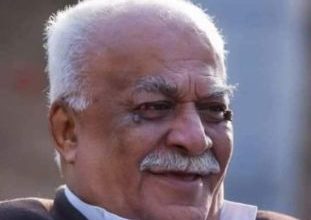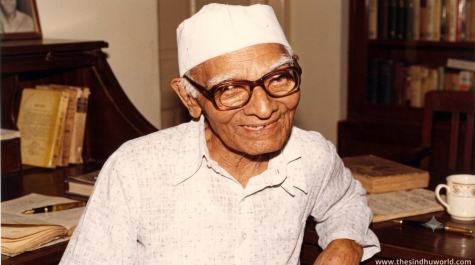
Dada Shewak Bhojraj (1st October 1906 – 1st March 1988) made Child Welfare his life’s Mission.
He established ‘Balkan-ji-Bari Child Welfare Association’ in 1926. Its name, meaning “Children’s Own Garden,” reflected Bhojraj’s belief that children required not only classroom education but also happiness, recreation, creativity and opportunities for healthy social development.
Jayanti Arjandas Thakkar “MITHI”
Dada Shewak Bhojraj was a distinguished son of Sindh whose life brought together the ideals of the freedom struggle, education, literature and social service. A Gandhian freedom fighter, writer, journalist, educationist and social worker, he is particularly remembered as the founder of Balkan-ji-Bari, a pioneering child-welfare movement that grew from Sindh into an organization with a wider national and international presence.
He was born on 1st October 1906 at Larkana, Sindh. He received his early education in Larkana, Sukkur and Karachi and pursued higher education in Karachi. Records connected with D.J. Sindh College, Karachi, place Shewak Bhojraj among its students, while biographical accounts record that he completed his B.A. His educational years helped develop the intellectual and literary interests that later became an important part of his public life.
From his youth, Bhojraj was drawn towards literature and social questions. He believed that the written word could do more than entertain—it could awaken social consciousness and influence the minds of the younger generation. He therefore combined his literary interests with constructive social work, a characteristic that remained visible throughout his life.
The ideas of Mahatma Gandhi deeply influenced him at an early age. He joined the Non-Cooperation Movement, Salt Satyagraha and Quit India Movement, accepting imprisonment and personal hardship as part of the freedom struggle. During his participation in the Salt Satyagraha associated with Gandhi’s Dandi movement, he was imprisoned and faced severe action by the British authorities against his belongings and printing establishment. He was eventually forced to leave Karachi.
But imprisonment and persecution did not diminish his commitment to public service. Instead, his Gandhian understanding of freedom increasingly found expression in constructive work—particularly education and the welfare of children.
It was from this vision that Balkan-ji-Bari emerged. The movement had its beginnings in 1923 and was formally established as the Balkan-ji-Bari Child Welfare Association in 1926. Its name, meaning “Children’s Own Garden,” reflected Bhojraj’s belief that children required not only classroom education but also happiness, recreation, creativity and opportunities for healthy social development.
Balkan-ji-Bari brought children together without distinctions of class, creed, language or sex. Libraries, playgrounds, hobby clubs, nursery schools, excursions, exhibitions, cultural programs and other educational activities became part of its work. What began in Sindh gradually expanded into a broad child-welfare movement across India.
Bhojraj was equally committed to children’s literature. He started the Sindhi children’s magazine Gulistan, which became associated with the literary and educational development of young Sindhi readers. His literary works included the novels Ashirwad (1933) and Dada Shyam (1934), both written against the background of the freedom struggle and reflecting the influence of Gandhian thought. Sindhi literary histories recognize him among the writers who contributed to the development of modern Sindhi prose.
His literary contribution continued to have an educational life beyond his own generation. Ashirwad was later included as a children’s novel in the Sindhi curriculum of the University of Delhi, demonstrating its continuing place in Sindhi children’s literature.
After leaving Sindh, Bhojraj settled in Bombay and devoted himself increasingly to Balkan-ji-Bari. He also published the English magazine Pushpa, using journalism and literature as additional means of spreading social and educational ideas. The organization’s Silver Jubilee was celebrated in Bombay in 1950, with Prime Minister Jawaharlal Nehru as chief guest.
His concern for children eventually took him into another important field—the education and welfare of Adivasi communities. At Bapugaon in Maharashtra, he established a residential school for Adivasi boys and girls in a remote area. The school combined ordinary academic education with practical training in spinning, sewing, knitting, embroidery, gardening, carpentry and domestic work. Character-building and civic responsibility were given equal importance. A contemporary Government of India account records that Bhojraj and his wife worked voluntarily in this service.
His child-welfare work continued to grow beyond regional boundaries. Balkan-ji-Bari developed into an organization with a national and international outlook and subsequently had recognised association with the United Nations/ECOSOC system. Thus, the small seed planted by a Gandhian social worker from Sindh eventually developed into a much wider movement devoted to children.
In recognition of his long and dedicated service to society, the Government of India awarded Dada Shewak Bhojraj the Padma Shri in 1983 for Social Work. The official Padma Awards record lists him under Maharashtra and the field of Social Work.
Dada Shewak Bhojraj passed away on 1st March 1988. His life represents a remarkable journey from Larkana’s educational and literary world to the Gandhian freedom struggle, and from there to decades of constructive social service.
For the Sindhi community, his legacy has a special resonance. He carried from Sindh not merely memories of his birthplace, but a conviction that education, literature, children’s welfare and service to the disadvantaged could become instruments of nation-building. His Balkan-ji-Bari became the practical expression of that conviction, while his writings preserved another part of his contribution to Sindhi cultural life.
Dada Shewak Bhojraj’s story is therefore not only that of a freedom fighter who went to prison. It is the story of a Sindhi Gandhian who turned the experience of struggle into a lifelong program of constructive service—giving children a garden of learning, literature and joy, and giving disadvantaged communities an opportunity for education and dignity.
Read: Lakhmi Khilani – Engineer, Academician, Author and Poet
___________
Jayanti Arjandas Thakkar “MITHI” — Researcher, Writer, Social Worker
Courtesy: Indian Institute of Sindhology, Gandhidham, India