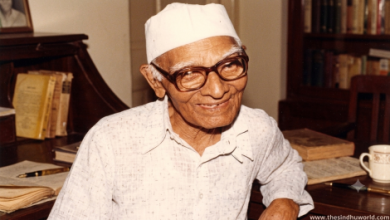
A heartfelt tribute to Rais Wado Ali Ahmad Nizamani—affectionately known as ‘Adal Bha’—whose lifelong dedication to education, literature, and community leadership continues to illuminate Karram Khan Nizamani.
Bharumal Amrani
Some individuals embody guidance and act as a beacon of light in their character and presence, illuminating the path for entire communities. The refined Sindhi poet and translator, Sain Kalal, served as a guiding light for many. In the company of Sain Kalal, my friends and I wandered through the realm of Shah Abdul Latif Bhittai and the alleys of Hala, eventually settling down in Karram Khan Nizamani a splendid village of Sindh much like the birds of Thar.
When the soul grows weary amidst the dust and turmoil of the world, one visits the shrine of Bhittai to rejuvenate mind and spirit, and then proceeds directly through Hala to Karram Khan Nizamani.
Within an hour of gathering in the traditional village katchery, the residents mention a certain individual by the affectionate title ‘Adal Bha’ at least five times with profound respect, leaving any newcomer wondering who this ‘Adal Bha’ truly is. Touched by the villagers’ deep reverence, they readily read the visitor’s curiosity and explain, ‘Adal Bha is our esteemed village leader, Rais Wado.’
From that point onward, the virtues and achievements of Rais Wado Ali Ahmad Nizamani unfold like a cherished folk legend—beginning with his maternal grandfather, Maulana Shafi Muhammad, and leading into Rais Wado’s own education, his dedicated support and encouragement for underprivileged classmates, his academic distinction in Political Science, his active participation in the Movement for the Restoration of Democracy (MRD), his imprisonment, his heroic role in the historical struggle of March 4, his organizing of political and social gatherings, his patronage of literary and cultural activities, his fostering of tolerance and mutual respect, his establishment of educational institutions from primary to high schools, and his tireless efforts to cultivate reading habits and encourage youth to build libraries.
When I first visited this village alongside Sain Kalal, I stayed at the guest house (oataq) belonging to Naeem Khan, Rais Wado’s cousin. While my companions retired for the night after dinner, I discovered a magnificent library in the central room of the guest house and spent the entire night browsing and reading through the collection.
I learned then that Rais Wado was not only an avid reader himself, but would also engage the local youth, asking for their impressions of the books they had recently finished. Sain Kalal had playfully cautioned me, saying, ‘If my Adal Bha arrives, he will ask you for a detailed account of every single book.’ When I asked if the library belonged to Rais Wado, Sain Kalal shared that while most of the books belonged to Dr. Haider Nizamani, Rais Wado took painstaking care of every single volume.
I was deeply saddened to learn of the passing of Rais Wado Ali Ahmad Nizamani—the ‘Adal Bha’ of Karram Khan Nizamani village—on October 1, 2025. I extended my heartfelt condolences to his loving friends and the villagers of Karram Khan Nizamani. A year has passed since then, and while the memories of Adal Bha remain vibrant in the guest house, I have not been able to revisit the village following the departure of Sain Kalal.
Read: Saindad Sand: The Desert’s Voice
___________
 Bharu Mal Amrani is a distinguished folklorist, poet, writer, researcher, journalist, script writer & compere of Radio Pakistan, and social–environmental activist from Tharparkar, Sindh, who has devoted more than two decades to the preservation, documentation, and promotion of Thari dialect, folklore, culture, and heritage. Currently he is working as a subject specialist of Sindhi at Raichand Rathore Government Higher Secondary School, Chelhar.