A Look at Dr. Lalit Mohan Sharma’s Short-Story Collection ‘Blind Man’s Bluff’
Taken as a whole, the book becomes much more than a collection of twenty stories. It emerges as the book of memories of a man who, from the later years of his life, looks back with a certain detachment at his times, relationships, failures, love, death and society.
Ajay Parashar
Few would disagree with the proposition that life is a game of blind man’s bluff. No one quite knows where the search of a human being, wandering through memories, grief and time, finally ends. At such moments, one is naturally reminded of a song written by lyricist Anand Bakshi for the Hindi film Pushpanjali and sung by Mukesh: “Those who leave this world—where do they go? (दुनिया से जाने वाले, जाने चले जाते हैं कहाँ)”
Perhaps the greatest and most enduring achievement of Blind Man’s Bluff, the first collection of stories by Dr. Lalit Mohan Sharma, essentially a poet by temperament, is that while reading it, Mukesh’s song comes unbidden to the reader’s lips and begins to ripple somewhere deep within.

And rightly so—for where does someone who is said to have gone away really go? They continue to live in objects, memories, habits and the empty spaces left behind within us. Death may end a life; can it end memory. Memories remain here, floating somewhere in the air around us.
Perhaps that is why, despite differences of geography and historical period, similar or even identical thoughts about life and human existence keep surfacing across the world. Otherwise, why would Carl Jung, while recording the thoughts of his patients in his Red Book, have been startled to hear a patient utter a sentence written in Greek centuries earlier: “The wind blows when the sun’s tail moves”?
Published earlier this year, Dr. Sharma’s debut collection brings together twenty stories. It is worth noting at the outset, however, that evaluating the book solely through the conventional lens of a short-story collection may not do full justice to its literary range and character. The author himself tells us in the preface that he is a poet by temperament and that he has attempted to express in prose those experiences that could not be conveyed as effectively through poetry. This perhaps explains why the boundaries between story, memoir, autobiographical narrative, reflective prose, allegory and the short-short story repeatedly merge into one another. Another distinctive feature of the collection is that the author does not seem overly concerned with fictionalizing the experiences of his own life.
Memory and absence, memory and forgetting, the individual and the system, and an honesty born of lived experience form the deep currents that keep this collection firmly rooted in reality. At first glance, the book appears to be a compilation of twenty short stories; once one enters its world, however, it becomes evident that its range extends well beyond the prescribed boundaries of the conventional short story. There is fiction here, but also memoir, autobiographical memory, socio-political commentary and allegory—and, at places, poetry that has simply taken the form of prose. The author himself acknowledges that, after a long engagement with poetry, his journey into prose arose from a desire to articulate experiences that he felt could not be expressed as effectively either in metrical or free verse.
The twenty pieces in the collection display considerable thematic diversity. Beginning with Abandoned, the book moves through Blind Man’s Bluff, An Order Withdrawn, An Assembly Question, Half-Day’s Leave, Mourning the Dead, Wounded Healing, Fear, Forgetting, Carnality, The Misfit, Lizard, My Friend and Birth and Dying, before eventually reaching Absconding. Beneath this diversity, however, certain undercurrents continually touch and intersect with one another—death, memory, loneliness, love, family relationships, the inner restlessness of the human being, and the individual’s confrontation with the system and with the times in which one lives.
Of all these currents, the deepest is that of memory and absence. In Abandoned, the very first piece in the collection, the house left behind after the sudden death of the protagonist’s wife ceases to be merely a house. The veranda, curtains, empty room, telephone, photographs and everyday objects become extensions of the man’s inner emptiness. The wife is absent, yet her absence is so dense that she seems more present than the objects that physically remain.
The same feeling assumes a more intimate form in Mourning the Dead. The author makes no attempt to transform married life into an idealized love story. There are complaints, quarrels, disagreements, and all those little habits that once caused irritation while the couple lived together. After death, those very ordinary things—a wet towel, a dust-covered car, food, clothes and everyday squabbles—become the priceless capital of memory. Here, through the most commonplace details, the author captures a profound truth of life: we often recognize the real value of a relationship not while it is still with us, but only after it is gone. It is perhaps this very truth that enables writers to continually expand the realm of their creative work.
Wounded Healing approaches the same grief from another direction. Against the familiar belief that time is the greatest healer, the author places a pain that time cannot erase. For a mother wounded by the death of her young son, words of consolation lose their meaning. Some wounds never heal; one merely learns to live with them. The author’s sensitivity in this story emerges not from any philosophical conclusion, but from human helplessness itself.
In Forgetting, the relationship between memory and oblivion becomes even more complex. Jung comes to mind once again. Is sleep a form of forgetting? Does a dead person, by returning in a dream, negate death for a few fleeting moments? Amid the consciousness moving between night, darkness, wakefulness, cigarettes and memory, time loses its ordinary rhythm. In the conventional sense, this is less a story than a narrative unfolding within the mind. It is here that the poet in Dr Sharma seems to come closest to the storyteller.
In Birth and Dying, centered on memories of the author’s mother, he knows the date of her death but not the date of her birth. Termites have devoured the register in which his maternal grandfather had meticulously recorded important family dates. From this seemingly insignificant incident arises a poignant irony: the beginning of a human life gradually disappears from the record, while the date of death becomes permanently inscribed in memory. The mother returns now as a fellow passenger on a bus, now in the kitchen, now at prayer, and at another moment holding her grandson in her lap. Here, the author’s strength lies not in detailed description, but in the very fragmentation of memory.
Another important dimension of the collection is the relationship between the individual and the system. Pieces such as An Order Withdrawn and An Assembly Question appear to emerge from the author’s experiences of academic and administrative life. In the former, the sequence of events surrounding the alteration or survival of a transfer or posting order exposes the peculiar ironies of the government machinery. On one side is the world of the Secretariat, ministers, officials and connections; on the other, a minor procedural lapse within the system ultimately overturns all calculations.
In An Assembly Question, an ordinary administrative decision turns into a question in the Legislative Assembly the moment it comes into contact with politics. A program organized on a college campus, the presence of a former Chief Minister, and the matter of a nominal fee gradually become an issue of political prestige. In the end, the system completes its paperwork, and life begins to move on.
What distinguishes these pieces is the reality that has been personally lived. The author does not observe bureaucracy from the outside; he shares his experiences after having walked through the corridors of the bureaucracy. Yet it is precisely here that one of the collection’s limitations of craft becomes visible. In some stories, the lived experience is so dense that its transformation into fiction remains incomplete. Such pieces come to rest somewhere between story and memoir. The event is credible, but fiction requires not merely the credibility of an event; it also demands its artistic recreation. Had the author, in some places, maintained a little more distance from the actual event, his characters and situations might have acquired a more independent fictional life.
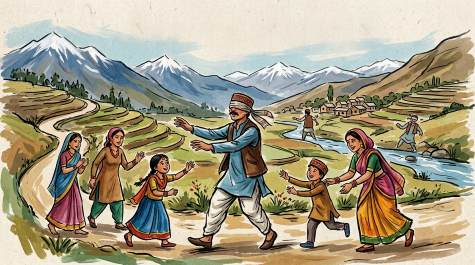
The third circle of the collection is woven out of social and political unease. In the title story, Blind Man’s Bluff, the author’s concern over communal tension, crowds, violence, propaganda and the self-absorption of power becomes explicit. The story evokes a time in which a person is increasingly recognized not by human qualities but by identities associated with clothes, language, objects of worship and history. Satirizing the language of power, the author points towards a tendency in which failure ceases to be an acceptable word and the causes of adversity are sought in nature, the times, or previous regimes. Such a tendency is increasingly visible in political corridors across the world. Turkish writer Ece Temelkuran has explored it tellingly in her book How to Lose a Country.
The Misfit connects this unease with the question of intellectual dissent. In the story, Ranjit imagines a forum where educated people can engage with an idea without necessarily accepting it. But the moment uncomfortable questions arise, the urge to avoid dialogue grows stronger. Eventually, it is the person who thinks critically who begins to appear as the “misfit” in his own surroundings.
The author’s ideological position is clearly visible in these pieces. This clarity is a strength, but at times it also becomes a limitation of the narrative. Where an idea emerges naturally from character, incident and dialogue, both the satire and the questions it raises are effective. At some places, however, the author’s idea moves ahead of his characters and begins to speak for itself. The story then edges closer to the essay. In fiction, the author’s stepping back a little can sometimes allow the reader to move much further ahead.
The very title ‘Lizard, My Friend’ evokes in the reader’s mind an unmistakable echo of ‘My Friend, Donald Trump’, reverberating through the corridors of an increasingly distorted political landscape. In that sense, this can be counted among the more experimental pieces in the collection. The lizard assuming human form, the intermingling of dream and reality, and the image of transformation give the narrative an allegorical dimension. The author himself eventually links the experience with transformation. Here, fable, political suggestion and surrealism blend together.
While reviewing the collection, however, Dr. Sharma’s language demands a separate consideration. His narrative language bears the deep imprint of poetry. The English of the book is deliberately unlike conventional narrative prose. Short sentences, incomplete phrases, abruptly shifting memories, visual imagery and a stream-of-consciousness structure become distinguishing features of his style. At several places, prose almost turns into prose poetry. This mode is particularly effective in pieces dealing with death, love, memory and loneliness.
Yet this very aspect of the collection demands greater editorial care. Numerous inconsistencies in language, punctuation, syntax and printing interrupt the flow of reading. Not every broken sentence can function as an artistic device of stream of consciousness; in some places, it appears to be the result of editorial laxity. A little more care and attentive literary editing could have made the book considerably more polished without disturbing the originality of the author’s style.
There was also scope for some rearrangement in the structure and sequencing of the book. Had the twenty pieces been organized according to their underlying currents—memory and death, love and the body, the individual and the system, society and power—the internal coherence of the collection might have emerged more clearly. The present sequence certainly offers variety, but at times the reader is abruptly transported from profound personal grief into a political or administrative episode, which can be somewhat unsettling.
Despite all these limitations, the greatest strength of Blind Man’s Bluff lies in the honesty born of lived experience. The author does not embellish life before presenting it. In the relationship between husband and wife, there is love, but there are quarrels too; in the memory of the mother, there is tenderness, but also distance and guilt; within the system, there is absurdity, but also the helplessness of the person caught in it; and in public life, there are ideas, but also the loneliness that dissent can bring.
Taken as a whole, the book becomes much more than a collection of twenty stories. It emerges as the book of memories of a man who, from the later years of his life, looks back with a certain detachment at his times, relationships, failures, love, death and society. In his preface, the author refers to the curiosity inspired in him by the fictional worlds of Dostoevsky, Manto, Albert Camus and other writers. Yet, the collection’s greatest strength emerges in those moments when the author moves beyond the support of grand literary and intellectual references and draws closer to his own lived experiences. It is here that his distinctive voice resonates with the greatest authenticity, naturalness, and credibility.
About the Author
Dr. Lalit Mohan Sharma, born in 1952, has served in Himachal Pradesh Education Department in various teaching and administrative capacities till he retired as Principal of Government College, Dharamshala. Dr. Sharma is a bilingual poet, translator and author. His publications include 15 books of English poetry, two anthologies of Hindi poems, Another Gandhi, a monograph on a freedom fighter and A Three- Step Journey, an English translation of Zahid’s Urdu poems.
Read: Reflections on ‘Icy Chill on Fire’
___________
Ajay Parashar is based in Sidhpur, Tahsil-Dharamshala, District Kangra, Himachal Pradesh India.