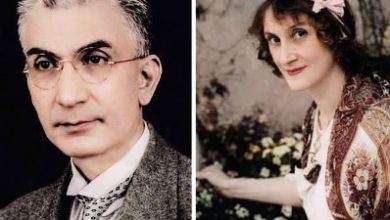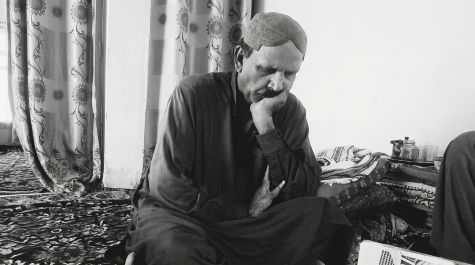
Prof. Saindad Sand (1960/1–2024) was an esteemed Sindhi poet, scholar, and educator whose work distilled the deep melancholy, history, and folklore of his native Thar desert into modern verse.
Bharumal Amrani
A handsome poet with a gentle disposition, in whose poetry tears speak and the history of the heart is chronicled. His art spans centuries, bringing the anguish of the Kurukshetra battlefield to the banks of the Indus River. From the Karan Phool (a traditional ear ornament) of his pen drip the extracts of sorrowful roses. He possesses the rare gift of warming the listener’s soul through the spoken cadences of verse. In the land of sand dunes, his poetry knows how to shine as the morning star (Vahao Taro). Through his work, one learns how grief can be made to ripple through words.
Passing through sorrows, pain, solitude, and melancholy, he maintained a lifelong devotion to poetry. Every day, the songbird of love (Taro) sang in his soul, and the peacocks of affection called out. Yearning for a single drop of close companionship, he addressed poetry in the words of Rasool Gamzatov:
”O Poetry! Do you not know that I can never abandon you? Can I ever run away from the joys of my life, or from the river of tears swelling in my eyes?”
He knew that without Moomal, Rano (Mendhro) is nothing; without the yearning for Saranga, the entire journey of Sadawant is futile; and it is solely because of the longing for the soil of Malir that Marui attained immortality.
In a foreword to Dil Ji Tareekh (History of the Heart), the second poetic collection of this beautiful Sindhi language poet Prof. Saindad Sand, I wrote:
”Before absorbing the intoxication of Sain Saindad Sand’s poetry into one’s heart, it is essential to first relish the beauty of the folk poetry of his native Thar—a poetry imbued with deep love for the homeland and an immense aesthetic fervor, both of which are reflected in his work.”
Early this morning near the pond, I was astonished to see deities bowing in reverence to a patch of ground. Going closer to inspect the spot, I realized that you had gone there at dawn to draw water, leaving behind the footprints stained with fresh henna. The deities were prostrating before that sacred earth.
At night, light flashed like lightning toward Amarkot (Umerkot) and Dhat. I was in a distant land. Seeing that radiance from afar, I thought rain had returned to Thar, and set out immediately. On the way, a traveler informed me that it had not rained at all. I then realized you must have been riding a swing when your veil slipped, and the brilliance of your skin lit up the sky.
O my son! Rise and heed the call of the soil. If you retreat during this national struggle, my milk shall turn to poison for you.
O friend! I have never liked the neighborhood of cowards; I sacrifice myself for those brave souls who bargain with their heads.
Neither meeting is easy nor parting; leave both behind. Parting causes the fish to perish, while meeting draws the moth to its death.
Among the tribes of Sindh, the Sodha tribe has been renowned for upholding truth, valor, and generosity. As the Charan poet declares:
Whether Kachhwaha, Jhala, Rathore (Kamdhaj), or the praised Sisodiya warriors of the world—or even the Yadu descendants of Machhari—none can ever match the Sodhas.
The Sodha sons of Sindh carved out their legacy across history: from sacrificing themselves for Dodo Soomro in the desert of Rahimki Bazaar to fighting heroically on the battlefield of Taltee. From Hansaji Sodho to Ranmal Sodho, the pages of history are filled with the historical feats of true Sodha. In both classical and modern Sindhi literature, “Sodha” characters stand as monumental figures.
The Sand tribe—known in the Thari dialect as Savand—is one of the 35 sub-castes of the Sodha tribe. It is said that three generations before Gujjo Rano lived Savand Sodho, whose descendants came to be known as Savand or Sand.
While the Sodha tribe historically maintained a reputation for sword craft through generations, the Sand branch in Sindh became recognized more for holding the “pen” than the “sword.” Among the Ranos of poetry’s Kaak (the realm of love), figures such as Mama Jaman Darbadar, Haleem Baghi, and Prof. Saindad Sand, alongside Haji Sand, Anwar Sand, and Ishaq Sand, have earned widespread acclaim.
Sain Saindad was the youngest of five sons born to Muhammad Hassan Sand in the village of Mataro Sand near Islamkot. His elder brothers are Lawang, Imam Bakhsh, Peer Dano, and Mangio. According to official school records, his date of birth is March 1, 1960, though his actual year of birth was 1961.
From childhood, Saindad was an exceptionally bright student. To pursue his education, he traveled to primary and secondary schools across various villages, including Joglar, Venjhnaiari, Islamkot, Jogi Marhi, Fazal Bhanbhro, and Naokot. After completing his first year at Shah Abdul Latif College in Mirpurkhas, he enrolled in Sachal College, Hyderabad, for his Intermediate studies, eventually making his way to the Old Campus of the University of Sindh. From primary school to his Master’s degree in Sindhi, he consistently secured first position, passing his M.A. in Sindhi with first-class honors.
Recalling his student days, Sain Saindad often spoke of “Fazal Bhanbhro,” where he lived and studied alongside Faqir Sher Muhammad Bilalani. Renowned short-story writer and playwright Abdul Qadir Junejo and Prem Shivani were among his teachers, instructing students in standard curriculum as well as fiction, poetry, and fine arts.
From 1978 to 1986, Saindad worked at Sindhology. By his own account, he would quietly read books on poetic technique away from the eyes of Dr. Ghulam Ali Allana and Madam Mahtab Akbar Rashdi, though he often viewed theoretical knowledge as distinct from lived expression.
On September 22, 1986, he joined Degree College Mithi as a Lecturer in Sindhi Literature. During his tenure at Mithi College, he rose through the ranks from Lecturer to Professor, eventually serving as Principal. It was during his service that the Degree College Mithi was named after the celebrated folk singer, Sadiq Faqir. Saindad retired from government service in February 2017 while serving at Degree College Diplo, yet he continued to teach and share knowledge through informal classes for students well after retirement.
Prof. Saindad Sand began writing poetry during his Intermediate studies. For several years, he would write verses only to tear them up, but the first ghazal he ever composed remained etched in his memory like a first love:
Yadun jagyun sapna jagya,
Akhrin andar ghorha jagya.
(Memories awakened, dreams awakened,
Within the eyes, tears awakened.)
Ghorhen Galhayu (Tears Have Spoken) became his debut poetry collection, containing this initial ghazal. The piece was first rendered by Kareem Faqir and later recorded by numerous vocalists. Kareem captured the profound melancholy of Nagarparkar in his soulful rendition, making it feel as though Sadawant were singing in a Jain temple while longing for Saranga.
Just as Saindad was initially reluctant to publish his first collection, Ghorhen Galhayu (relenting only under intense persuasion from friends like Dilip Kothari), he similarly resisted releasing his second collection, Dil Ji Tareekh. Eventually, Dilip Doshi Lohano and I persuaded him to proceed.
Following the martyrdom of Benazir Bhutto, he wrote poignant verses (Baits) amidst deep grief, which were compiled in his collection Sindh Kurokshetra Jiyan (Sindh Like Kurukshetra). This was the sole book the poet himself was eager to publish; it was brought out by Vasdev Jani through Amesha Publications. I had the honor of writing the forewords for both Dil Ji Tareekh and Sindh Kurokshetra Jiyan. Drafting the introduction for the latter was an intensely moving experience:
Dharti ji daman mein, suti munhji bhen,
Duniya banji neenr, rooi thanh ki roz thi.
(In the lap of the earth sleeps my sister,
The world becomes an eye, weeping for her daily.)
Rani tunhji rat man, jurya jiyala,
Bhala i bhala, Sindh Kurokshetra jiyan.
(O Queen! From your blood, brave hearts were born,
Lances upon lances, Sindh stands like Kurukshetra.)
Earlier in life, Saindad composed poetry late into the night in his college hostel room, lost in solitude while chain-smoking. Later, in his green home near Godam Colony, he wrote as the first light of dawn emerged. Yet internal solitude, life’s bitterness, tears, and sorrow remained constant companions. He never concerned himself with critics measuring poetry by rigid formulas or ideological reviewers underlining lines with a ballpoint pen. His expression was natural and spontaneous; the absolute truth of his life lies within his poetry.
When a friend once asked me whether poetry is an autobiography of the poet, I spontaneously recited a few lines of Saindad verse, explaining that he laid bare the secrets of life in precisely this manner. Opening the doorway of his heart, he sought beauty from the edge of vision to the rays of imagination, translating romantic hues, psychological insights, and philosophical reflections directly into his art.
The mid-1980s through the 1990s marked the rise of vocalists Sadiq Faqir and Kareem Faqir. _Sainingdad’s poetry was first brought to life by them before resounding across Sindh through various artists. His verses sung by Fouzia Soomro gained widespread popularity, particularly:
”Khn hath hilaya ta ghorha gari pya” (When someone waved goodbye, tears fell)
”Ko ta ahrho hujey, ghorha munhja aghay” (If only there were someone to wipe my tears)
”Mirkandi mirkandi ji toon munh san milien, gham munhja khushi mein badalji vanjan” (If you meet me with a smile, my sorrows turn to joy)
”Vichhri vanjin tho toon par yad kandin dadho” (You are parting ways, but you will miss me deeply)
Lines like “Toliy’an man i tariyo tha, dil patthar ji dhariyo tha” and “Dil ki dhodindarr hi gharhi ahe” were rendered by Sadiq Faqir with a resonance no other singer could duplicate. In reciting a verse from Saindad’s ghazal “Jadhn gheri vanje gham ko, tadhn mun dey hali acchan”, Sadiq Faqir infused the phrase “Munhji mithri janan” (My sweet beloved) with such melody that it echoed in the listener’s heart like the call of a cuckoo. Rajab Faqir, Rafeeq Faqir, and Abbas Faqir have likewise sung his poetry with deep devotion.
Ustad Hussain Faqir also delivered exceptional renditions of his poetry. To learn raaga and music from Ustad Hussain Faqir, Saindad purchased a new harmonium. Ustad began lessons in the hostel room, though how long those lessons continued or how much formal music theory Sain mastered remains uncertain; what was always clear was his lifelong love for melody and music.
I do not recall the exact date of my first meeting with Sain Saindad, but I vividly remember attending the “Welcoming the Rains” (Vaskare Ji Aajyan) event organized by Sadiq Faqir and other companions in Saran Colony, Mithi, in 1997. I recited a Wai (a traditional poetic form), which Sain praised warmly.
On my first day at college, Sain entered the classroom and asked questions regarding Shah Abdul Latif Bhittai. I was among those who answered correctly. Throughout our college years, literary gatherings met regularly—from the classroom to Sain’s hostel room—focusing on literature, poetry, and life values, often stretching past midnight. On one cold winter night, I prepared to leave his room without a coat or sweater; Sain gave me his fine Ajrak shawl to wrap around myself. Such a high-quality Ajrak was beyond my means to purchase at the time. The following evening, before returning it, I draped it over my shoulders and walked through the town a few times to show it off.
Whenever I met Sain, he maintained the same warmth, respect, and candor. He possessed an exceptionally sensitive nature, guided by his heart rather than societal conventions, and was devoted to his students. He often remarked that a person might remain “de-classed,” but must never allow themselves to be “degraded.” Consequently, he never tolerated disrespect, carrying a refined artistic dignity (ego).
During our student years, Sain Reejho Krishnati served as College Principal—a truly noble human being who treated me with great kindness. When a group of us requested a trip to the Karoonjhar Mountains, Sain Saindad advocated on our behalf and accompanied us as we explored the Nagarparkar region.
I read extensively from Sain’s personal library. Thanks to my closeness with him, I also gained access to the college library resources. He remained a major exponent of modern literature and progressive thought in Thar.
Shortly after the “Thar Seminar,” a grand literary gathering (Rahaarn) was organized in Mithi for Sain Saindad by his former students—Dr. Lal Lohano, Dr. Suresh Makhi, Dr. Kishor Khatri, Vasdev Jani, and others. This coincided with the height of Fouzia Soomro’s popularity; a recording of that evening remains preserved with Pappu Kotak.
Sain wrote prose infrequently, his prose was refined. His book Khayalan Ja Pakhi (Birds of Thoughts) compiles radio scripts, speeches, and interviews. His radio broadcasts enjoyed immense popularity. Another of his works, Thar Ji Adabi Tareekh (Literary History of Thar), remains unpublished. He briefly penned newspaper columns, though he discontinued the series after a few installments.
When Sain became Principal of the college, I arranged a commendation ceremony in his honor at the Mithi Press Club along with my colleagues Shahab Nahriyo and Nashad Samoo. Though initially hesitant, Sain accepted out of regard for his students and friends.
Although I began writing during high school, I learned poetic meter and prosody (Arooz) directly from Prof. Saindad Sand. Previously, I had attempted to compose verse using Taj Joyo’s book Sindhi Geet, though I had not yet mastered the nuances of metric science.
When I launched the weekly newspaper Thar News, Sain offered his full backing, guiding our team continuously through its five-year run.
Creator of iconic folk verses such as “Mathari mathi moriro boley, manro heenyro hichkoley”, Prof. Saindad Sand navigated life in Thar with deep insight, fortitude, and steadfast principles. Active in the Sindhi Adabi Sangat since his days in Jamshoro, he frequently hosted Mithi branch meetings in his hostel room, serving at various times as Branch Secretary and Councilor.
Whenever I looked at Saindad, Mirza Ghalib’s famous couplet came to mind:
Na janoon nek hoon ya bad hoon, par sohbat mukhalif hai!
Jo gul hoon to hoon sehra mein, jo khas hoon to hoon gulshan mein.
(I know not whether I am good or evil, yet my surroundings conflict with me;
If I am a flower, I bloom in the desert; if a weed, I grow in the garden.)
Like a flower blooming in the heart of the desert, this poet stood solitary like fragrance itself, unique to his native soil. He distilled tears into words to nurture his poetic craft. In 1998, a manuscript of his poetry was stolen from his hostel room—a loss he grieved throughout his life.
Concluding Reflections
I have written extensively on Saindad Sand’s poetry in the past, including an analysis of his prose in Khayalan Ja Pakhi. In this biographical sketch, I have sought to convey his personality and art without repetition. Readers may judge how far I have succeeded; I have written what I genuinely felt regarding his life and work. Many memories remain, to be shared on another occasion.
Sain frequently recited his own ghazal:
Rat guzri vanje ta dadho suttho,
Yad visri vanje ta dadho suttho.
(If the night passes, it would be so good,
If the memory fades, it would be so good.)
Poets like Saindad are born but once; in a single lifetime, they gather the artistic essence of thousands of lifetimes, filling all directions with vibrant color. In an expanse adorned with millions of stars, their creative brilliance shines anew with every passing day, and centuries bear witness to the light of their verses.
In life’s journey, every stanza of Saindad’s poetry represents a step forward. Traversing the dry desert of human attitudes, an ocean of pain (Hakro) surged within him, giving his poetry a deeply reflective interiority. Behind every couplet lies a lived reality.
Sain Saindad was a poet of tears and sorrows. Even when a smile crossed his dark-complexioned face, it seemed as though a quiet line of shy tears lingered just behind that innocent expression.
Just as musicians practice their scales (Riyaz), he performed his poetic Sadhana (devotional discipline). He carved every line from the depths of his soul like fire, contributing a distinct desert voice from Thar to modern Sindhi ghazal.
Beginning his professional journey at Sindhology, Prof. Saindad Sand went on to play a major educational role through teaching and administration at colleges in Mithi, Diplo, and beyond.
This fine poet of the Sindhi language passed away on International Mother Language Day. On World Book Day, following special directives from Sain Sardar Shah, an official letter was issued to name the college in his honor. Although a signboard was initially delayed at the local level, it has now been formally installed at the college entrance.
Saindad Sand’s published works include Ghorhen Galhayu (poetry), Dil Ji Tareekh (poetry), Sindh Kurokshetra Jiyan (poetry), Khayalan Ja Pakhi (prose), and Ko Ta Ahrho Hujey (poetry), along with remaining unpublished manuscripts. The devoted labor of this respected teacher and great poet of Sindh continues to receive the recognition it richly deserves.
Read: Peacocks have forgotten their dance
_________
 Bharu Mal Amrani is a distinguished folklorist, poet, writer, researcher, journalist, script writer & compere of Radio Pakistan, and social–environmental activist from Tharparkar, Sindh, who has devoted more than two decades to the preservation, documentation, and promotion of Thari dialect, folklore, culture, and heritage. Currently he is working as a subject specialist of Sindhi at Raichand Rathore Government Higher Secondary School, Chelhar.