Elsa Kazi: Sindh’s German Literary Icon
Her Contribution to the English Translation of Shah Jo Risalo

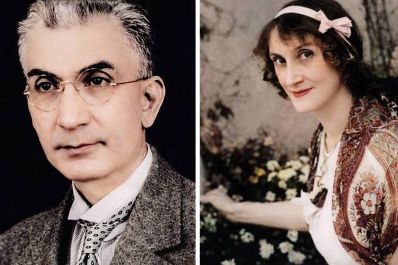
Born in Germany, Elsa Kazi—revered as “Mother Elsa”, became a landmark figure in Sindhi cultural history through her poetic English translation of Shah Abdul Latif Bhittai’s Risalo.
- Supported by her husband, Allama I. I. Kazi, she bridged vast linguistic and cultural divides to capture the rhythm, imagery, and mystical spirit of Bhittai’s work, pioneering a legacy that inspired generations of scholars and translators.
Rafia Bukhari
Elsa Kazi (1884–1967), affectionately known as “Mother Elsa” in Sindh, holds a high esteem in the literary and cultural history of the region. A German-born writer, poet, translator, and a painter, she was the wife of the eminent philosopher and scholar Allama I. I. Kazi. Although she was not a native speaker of Sindhi, her profound dedication for Shah Abdul Latif Bhittai and her deep association with Sindh enabled her to engage closely with the spiritual and philosophical dimensions of Bhittai’s poetry.
Elsa Kazi’s literary contribution extends beyond her translation of Shah Abdul Latif Bhittai. Nevertheless, her English rendering of Shah Abdul Latif Bhittai’s Risalo (Selections), published in 1965 remains one of her most noteworthy literary achievements. Although the work contains selected verses rather than the complete Risalo, it occupies an important position in the history of English translations of Bhittai’s poetry.
For a reader familiar with Shah Jo Risalo in the original Sindhi, Kazi’s rendering exposes an evident attempt to reproduce not merely the literal meaning of Bhittai’s verses but also their poetic and mystical dimensions. She transforms the substance of the original verses into an English poetic form in which rhythm, imagery, and musical notes contribute to an effect reminiscent of the original poetry. Translating poetry is inherently challenging because the translator must negotiate between linguistic meaning and poetic form. The difficulty becomes even greater when the source text is mystical poetry deeply embedded in a particular cultural and spiritual tradition.
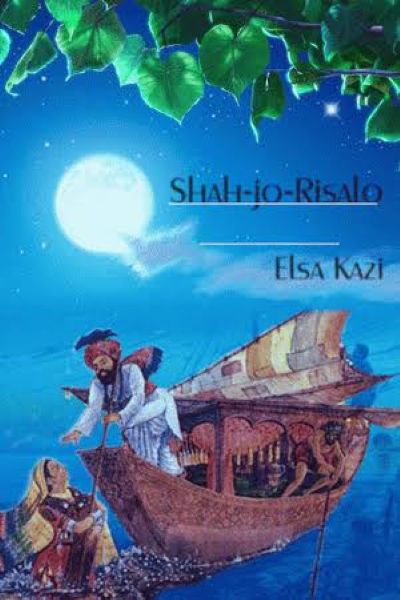 Elsa Kazi as a Poet and Translator
Kazi’s own poetic sensibility appears to have played an important role in her approach to Bhittai’s poetry. Her ability to appreciate the aesthetic and spiritual dimensions of poetry allowed her to approach Shah Jo Risalo not merely as a text material but as a work of mystical and philosophical significance.
One of the notable examples of her poetic rendering appears in her translation of a verse from Sur Suriraag:
“Those who kept up all night
To adore Glorious One;
Latif says: E’en their dust
Became with honour dight;
Scores to their resting site
Flock, homage there to pay.”
(Kazi, 1965, p. 106)
The translation proves Kazi’s endeavor to preserve the devotional atmosphere of Bhittai’s poetry while presenting it in an English poetic structure. The imagery of devotion, honour, and spiritual reverence remains central to the translated passage.
Another striking example is found in Sur Marui, where Bhittai evokes the pre-creation pledge between God and human soul:
“Am I not thy Lord?” came a voice;
A voice so sweet and clear;
And I said: “yes” with all my heart
When I this voice did hear;
And with a bond I did adhere
That moment to my love.
(Kazi, 1965, p. 179)
The passage refers to the Qur’anic concept of the compact, in which the human soul responds affirmatively to the divine question, “Am I not your Lord?” In Bhittai’s poetry, the episode acquires a mystical significance, while Marui turns out to be associated with spiritual fidelity and commitment.
Kazi’s rendering attempts to preserve this spiritual dimension. Her translation therefore demonstrates that her engagement with Bhittai was not confined to lexical equivalence. Rather, she sought to communicate the mystical resonance underlying the original verses.
The Role of Allama I. I. Kazi
The role of Allama I. I. Kazi in Elsa Kazi’s engagement with Shah Jo Risalo be worthy of attention. Since Elsa Kazi was not a native speaker of Sindhi, her husband’s knowledge of Sindhi language, literature, philosophy, and Islamic thought provided valuable assistance in understanding Bhittai’s poetry.
Their intellectual and literary partnership appears to have contributed significantly to the development of Elsa Kazi’s translation. Her familiarity with English poetic expression, combined with Allama I. I. Kazi’s understanding of Sindhi and Islamic philosophical traditions, created a unique perspective for the translation.
Her work can therefore be viewed not simply as a linguistic transfer from Sindhi into English but as an intercultural literary endeavor. Her dedication to Bhittai and her admiration for Sindh appear repeatedly in accounts of her literary life. Her famous admiration for Bhittai is reflected in the exclamation attributed to her: “Oh! There is no poet like Latif.”
This statement illustrates the profound literary appreciation that she cherished in her heart for Shah Abdul Latif Bhittai.
Preservation of Poetic Form
One of the notable characteristics of Kazi’s selected translations is her attention to poetic form. She attempts to reproduce elements of rhyme, rhythm, imagery, and musicality, while simultaneously conveying the semantic and spiritual content of the source text.
Such an approach presents a considerable challenge because Sindhi and English differ substantially in their linguistic structures, poetic conventions, cultural associations, and systems of imagery. A translation that seeks to reproduce both meaning and poetic effect must consequently negotiate between fidelity to the source and creativity in the target language.
Kazi’s work validates such negotiation. Her translation suggests that she was concerned not only with what Bhittai conveyed but also with how his poetry could be knowledgeable in English. Her poetic background appears to have supported her in creating an English poetic form capable of conveying aspects of the original’s aesthetic and spiritual atmosphere.
Elsa Kazi’s influence on other women
Elsa Kazi’s translation also occupies an important place in the subsequent history of translating Bhittai’s poetry into English, because she was the first woman who translated Shah Jo Risalo preceded by Amena Khamisani’s The Risalo of Shah Abdul Latif Bhittai (1994).
Khamisani herself acknowledges the significance of Kazi’s work, stating:
“Mrs. Elsa Kazi’s Selections of Shah Jo Risalo and Brohi’s introduction to it, were of a great help to me.”
(Khamisani, 1994, p. 16) . Elsa Kazi also played a pivotal role in my research on the English translations of Shah-Jo-Risalo. As a poet myself, I felt a particular affinity with her literary work and exploring her translation of Bhittai’s poetry. Further my aspiration to understand how her poetic vision shaped her approach to translation drew me deeply towards her work.
These acknowledgements indicate that Kazi’s translation constituted an important point of reference for the later translators/researchers of Shah Jo Risalo. Her contribution can therefore be considered within the broader development of women’s engagement with the English translations of Bhittai’s poetry.
A Foreign Voice in Sindhi Literary Tradition
Elsa Kazi’s contribution is particularly interesting because she approached Bhittai’s poetry from outside the linguistic and cultural tradition in which it originated. Her achievement raises an important question concerning the relationship between cultural belonging and literary understanding.
A translator does not necessarily need to belong to the culture of the source text to respond deeply to its literary and spiritual dimensions. At the same time, the absence of native linguistic and cultural competence creates particular challenges for translation. Kazi’s work is significant precisely because it represents an attempt to cross these linguistic and cultural boundaries.
Her engagement with Bhittai demonstrates the possibility of literary dialogue across cultures. Through her translation, aspects of Sindhi mystical poetry became accessible to English-speaking readers beyond the immediate cultural and linguistic environment of Sindh.
Her contribution should therefore be understood as part of the wider history of intercultural literary exchange surrounding Shah Abdul Latif Bhittai.
Mother Elsa and Her Legacy
Elsa Kazi passed away in 1967 at the age of 82 and was laid to rest beside her husband, Allama I. I. Kazi, at the University of Sindh in Hyderabad. Although she did not have children of her own, she developed a devotional bond with students and the people of Sindh, who affectionately came to know her as “Mother Elsa.”
Her association with Sindh extended beyond her marriage to Allama I. I. Kazi. Through her literary and artistic work, she became associated with the cultural and intellectual life of the region. Her translation of Bhittai’s poetry remains an important part of this legacy.
Read: Life-long Love Story of Sindhi and German Scholars
_______________
 Rafia Bukhari, an English-language poetess and writer from Larkana, was born on June 15, 1982, to the Syed family. Her two English poetry books, “The Painful Payment” (2021) and “A Flight of Broken Wings” (2023), have already been published.