A Roadmap for Social Harmony, Linguistic Balance and Sustainable Development in Sindh
- The people of Sindh should not remain indifferent to their demography, culture, language, land and natural resources.
- The protection of Sindh’s survival, peace, culture, language, resources and demography is a collective responsibility of every Sindhi.
By Z.A. Buriro
For the Social Harmony and Linguistic Balance in Sindh, it has now become equally important and imperative to take impactful and effective measures to protect the culture, language, resources and demography of the province, particularly in its major cities and especially in Karachi.
Under the Constitution of the Islamic Republic of Pakistan, every citizen has the right to promote and preserve his historical and cultural identity. Similarly, the people of Sindh should strengthen their historical, cultural and economic relationship with Karachi. They must come to Karachi, settle there, participate in employment and business, and contribute to strengthening their language and cultural identity, which ultimately contributes to social harmony in its capital city in particular and Sindh in general.
Important Roadmap
1) Regulation of Land Use, Housing Schemes and Urban Expansion.
The Government should introduce new laws to regulate uncontrolled migration from other regions of the country. Under such legislation, the purchase and sale of land in Sindh by any citizen having an identity or permanent legal affiliation with another region should be restricted to a maximum of 120 square yards, and that too solely for residential purposes. An extremely strict and comprehensive legal procedure should be prescribed for such purchases, with the condition that the concerned person may purchase such land in Sindh only after relinquishing his or her citizenship/legal permanent-residence status of the region of origin.
The Government should enact modern and effective legislation for the protection of Sindh’s land, resources and demography. Moreover, unregulated housing schemes, the conversion of agricultural land and illegal occupation must be effectively halted and regulated, so that the land of Sindh cannot be converted in an unregulated manner into commercial or residential projects.
For people coming to Sindh from other regions and countries for employment or education, an effective system such as a Work Permit or Study Permit, in accordance with the law, may also be implemented.
2) Establishment of a Provincial Population, Migration and Urban Settlement Database Authority & Introduction of a Digital Domicile & PRC MIS System.
Furthermore, the system of Domicile and Permanent Residence Certificate (PRC) in Sindh should be fully integrated with a centralized, digital and transparent Management Information System (MIS), supervised by a high-level Provincial Population, Migration and Urban Settlement Database Authority.
Strict verification of permanent residence, legal documentation, actual residence and other legal criteria should be made mandatory for the issuance of Domicile and PRC, so that fake Domiciles and PRCs can be effectively eliminated.
3) Introduction of Work / Study Permits.
For people coming to Sindh from other regions and countries for employment or education, an effective system such as a Work Permit or Study Permit, in accordance with the law, may also be implemented.
4) Establishment of Sindh Provincial Highways Authority.
The Government should establish its own Provincial Highways Authority (PHA), which should be responsible for the construction and maintenance of modern highways, motorways, bridges, bypasses and other major road-infrastructure projects within the province.
Similarly, need-cum-basis toll plazas should be established on provincial highways, and a portion of the revenue generated through tolls should be spent on the development of Sindh and its road infrastructure.
5) Integrated Entry-Point, Traffic and Transport Monitoring.
A modern, integrated digital surveillance and traffic-monitoring system should be established at all entry and exit points of Sindh so that the lawful movement of people, goods and vehicles can be better managed and security can be ensured.
6) Protection and Promotion of the Sindhi Language:
*Declaring Sindhi Compulsory from Primary to College Level.
The Sindhi language should be introduced as a compulsory subject from the primary level up to the college level in all public and private educational institutions across Sindh, so that future generations can remain strongly connected with the Sindhi language, literature, culture and history.
*Sindhi Language Competency in Relevant Public-Sector Recruitment.
For government employment in Sindh, all candidates applying through the Sindh Public Service Commission (SPSC) and other testing agencies, such as SIBA, etc., should be required, before submitting their applications, to provide an affidavit confirming their ability to understand, read, write and speak the Sindhi language.
Where necessary, an appropriate test or criterion should also be established to assess knowledge of the Sindhi language during the recruitment process for relevant government posts through a lawful and merit-based mechanism.
7) Establishment of a Sindh Arts & Cultural Council.
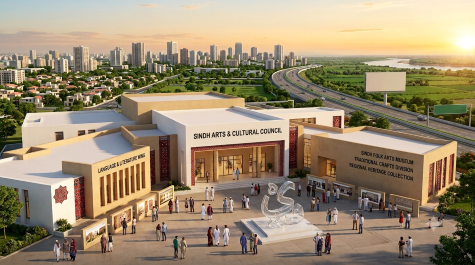
The Government of Sindh should establish a large, prestigious and modern “Sindh Arts & Cultural Council” in Karachi, with regional offices in the divisional headquarters of Hyderabad, Sukkur, Larkana, Shaheed Benazirabad and Mirpurkhas.
This institution should serve as a comprehensive platform for the promotion of the Sindhi language, literature, music, arts, culture, history, folk heritage and the civilizational identity of Sindh.
It should be made mandatory for all public and private universities, educational institutions, important government buildings, highways, main roads and public places to display the names of institutions and locations prominently in the Sindhi language alongside Urdu and English wherever those names are already displayed in all major cities, including the capital, Karachi.
8) Bilingual/Trilingual Public Signage Including Sindhi Language at All Boards, Roads and Buildings.
It should be made mandatory for all public and private universities, educational institutions, important government buildings, highways, main roads and public places to display the names of institutions and locations prominently in the Sindhi language alongside Urdu and English wherever those names are already displayed in all major cities, including the capital, Karachi.
This would further promote the official, educational and social use of the Sindhi language.
9) Strengthening Balanced Social, Cultural and Political Representation in Karachi.
All progressive parties, particularly those that claim to represent the rights of the public, should establish their central headquarters in Karachi so that a balanced environment of political presence, public outreach and social harmony can be maintained in the capital city of Sindh.
Last but Not the Least
The people of Sindh should not remain indifferent to their demography, culture, language, land and natural resources. Serious, lawful and democratic debate and policy are required regarding rapid urban expansion, unregulated housing schemes, land conversion and the rapid growth of population taking place in Karachi and other major cities of Sindh.
Large housing projects such as Bahria Town also provide an opportunity to consider what policy should be adopted in the future regarding the land, resources and demography of Sindh.
If concrete, constitutional, legal, democratic and peaceful measures are not taken now to protect the culture, language, land and demography of Sindh, many new challenges may emerge for future generations concerning the historical and cultural identity of Sindh.
This should not be a message of hatred against any nation or community; rather, it should be a call for serious thought, awareness and lawful struggle for the protection of the historical, cultural, linguistic and constitutional rights of Sindh.
The protection of Sindh’s survival, peace, culture, language, resources and demography is a collective responsibility of every Sindhi.
Read: Strengthening Sindh as a Sustainable Federal Unit
________________
 The Writer is a Civil Servant, Interdisciplinary Student of Law, Linguistics and Sociology, based in Karachi* He can be reached at buriro.za@gmail.com