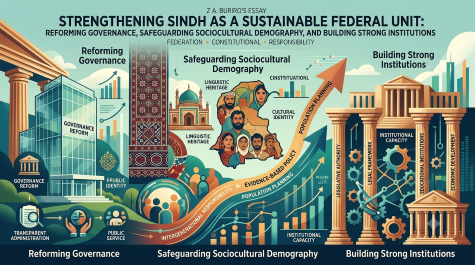
Reforming Governance, Safeguarding Sociocultural Demography, and Building Strong Institutions
- If a large, unchecked influx and internal migration from other regions of the country into Sindh continue on a large scale without adequate planning, documentation, regulation, and integration policies, what institutional mechanisms will be available to protect the legitimate demographic, linguistic, cultural, and socioeconomic interests of the indigenous population?
- And if Sindh’s population were to reach substantially higher levels in the coming decades, would emotional slogans and sentimental attachment alone provide an adequate framework for addressing such complex challenges?
By Z. A. Buriro
One of the principal arguments advanced in favour of creating new provinces—including proposals concerning the administrative reorganization or division of Sindh—is the challenge of governance stemming from population growth, administrative expansion, and the increasing complexity of managing a large and diverse population. Sindh’s population, already numbering in the tens of millions, is frequently cited in this discourse as evidence that existing administrative arrangements may require serious reconsideration.
However, the debate should not be confined merely to emotional attachment, political rhetoric, or sentimental expressions of love for Sindh. The historical, cultural, linguistic, demographic, economic, and administrative interests of Sindh require a long-term, evidence-based, and institutionally sustainable approach.
For decades, a significant segment of the people, political leadership, intellectuals, researchers, and influential stakeholders of Sindh has expressed strong concern regarding the preservation of the province’s demographic character, the Sindhi language and culture, land and other resources, and the constitutional and administrative integrity of the province. Yet, the fundamental question remains: to what extent have these concerns been translated into comprehensive legislation, effective administrative mechanisms, reliable demographic policies, and sustainable institutional safeguards?
Read: Sindh Assembly adopts resolution against division of province
Emotional attachment to one’s homeland undoubtedly has cultural and historical value. However, emotions alone cannot substitute for sound public policy, effective legislation, institutional capacity, accurate demographic data, transparent governance, and legally sustainable administrative arrangements.
This question becomes even more significant when considering long-term demographic trends. If a large, unchecked influx and internal migration from other regions of the country into Sindh continue on a large scale without adequate planning, documentation, regulation, and integration policies, what institutional mechanisms will be available to protect the legitimate demographic, linguistic, cultural, and socioeconomic interests of the indigenous population? And if Sindh’s population were to reach substantially higher levels in the coming decades, would emotional slogans and sentimental attachment alone provide an adequate framework for addressing such complex challenges?
These questions should not be approached through fear, hostility, or antagonism towards citizens of other provinces. Pakistan is a federation, and citizens possess constitutional rights to movement, residence, and livelihood, subject to the law. The real issue, therefore, is how a federal province can simultaneously uphold constitutional rights, ensure equitable access to opportunities and resources, maintain effective governance, and preserve its legitimate historical, linguistic, and cultural interests.
A serious response requires a scientific and institutional framework. This should include evidence-based population planning; transparent and properly maintained land and revenue records; effective Domicile and Permanent Residence Certificate (PRC) systems operated strictly in accordance with the law; rational urban and rural planning; the protection of cultural and linguistic heritage; fair and transparent public-sector recruitment mechanisms; an equitable distribution of development resources; strengthened local government; and appropriate legislation within the constitutional framework.
The objective should not be to exclude citizens on the basis of their provincial origin. Rather, the goal must be to ensure that demographic change, migration, urbanization, and economic development are managed through law, policy, planning, and institutions—rather than through political improvisation or emotional mobilization.
The future of Sindh cannot be secured merely by repeating that Sindh is indivisible or by invoking historical and emotional bonds. Such sentiments may inspire collective consciousness, but the durable protection of any province ultimately depends upon the strength of its institutions, the quality of its governance, the effectiveness of its laws, and the capacity of its people and leadership to formulate and implement long-term public policy.
Therefore, the present moment calls for serious reflection:
What institutional framework should Sindh develop today so that future generations are not compelled to confront tomorrow’s demographic, administrative, cultural, and economic challenges without adequate legal and policy safeguards?
This is not merely a question of political emotion. It is a question of governance, constitutionalism, demography, public policy, and intergenerational responsibility.
It is high time to think beyond slogans—and to think in terms of institutions, legislation, evidence, and long-term strategy.
Read: Respect Sindh, Strengthen Pakistan
_________________
 The writer is a civil servant and an interdisciplinary student of law, linguistics, and sociology.