The Journey That Never Ends
Lofoten: The Road Ends at Å, but the Journey Never Really Does


The road carried us farther and farther towards the western end of Lofoten. And then we arrived at Å. Yes, simply Å. One letter.
- My mind travelled thousands of kilometers away. From Å in northern Norway to Moro in Sindh. I remembered some Surhio families in Moro who have long been involved in selling fishing-related materials to fishermen, particularly those associated with Manchar Lake. Cold northern waters and the warmer landscape of Sindh. Lofoten fishing villages and Manchar Lake. Yet the basic human connection was remarkably similar.
By Abdullah Usman Morai | Sweden
It was still July 2026, but somehow our time in Lofoten was already coming to an end.
There is something strange about the last day of a journey. Even when you are tired, even when your luggage is packed, and the car is ready to leave, the heart refuses to accept that the journey is ending. You begin to look at ordinary things differently. A road sign suddenly seems memorable. A mountain you have passed several times becomes something you want to photograph again. A small bridge, a roadside beach, a tunnel or even a cup of tea starts carrying the weight of a memory.
That morning, Dr. Imran and I checked out of our accommodation and prepared ourselves for one final drive through Lofoten.
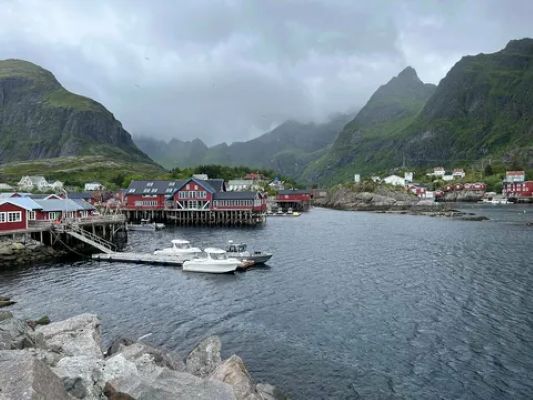 For the past few days, we had been travelling around these islands, and the roads no longer felt completely unfamiliar. We knew some of the curves, some of the tunnels and some of the places where the mountains suddenly opened to reveal the sea. We had become familiar with the rhythm of E10—the main road running through much of Lofoten.
Yet, despite that familiarity, the landscape continued to surprise us.
Mountains remained mountains, but every mountain seemed to have a different personality. Water appeared everywhere, sometimes as a fjord, sometimes as a quiet bay, sometimes as a strip of blue beside the road. Seabirds moved above us, clouds floated around mountain peaks, and the changing northern light kept giving the same landscape a different face.
We had one important advantage on this final day: we were no longer trying to understand Lofoten. We had already begun to understand it. And that made the drive even more enjoyable.
A final morning on E10
We started our journey on E10 once again.
The road carried us through the familiar landscape of Lofoten, mountains rising almost directly from the sea, small settlements tucked into narrow spaces, bridges connecting islands and tunnels disappearing into the rocky landscape.
One of the remarkable things about travelling through Lofoten by car is that the journey itself becomes part of the destination. You do not necessarily need a major attraction every few kilometers. Sometimes the road is enough.
 A turn reveals a beach. Another turn reveals a fishing village. A tunnel takes you through a mountain, and moments later you emerge beside the sea.
Then there is another bridge. Then another mountain. Then another stretch of water.
Lofoten seems to have been designed by someone who disliked straight lines and ordinary landscapes.
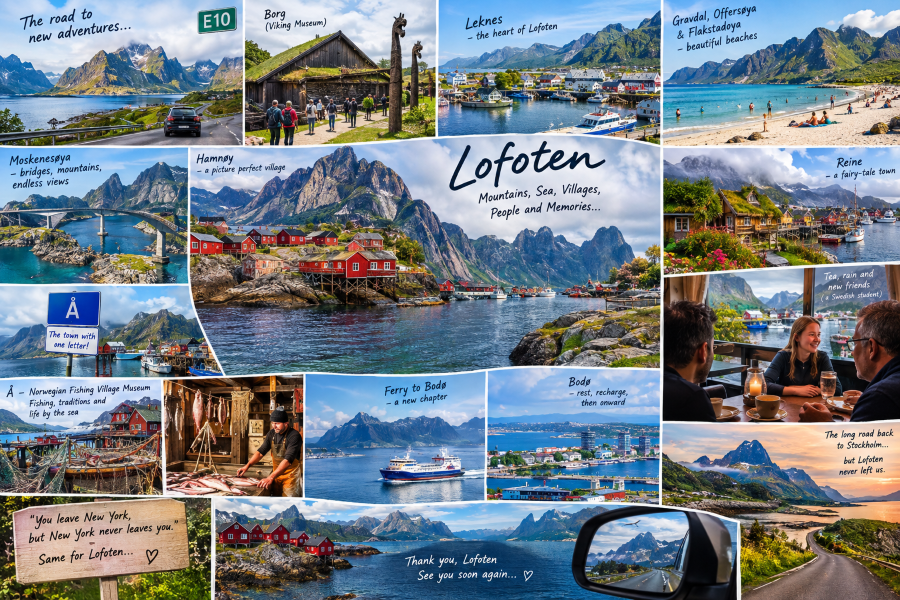
Our first planned stop was Borg.
Borg and the Vikings
Borg is home to the famous Lofotr Viking Museum, built around an archaeological discovery of a Viking Age chieftain’s settlement. The site is particularly significant because archaeologists found the remains of a large chieftain’s house there, and the reconstructed longhouse has become one of Lofoten’s major historical attractions.
The museum is situated on a hill, and as we approached, we could immediately see that this was not going to be a quiet little roadside museum.
There were many visitors. Cars were parked around the area, families were walking towards the museum, and the whole place had the atmosphere of a popular summer attraction.
The main experience includes the reconstructed chieftain’s house, exhibitions, crafts, and other activities designed to bring Viking Age Lofoten back to life. The museum also has a shop and café, and during the summer visitors can experience additional activities connected with Viking life.
We, however, were working with a different kind of clock. Our time was limited.
We did not plan to enter the full museum complex or spend hours exploring its exhibitions. Instead, we walked around the publicly accessible parts, looked at the surroundings, took in the atmosphere, and allowed ourselves a little glimpse into a place that had been important many centuries before modern roads, cars, and tourists existed.
Standing there, I found myself thinking about how dramatically the meaning of travel has changed.
The Vikings came here because the sea was their highway. Today, we came because the roads are our highway. They depended on boats. We depend on a car. They followed the coastline for survival, trade, and exploration. We followed almost the same geography for curiosity and adventure.
Different centuries, different purposes, but perhaps the same human desire: to see what lies beyond the next mountain.
We eventually left Borg and returned to the road.
 Leknes: the practical heart of the islands
Our next destination was Leknes.
Compared with the tiny fishing settlements scattered across Lofoten, Leknes felt almost like a proper town.
Located on Vestvågøy, Leknes is one of Lofoten’s two places with city status and functions as an important transport and commercial center. It is also a major junction for bus routes across the islands.
For a traveller moving through Lofoten, Leknes has a different character from places like Reine and Hamnøy.
It is less about the postcard image and more about everyday life.
People shop there. Cars refuel there. Buses connect there. Supplies are bought there. For us, Leknes had a particularly practical purpose. Our car needed fuel. So we stopped and refilled the tank.
It was one of those simple travel moments that rarely appears in photographs but is essential to every road trip. Beautiful landscapes may inspire a journey, but fuel keeps the journey moving. Once the tank was full, we continued.
We passed through Gravdal, then Offersøya, and continued towards Flakstadøya.
The landscape became increasingly dramatic.
The sea appeared again and again beside the road. Beaches opened up between mountains. In some places, people were enjoying the northern waters, swimming, sitting near the shore or simply spending time outdoors.
Looking at them, I had to remind myself where we were.
This was the far north.
Yet, on a summer day, people were behaving as if the sea belonged to a Mediterranean holiday.
Only the mountains gave away the real location.
There was something almost surreal about seeing people enjoying beaches beneath enormous Arctic mountains.
In Lofoten, the sea is not merely scenery. It is part of life.
Fishing, travel, tourism, recreation, and settlement have all developed around it. Even the villages seem to lean towards the water.
And as we drove farther west, the feeling of being surrounded by sea became stronger.
 Entering Moskenesøya
Eventually, we reached Moskenesøya. The landscape changed again.
Moskenes is famous for some of the most dramatic scenery in Lofoten, where steep mountains seem to rise almost directly from the ocean, and small bridges and roads connect the islands and settlements.
This was the Lofoten we had perhaps imagined before coming here.
Sharp mountains. Blue-green water. Tiny settlements. Red wooden houses. Bridges. Fishing boats. And roads that seemed to disappear into the landscape.
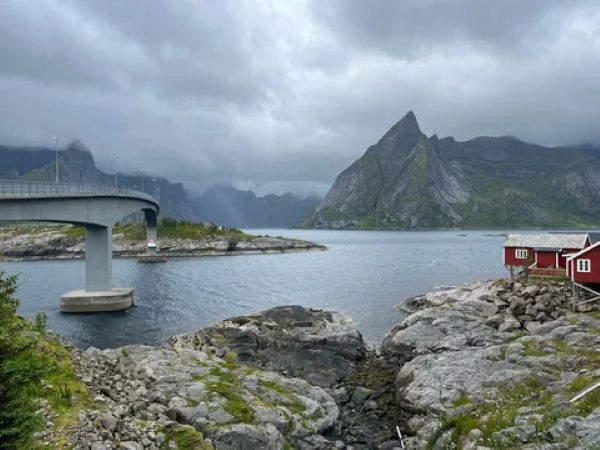
One of our stops was Hamnøy. And what can I say about Hamnøy? Sometimes a place needs very few words. You see it, and the first reaction is simply: Wow.
Hamnøy is famous for its red rorbuer, the traditional fishermen’s cabins, and its dramatic setting between mountains and water. The village has become one of the iconic images associated with Lofoten.
The red wooden houses seemed almost too perfectly placed. They stood near the water, surrounded by mountains, as if someone had carefully arranged them for a photograph. And then there was the bridge. The bridge itself became part of the experience.
There was a walking facility where visitors could walk and stop to admire the scenery. We did not simply want to pass through. We wanted to stand there for a while and look.
The water was calm. The mountains were enormous. The houses were red. Boats moved quietly around the harbour. And somewhere nearby, fish and chips were available.
That last detail somehow made the whole scene feel more human. Beautiful landscapes are wonderful, but food has a way of bringing a traveller back to earth.
You can stand before a mountain and feel philosophical. Then you smell fish and chips and suddenly become very practical. We continued our journey.
 Reine: a village that looked almost imagined
Then came Reine.
I had seen photographs of Reine before travelling to Lofoten, but photographs do not fully prepare you for the real place.
Reine is one of the most photographed settlements in Norway, and it is easy to understand why. The village sits among islands, fjords and dramatic mountains, with traditional fishermen’s cabins and a landscape that looks almost unreal.
For me, Reine felt like a fairy-tale town. Not a fairy tale with castles and princes. A different kind of fairy tale. A northern one. Wooden houses instead of castles. Fishing boats instead of royal ships. Steep mountains instead of palace walls. And water everywhere.
It was raining slightly when we arrived. But somehow the rain made Reine even more beautiful.
The colours became softer. The mountains looked darker. The water reflected the grey sky. The wooden buildings appeared warmer against the cool landscape.
Near the water, we found beautifully designed wooden seating structures. Their roofs were covered with plants, almost as though nature had slowly begun reclaiming the architecture.
They stood in a park-like area close to the water and boats. I looked at them and thought: This is what happens when architecture does not try to defeat nature but learns to live with it.
There was no need for excessive decoration. Wood. Grass. Water. Mountains. Boats. Rain.
Everything belonged together. We decided to have tea.
For me, travelling and tea have always had a close relationship.
Whether in Sindh, Stockholm, Rome, Norway, or somewhere completely unexpected, tea creates a small pause in the middle of movement.
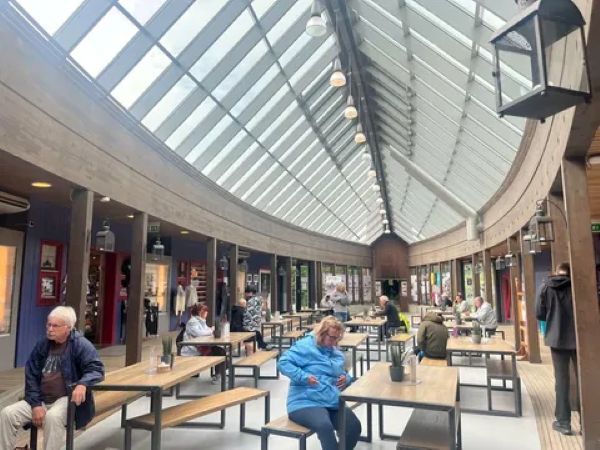 We entered a nearby café. It was cosy.
Outside, Reine was wet with rain. Inside, there was warmth, conversation, and the comfortable atmosphere of a place where people could sit for a while.
Some students were working there. And then came one of those small coincidences that make travel memorable. We met a student who was Swedish and working there during her school holidays.
A Swedish student working in a café in Reine, at the far end of Lofoten, while we were two travellers from Sweden exploring Norway.
It was a small meeting, but these are the encounters that often remain in memory longer than famous monuments.
You travel thousands of kilometers, and sometimes the most memorable conversation is with a person you never expected to meet.
We finished our tea. But time was moving. And this was where our Pakistani sense of humour came into play.
On the backs of trucks in Pakistan, one sometimes sees the phrase: “Zid nahen, time dee majboori ae.” In other words: It is not stubbornness; it is the compulsion of time.
That day, time was indeed our compulsion.
We wanted to stay longer. We wanted to explore more. We wanted to sit beside the water and perhaps wait for the rain to stop. But we could not. We had another destination ahead.
Å, the town with a one-letter name
So, we continued. The road carried us farther and farther towards the western end of Lofoten.
And then we arrived at Å. Yes, simply Å. One letter.
I have travelled to many places and heard countless town names, but I cannot remember having visited another town whose entire name consisted of a single letter. Even the name itself feels like a curiosity.
But Å is much more than a strange name on a road sign.
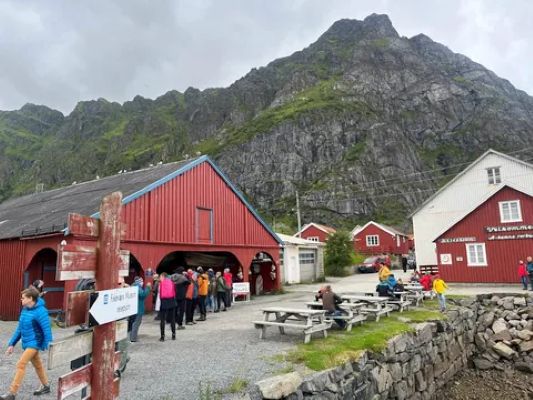
It is a historic fishing village and, for many travellers, the final destination at the western end of the E10 through Lofoten. The village is home to the Norwegian Fishing Village Museum, one of the best-preserved old fishing villages in Northern Norway.
There was something special about arriving there.
Perhaps because we knew that the road was almost ending.
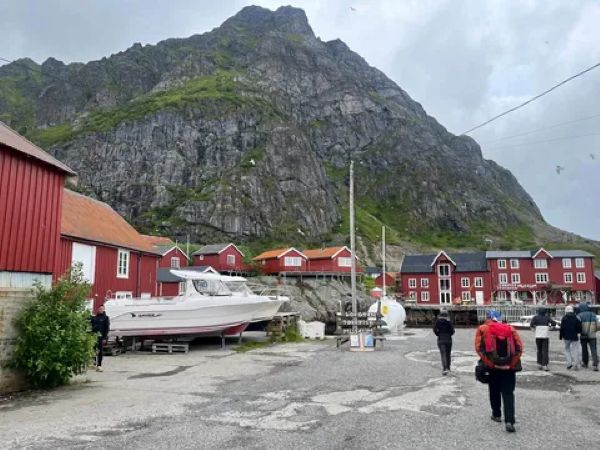
Perhaps because the landscape had become so compressed, mountains, sea, wooden houses and fishing infrastructure all appearing within a small area.
Or perhaps simply because Å had that unmistakable feeling of a place whose identity had been built around the sea.
Fishing was everywhere. The boats. The wooden buildings. The equipment. The smell. The structures. The stories.
This was not a village that had recently discovered tourism. Tourists had arrived, of course.
There were plenty of them. But underneath the tourism was a much older identity. A fishing community.
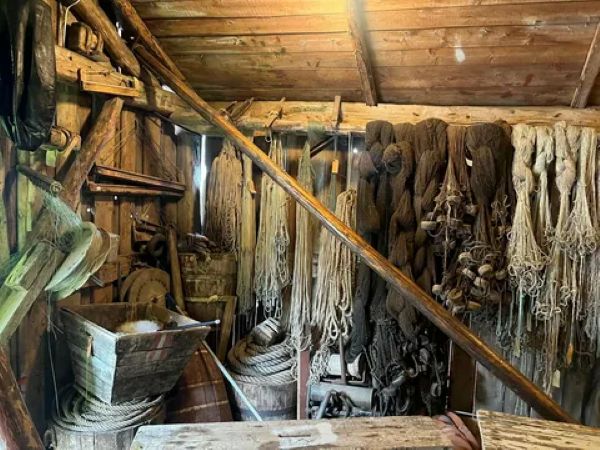 A museum that brought Moro to mind
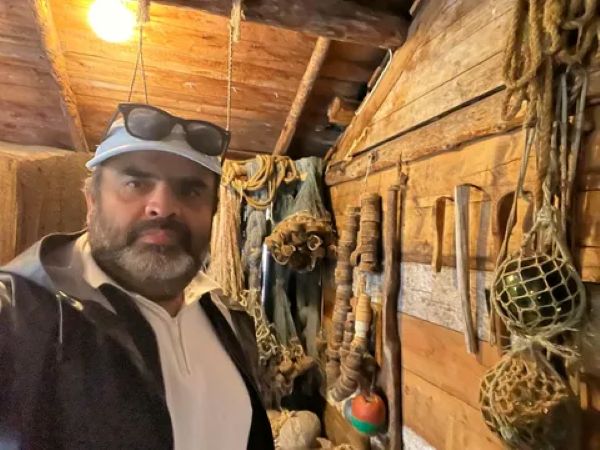
We visited the Norwegian Fishing Village Museum.
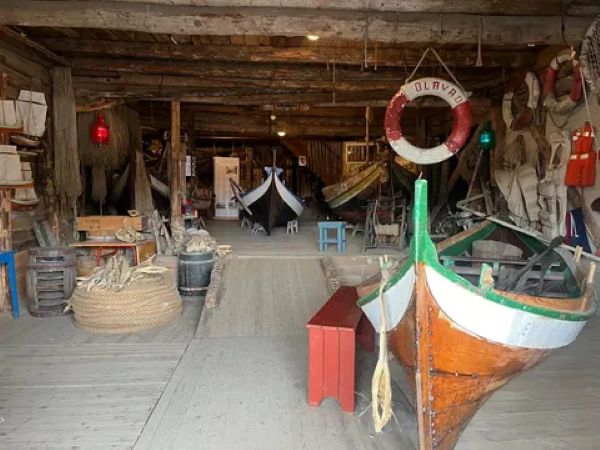
The museum preserves authentic buildings associated with traditional fishing-village life, including a boathouse, cod-liver-oil factory, fisherman’s cabin, smithy, post office, bakery and other historic structures. It presents life in the village and the Lofoten fishery, particularly from around 1840 to 1960.
The museum was relatively small in appearance, but it was full of people.
As I entered and looked around, something unexpected happened.
My mind travelled thousands of kilometers away. From Å in northern Norway to Moro in Sindh.
I remembered some Surhio families in Moro who have long been involved in selling fishing-related materials to fishermen, particularly those associated with Manchar Lake.
The surroundings were completely different.
Norway and Sindh.
Cold northern waters and the warmer landscape of Sindh. Lofoten fishing villages and Manchar Lake. Yet the basic human connection was remarkably similar.
Where there is water, there are people whose lives depend on water. Where there are fishermen, there are people who provide them with boats, nets, equipment, tools, and other necessities. Where there is a livelihood, an entire small economy develops around it.
That was one of the most interesting things about the museum for me.
It was not simply displaying old objects. It was telling the story of a community.
The museum’s historic buildings include the old shop, boathouse, cod-liver-oil factory, fisherman’s cabin, and bakery. The collection and displays show how fishing, boat traditions, stockfish, crafts, and everyday life were connected.
There was something very human about seeing the tools and spaces used by people who lived here generations ago.
A fisherman did not simply go to sea. Behind him was a whole network. Someone repaired equipment. Someone prepared food. Someone maintained boats. Someone worked with fish. Someone baked bread. Someone sold supplies. Someone processed the catch. Someone waited at home.
A fishing village was an economic system built around the sea. And perhaps that is why the museum reminded me of Moro.
Different geography. Different climate. Different history. But ordinary people everywhere understand work.
Fresh fish, old techniques
One of the memorable sights in Å was seeing people working with freshly caught fish.
There was a place where fishermen were cutting the fish using their traditional techniques. The movement of the knife. The handling of the fish. The familiarity of the workers with their task. It was not a performance in the artificial sense. It looked like knowledge passed from one generation to another. And again I thought about how many traditional occupations around the world contain knowledge that is rarely written down.
People learn by watching. By doing. By making mistakes. By repeating. By listening to older people. This is how communities preserve knowledge.
A book can tell you how something is done. But a person who has done it for decades can show you. That kind of knowledge is difficult to measure.
The museum was crowded, and tourists moved between the buildings, taking photographs and exploring the old structures.
Souvenirs were available too. As is often the case in famous tourist destinations, some of them felt a little expensive. But perhaps that is part of travelling.
You look. You compare. You smile. Sometimes you buy something. Sometimes you decide the memory is enough.
For me, the real souvenir of Å was not something that could fit into a suitcase.
It was the connection I had unexpectedly made between this tiny Norwegian fishing village and the fishing communities I knew from Sindh.
 The road had reached its end
Eventually, we had to leave Å. We returned towards Moskenes. The same roads looked slightly different on the return journey. Perhaps because we knew that this was the last time we would be driving through them on this trip.
There is a strange emotional quality to travelling back along the same road. On the way there, every bend carries anticipation. On the way back, every bend carries memory. We had now seen the western end of Lofoten. We had passed Reine. We had stood in Hamnøy. We visited. We had seen the Viking heritage at Borg. We had driven through Leknes, Gravdal, Offersøya and Flakstadøya. We crossed bridges, passed beaches, entered tunnels and followed roads squeezed between mountains and sea. And now we were heading towards Moskenes. The next stage of our journey was very different. We were leaving the islands by ferry.
Waiting for the ferry to Bodø
At Moskenes, we put the car into the queue. The ferry terminal was busy. Cars waited in lines, each one carrying its own little story. Some people were finishing their holidays. Some were beginning theirs. Some were returning home. Others, like us, were simply moving on to the next chapter. Our ferry would take us to Bodø.
The direct Bodø–Moskenes ferry is one of the main connections between Lofoten and mainland Norway, and the crossing takes roughly three and a half hours; vehicles can travel on the ferry as well.
For us, this ferry was more than transport. It was a transition. The road trip through Lofoten ended. A different road trip was about to begin.
We planned to stay one night in Bodø and then start the long journey directly back towards Stockholm.
Looking at the map, the distance was not small. And we knew it would be demanding.
Dr. Imran and I had already spent days driving long distances through northern Sweden and Norway. Now another long drive awaited us.
 But by then, we had learned something important about road trips: The map tells you the distance. The body tells you the difficulty. And the mind tells you whether the journey is worth it. We knew the journey would be tiring. But we also knew that we had already made it this far. So we would make it home. And we did.
Bodø: the next chapter
Bodø sits on a peninsula on the Norwegian coast and is an important regional center, combining a compact urban environment with mountains, sea and access to the wider Salten region.
Arriving there after Lofoten felt different.
Lofoten had been dominated by tiny fishing villages, narrow roads, mountains and water.
Bodø had more of a city feeling. But it was still unmistakably northern. The sea was nearby. The landscape remained dramatic. And the Arctic light was still part of the experience.
Bodø is also a transport hub, with roads, ferries, express boats, trains and flights connecting it with other parts of northern Norway.
For us, however, Bodø was not another major sightseeing chapter. It was a resting point. One night. A pause. A chance to sleep before beginning the long journey back to Stockholm. Looking back, I think that was the right decision.
Sometimes a traveller has to understand that not every place needs to be conquered. You do not have to see everything. You do not have to visit every museum. You do not have to climb every mountain. Sometimes you simply need to arrive, eat, sleep and continue.
The following day, Dr. Imran and I began our long drive towards Stockholm.
It was demanding, as expected. But somewhere along the way we realised something quite important: Perhaps we could have taken a proper break somewhere in the middle. The road was long enough to teach us that lesson.
When you travel by car across northern Scandinavia, distances can be deceptive. On a map, one road looks like a line.
In reality, it is mountains, tunnels, bridges, bends, weather, fuel stops, food, fatigue, and countless small decisions.
But eventually, Stockholm came closer. And then, finally, we made it.
“You leave New York, but New York never leaves you”
A few years ago, when we were leaving New York City, my nephews, Moiz and Salar, told me something that stayed with me.
They said:
“You leave New York, but New York will never leave you.”
At the time, I thought it was simply a beautiful sentence someone had somehow picked up.
But later I get, the more I understand it. Some places remain inside you. You leave them physically, but they continue to exist in your memory.
The smell brings them back. A photograph brings them back. A particular road sign brings them back. Sometimes even a cup of tea can take you back to a place thousands of kilometers away. And now I believe the same sentence belongs to Lofoten.
You leave Lofoten, but Lofoten will never leave you.
Because how can you forget a place where mountains meet the sea so dramatically? How can you forget red fishing cabins hanging above cold northern waters? How can you forget bridges connecting tiny communities? How can you forget the strange beauty of Å, a town whose name consists of one letter? How can you forget sitting in a café in Reine while rain falls outside, sipping tea and discovering that a Swedish student is working there during her school holiday? How can you forget Hamnøy? How can you forget the long roads through Flakstadøya? How can you forget seeing people enjoying beaches beneath Arctic mountains? How can you forget Borg and the memory of Vikings?
And how can I forget standing inside a Norwegian fishing museum and suddenly thinking about the Surhio families of Moro and their connection with the fishermen of Manchar Lake?
Perhaps that is what good travel does. It does not simply show you another place. It connects another place with the places you already know. A Norwegian fishing village can remind you of Sindh. A Scandinavian Road can remind you of Pakistan. A student in a café can remind you how small the world really is. A bridge can become a memory. A cup of tea can become a chapter. A road can become a story. And a landscape can become something that stays with you long after the luggage has been unpacked.
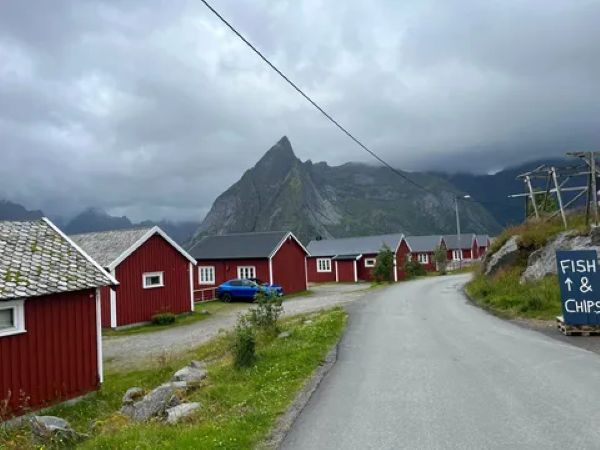 The last look back
Our Lofoten journey began with curiosity. We had arrived wanting to see what was there. By the end, we were leaving with a strange feeling that we had not seen enough. Perhaps that is the nature of beautiful places. You never feel finished with them. There is always another road. Another village. Another beach. Another mountain. Another tunnel. Another bridge. Another café. Another conversation. Another view that you did not have time to stop for. And perhaps that is perfectly fine. Travel does not need to be complete to be meaningful. Sometimes the unfinished parts are exactly what bring us back.
As we drove away, I thought about all those days in Lofoten, the mountains, the sea, the birds, the clouds, the roads, the tunnels, the fishing villages, the red houses and the changing weather.
We had come to Lofoten for the landscape. But we were leaving with stories about people. The student in Reine. The fishermen in Å. The tourists walking across the bridge at Hamnøy. The people enjoying the beaches. The workers at the museum. The people running cafés and shops. The countless ordinary people who make extraordinary landscapes into living places.
That is perhaps the most important lesson of travel.
A destination is never only its scenery. The mountain is beautiful. The fjord is beautiful. The beach is beautiful.
But a place becomes memorable because of the human life that exists between those things.
 Goodbye, Lofoten
Eventually, our journey took us away from the islands.
The ferry carried us from Moskenes towards Bodø, and from there the road carried us farther and farther south and east.
The dramatic Lofoten landscape slowly became a memory.
But I kept thinking about Å. About Reine. About Hamnøy. About the road. About the rain. About the tea. About the red houses. About the sea. About the mountains. About the Viking history at Borg. About the old fishing village. About Moro. About Manchar Lake. About how two places separated by thousands of kilometres can sometimes feel connected by something as simple as fishing. And then I remembered those words again:
“You leave New York, but New York will never leave you.”
Yes.
It is true for New York. But it is also true for Lofoten.
We left Lofoten. But Lofoten did not leave us.
It travelled with us in photographs, conversations, memories and stories. It travelled with us all the way from Moskenes to Bodø, from Bodø through the long Scandinavian roads, and eventually back to Stockholm.
Perhaps that is the real destination of every journey, not the place where you arrive, but the memories you carry home.
Thank God, the journey went smoothly. The long roads were crossed. The ferry carried us safely. The car brought us home. And the story of this particular journey came to an end.
But only on the map. Because some journeys never really end. They simply become memories waiting to be told again.
See you soon again, Lofoten.
Maybe not tomorrow. Maybe not next year. But somewhere, someday, another road will bring us back.
And when that happens, I know what the first feeling will be.
I will look at those mountains rising from the sea, take a deep breath, and probably say the same thing we said so many times during this journey:
Wow.
Read: Sweden: Quiet Power of Ordinary Voters
_______________________
Abdullah Soomro, penname Abdullah Usman Morai, hailing from Moro town of Sindh, province of Pakistan, is based in Stockholm Sweden. Currently he is working as Groundwater Engineer in Stockholm Sweden. He did BE (Agriculture) from Sindh Agriculture University Tando Jam and MSc water systems technology from KTH Stockholm Sweden as well as MSc Management from Stockholm University. Beside this he also did masters in journalism and economics from Shah Abdul Latif University Khairpur Mirs, Sindh. He is author of a travelogue book named ‘Musafatoon’. His second book is in process. He writes articles from time to time. A frequent traveler, he also does podcast on YouTube with channel name: VASJE Podcast.