

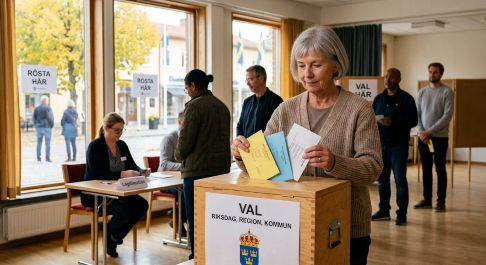
Living between two distinct political landscapes offers a unique lens on the mechanics of democratic life.
While political passion burns bright across both Sweden and Pakistan, the true measure of a democracy lies not in the volume of its rallies, but in the institutional trust that guarantees every vote is genuinely respected, counted, and reflected in the state.
By Abdullah Usman Morai | Sweden
Something is fascinating about living in a country where elections are not merely an event that appears on television every few years, but an important part of everyday democratic life. Here in Sweden, September brings an atmosphere of political expectation. People discuss parties, candidates, policies and, perhaps most importantly, what kind of society they want to live in.
This is the month when Swedish voters choose representatives at several levels of government. They vote for their municipality (kommun), region and the national parliament (Riksdag). Each election matters because each level of government affects a different part of people’s lives.
For an outsider, this may sound like a routine description of democracy. But for someone who has also experienced politics and elections in South Asia, particularly Pakistan, the Swedish system can sometimes feel remarkably different.
The most striking difference is the sense that your vote is expected to count and that institutions are expected to respect that vote.
The Meaning of a Ballot
In Sweden, voting is not simply about choosing a political party. It is about expressing a preference and participating in the direction of society.
A voter may have different priorities at different levels. One party may seem more convincing on municipal schools, another may have better ideas for regional healthcare, and a third may be preferred for national politics.
This makes the Swedish system particularly interesting.
A person does not necessarily have to think in terms of one political party for everything. Municipal politics can be about schools, elderly care, local planning, housing and public spaces. Regional politics can involve healthcare and public transport. National politics deals with broader questions such as the economy, taxation, defence, immigration, education and Sweden’s place in the world.
In other words, democracy comes closer to everyday life when people understand that different votes can have different purposes.
And that is perhaps one of the most important lessons of elections: politics is not only about leaders. It is about decisions that eventually reach people’s homes, workplaces, schools, hospitals and neighbourhoods.
Elections Are More Than Election Day
Another feature that I find interesting is the flexibility surrounding voting.
In Sweden, people do not necessarily have to wait until election day to cast their vote. There are opportunities for advance voting, allowing people to participate before the official election day.
There is also a sense of flexibility for voters who reconsider their choice. Under Sweden’s voting rules, a person who has voted in advance can, in certain circumstances, vote again on election day; the later vote replaces the earlier one.
This may seem like a small administrative detail, but it represents something much bigger: the voter remains at the center of the process.
Imagine someone voting early and then spending the following days listening to political debates, reading party programs or discussing the election with family and friends. If that person genuinely changes their mind, the system provides a mechanism to make that final choice.
It sends a powerful message: your vote belongs to you.
When Institutions Matter
Perhaps the most important difference is not the ballot paper itself but what happens around it.
A democracy is not created simply because people are given ballot papers. Democracy requires institutions that make people believe that their participation has meaning.
If citizens believe that their vote will be counted honestly, that electoral procedures are transparent and that elected representatives are genuinely accountable, they are more likely to participate.
That creates a relationship between the citizen and the state.
The citizen says: “I have a voice.” The institution responds: “Your voice has been counted.” And the elected representative understands: “I am here because people chose me.”
That chain of trust is enormously important.
Thinking About Home
Coming from Pakistan, it is difficult not to make comparisons.
Pakistan is also a country where people care deeply about politics. In fact, political discussions can sometimes be found almost everywhere, from tea stalls and roadside gatherings to family dinners and social media.
People have strong political opinions. They follow political leaders passionately. They argue about elections. They celebrate victories and mourn defeats.
So the problem is certainly not a lack of political interest among ordinary people.
The deeper question is whether citizens always feel that their political participation produces the result they expected.
South Asian politics has experienced repeated controversies surrounding elections, vote counting, electoral administration, political interference and the relationship between elected institutions and other centres of power. In Pakistan, terms such as Form 45, Form 46 and Form 47 have become familiar to politically engaged citizens because of disputes and allegations surrounding election documentation and results.
Whatever one’s political affiliation, such controversies can damage public confidence.
And once people begin to believe that their vote may not determine the outcome, something fundamental is lost.
People may still vote. They may still stand in queues. They may still campaign for their favourite candidates. But somewhere inside, they may begin asking a painful question: Does my vote really matter?

Parliament Should Reflect the People
A parliament is meaningful when citizens believe that the people sitting inside it genuinely represent the people outside it.
That does not mean every voter will agree with every decision. Democracy is not about getting everything you want.
In fact, genuine democracy sometimes means accepting an outcome you strongly dislike.
Your preferred party may lose. Your preferred candidate may not win. A policy you supported may be rejected.
But if you believe the process was fair, you can accept the result and prepare to participate again.
That is one of democracy’s greatest strengths.
You lose today, but you do not lose your right to try again tomorrow.
The government changes. Parliament changes. Political priorities change. But the democratic mechanism remains.
The Quiet Power of Ordinary People
Perhaps this is what I find most interesting about Swedish elections.
There is nothing particularly dramatic about an ordinary person walking into a polling station, receiving ballot papers, making choices and casting votes.
There may be no excitement comparable to a political rally. There may be no enormous crowd shouting slogans.
Yet there is enormous power in that quiet moment.
A pensioner voting about healthcare. A parent thinking about schools. A young person voting for the first time. A commuter considering public transport. A resident thinking about housing, roads, the environment or local development.
Each person brings a different experience into the voting booth.
And democracy is supposed to bring these individual experiences together and transform them into a collective decision.
The Real Test of Democracy
The real test of democracy is therefore not only whether elections are held.
The real test is whether people trust the process, trust the institutions, and believe that their voice has meaning.
An election should not be a ceremony performed merely to produce a predetermined result. It should be a genuine mechanism through which citizens can influence who governs them.
This is why the Swedish election season is exciting to watch.
The final result will tell a story not only about which parties win or lose, but about what millions of ordinary people want from their municipalities, their regions and their country.
And perhaps that is the most beautiful thing about voting.
A person who normally feels small in front of the machinery of the state suddenly possesses something remarkably powerful: one vote.
One voice. One choice.
And when millions of such choices are respected, they become democracy.
For me, that is perhaps the greatest lesson of watching elections in Sweden: democracy becomes meaningful when an ordinary person’s vote is not merely collected, but genuinely counted, respected, and reflected in the institutions that govern society.
Because ultimately, elections are not really about politicians.
They are about people.
And when people believe that their voice matters, they have a reason to participate in the future of their country.
Read: Afghan Students: Don’t Break Their Dreams
______________________
 Abdullah Soomro, penname Abdullah Usman Morai, hailing from Moro town of Sindh, province of Pakistan, is based in Stockholm Sweden. Currently he is working as Groundwater Engineer in Stockholm Sweden. He did BE (Agriculture) from Sindh Agriculture University Tando Jam and MSc water systems technology from KTH Stockholm Sweden as well as MSc Management from Stockholm University. Beside this he also did masters in journalism and economics from Shah Abdul Latif University Khairpur Mirs, Sindh. He is author of a travelogue book named ‘Musafatoon’. His second book is in process. He writes articles from time to time. A frequent traveler, he also does podcast on YouTube with channel name: VASJE Podcast.


