The annual Ramapir mela at a small Sukkur village draws Hindus and Muslims together around an all-night satsang, preserving Sindh’s syncretic tradition
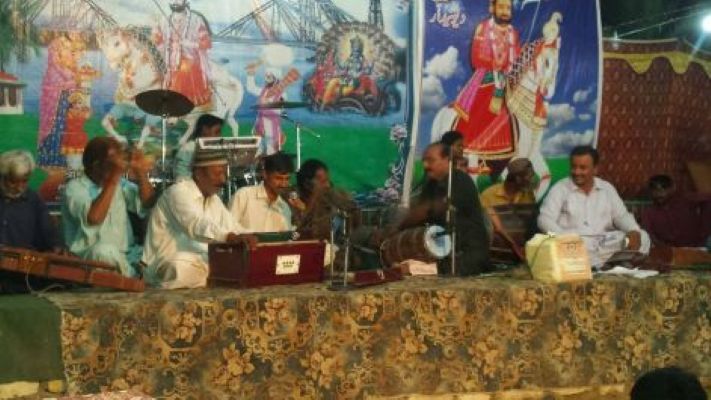
SUKKUR, Sept 13: Long after dusk had settled over the cotton fields of Rohri taluka, the hamlet of Janullah Shah Mari glowed. Lamps flickered in the courtyard of a modest shrine, cymbals kept rhythm, and voices rose and fell in bhajans that continued uninterrupted till dawn. It was Bhadav 1st; the first day of Bhadon in the Sindhi calendar and for the Meghwar community here, the night of Ramapir.
What looks from the outside like a village fair is, for those who keep it, something far more deliberate: an act of memory.
 For over a century, the Meghwar families of northern Sindh have gathered at Janullah Shah Mari to mark the annual mela of Ramapir; the 14th-century saint of Rajasthan, known in folklore as Ramdev Pir, Baba Ramdevji and, across the Thar, simply as a Pir whose shrine belongs to everyone.
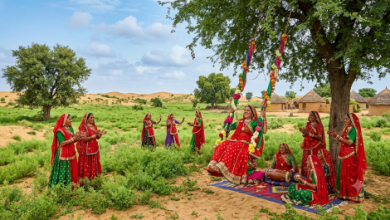
This year was no different. Devotees arrived from Sukkur, Khairpur, Ghotki and from towns of upper Sindh, many travelling overnight. Women carrying diyas, elders leading children by the hand, and alongside them, their Muslim neighbors from surrounding villages, who joined the gathering not as guests but as participants; a tradition that, locals say, has never been broken.
“The mela was started by our great-grandfather, Shri Naibhoo Mal,” says Shevadari Teerath Mal-Naroo Mal, custodian of the shrine at Janullah Shah Mari. “Since his time, we have celebrated it together with Muslims of this area. It was never only our festival.”
 That shared ownership is the most striking feature of the Janullah Shah Mari mela. In a province where large shrines command headlines, this small village observance preserves the intimate grammar of Sindh’s pluralism; grandparents teaching verses, neighbors sharing langar, and an all-night satsang where the life of the saint is recited not as myth but as moral instruction.
A saint across boundaries
Ramapir, born in 1352 in Bhatt Nagar, Rajasthan, to Raja Ajmal, is remembered in history and oral tradition for renouncing a Rajput royal household to stand with the poor and those pushed to the margins of caste society. His close association with Sufi saints of his time, his rejection of caste hierarchy, and stories of creating water in drought and healing the sick, gave him a following that never fitted neatly into one faith.
He died in 1385, but his principal shrine at Ramdevra in Rajasthan continues to draw hundreds of thousands. Across the desert, in Sindh, his presence is quieter but deeply embedded from the grand Ramapir Mandir at Tando Allahyar, still one of the largest annual pilgrimages for Pakistani Hindus, to smaller centers in Mirpurkhas, Hyderabad, Tando Muhammad Khan, Badin and now Sukkur division.
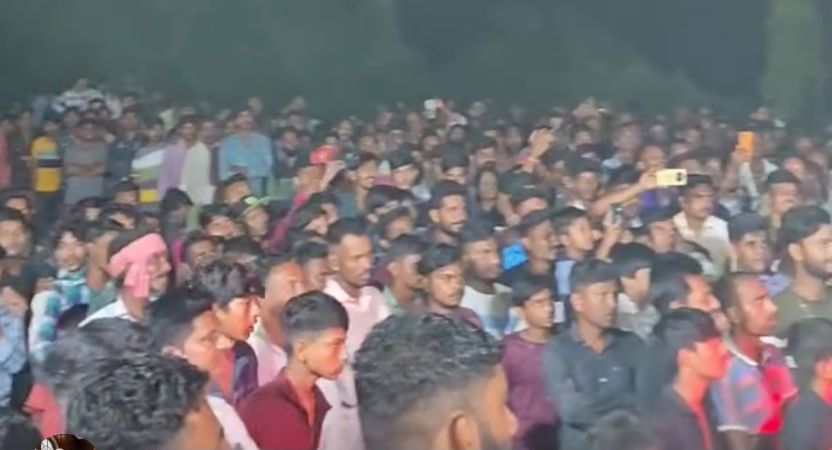 In Janullah Shah Mari, the emphasis is not on grandeur. There are no towering gates, no loudspeakers from afar. The ritual is the Satsang itself: devotees remaining awake through the night of Bhadav 1st, singing, praying, and retelling what their elders told them.
For scholars of Sindh’s syncretic tradition, this is precisely its value.
“Sindh’s cultural history has never been divided neatly along religious lines,” a Sukkur-based historian who attended the mela observed. “Its saints, its poetry, its melas created third spaces where people met not despite their religion, but through a shared idiom of respect.”
More than a fair
Ramapir’s own teachings, as preserved in bhajans and kafi-like verses sung at the mela, are disarmingly simple: love and brotherhood as the basis of human dignity; equality beyond caste; respect for all faiths; and service to the poor as the highest worship.
In a year when sectarian divides dominate headlines, the message resonated.
Participants described this year’s gathering as larger than previous years, with more young families present. Children were seen learning the words of bhajans from elders, while Muslim youth from neighboring settlements helped arrange mats and distribute food.
It is, as one devotee put it, “not a festival of Hindus or Muslims. It is a festival of Sindh itself.”
 As the lamps burnt low on Friday morning and the last verses of the Satsang faded, the mela at Janullah Shah Mari concluded as it always has with a prayer for all with special prayers for peace, stability and prosperity of Pakistan, and for the preservation of interfaith harmony and communal coexistence in Sindh.
In a province whose soil has raised Sufis, saints and poets who preached love above ritual, the Ramapir mela endures not because it is old, but because it remains useful. It reminds those who gather that faith, in Sindh, has long been a bridge rather than a boundary and that some traditions survive precisely because they teach people how to live together. (Press Release)
_________________