British Infrastructure Legacy in Pakistan-7
British-Era Airports and Airstrips of Pakistan

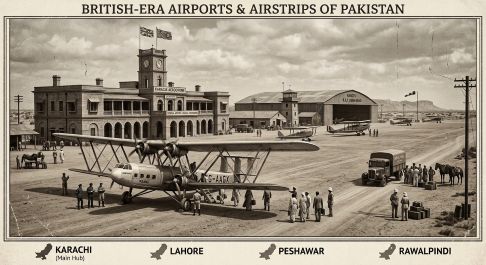
The first aerodromes appeared during the early twentieth century, initially for military aviation, postal services and imperial communications.
During the 1920s and 1930s, Karachi, Lahore, Peshawar and Rawalpindi became important points in the emerging air network. By 14 August 1947, Pakistan inherited one major airport at Karachi and three other established airports at Lahore, Rawalpindi and Peshawar, together with military and auxiliary airfields. The British aviation legacy was therefore different from their road or railway legacy. They did not leave Pakistan a dense national network of modern airports. Instead, they left a strategic system of major aerodromes and military airfields concentrated around Karachi, Lahore, Rawalpindi, Peshawar, Quetta and frontier locations.
By Ramesh Raja
Unlike roads, railways and irrigation, aviation was a comparatively new technology when the British developed the air network of the territory that became Pakistan. The first aerodromes appeared during the early twentieth century, initially for military aviation, postal services and imperial communications. During the 1920s and 1930s, Karachi, Lahore, Peshawar and Rawalpindi became important points in the emerging air network.
By 14 August 1947, Pakistan inherited one major airport at Karachi and three other established airports at Lahore, Rawalpindi and Peshawar, together with military and auxiliary airfields.
Part A: Karachi
- Drigh Road Aerodrome: Civil and Military Airport
The most important British-era aviation facility in present-day Pakistan was Drigh Road Aerodrome, Karachi, now the site of Jinnah International Airport and PAF Base Faisal. The airfield was established around 1920, with the first aerodrome completed in 1924.
Karachi’s geographical position made it exceptionally important to British imperial aviation. In 1929, Imperial Airways began operating through Karachi, making it an important stop on the developing Europe-Asia air route. In 1932, J. R. D. Tata operated the pioneering Karachi-Bombay airmail service from Drigh Road.
During the Second World War, Drigh Road became a major military aviation and aircraft-maintenance center. It contained large maintenance and supply facilities and was also used by American forces for aircraft assembly, repair and movement towards the China-Burma-India theatre.
- Karachi Airship Facilities
An extraordinary British project at Karachi was the enormous airship hangar constructed for the Imperial Airship Communications Scheme. Construction began in the late 1920s. The proposed hangar was approximately 261 meters long, 61 meters wide and 52 meters high. It was intended to accommodate Britain’s giant R101 airship, although R101 crashed in France before reaching Karachi.
Part B: Peshawar
- Peshawar Aerodrome: Civil and Military Airfield
The present Bacha Khan International Airport traces its origins to 1927, when a small airfield was established for aircraft travelling through the British Empire. Its strategic position made Peshawar a gateway between India, Afghanistan and routes towards the Middle East and East Asia.
The airfield was also an important RAF and military aviation station. British aircraft operated from Peshawar from the First World War period, and RAF formations were based there during the interwar and Second World War years.
Thus, Peshawar’s airfield served both military and civil aviation, particularly because of its proximity to the Khyber Pass and Afghan frontier.
Part C: Rawalpindi and Chaklala
- Chaklala Aerodrome: Military and Civil Aviation
Chaklala, near Rawalpindi, developed as an important British military air station. Its location near the military headquarters and cantonment made it particularly valuable for defence and troop movement.
During the Second World War, Chaklala became an important Royal Air Force and transport aviation facility. By the end of British rule it formed part of the established aviation infrastructure inherited by Pakistan around Rawalpindi.
Part D: Lahore
- Lahore Aerodrome: Civil and Military Airfield
Lahore also possessed an established aerodrome before independence and was one of the four airports inherited by Pakistan in 1947.
Its importance came from Lahore’s position as the principal city of Punjab and a major administrative, commercial and military center. The airfield connected Lahore with Karachi, Delhi and other cities of British India and was subsequently incorporated into Pakistan’s civil aviation system.
Part E: Frontier and Military Airstrips
- Kohat Airfield
Kohat was an important RAF station because of its strategic location on the frontier. British military aircraft operated from the area, and the airfield was used for frontier operations, reconnaissance and military communications.
- Mauripur, Karachi
The British also developed Mauripur as a major military airfield during the Second World War. It became an important Royal Air Force and Allied aviation installation. After independence, the facility became part of Pakistan’s military aviation infrastructure.
- Jiwani Airfield
On the Balochistan coast, Jiwani was developed as a strategic aviation and communications station. Its location near the Arabian Sea and the approaches to the Persian Gulf gave it military and navigational significance. It subsequently became Jiwani Airport.
Airfields and the Second World War
The Second World War dramatically expanded British aviation infrastructure in the territory of present-day Pakistan. Existing aerodromes were enlarged and additional military landing grounds and maintenance facilities were established. Karachi became particularly important because aircraft, equipment and supplies could arrive through the port and then be assembled, repaired and dispatched to operational theatres.
The 1947 RAF records show major aviation establishments at Drigh Road, Karachi, Chaklala, Peshawar and Kohat, demonstrating the extensive military aviation infrastructure that existed immediately before independence.
The Aviation Network Pakistan Inherited
The British aviation legacy was therefore different from their road or railway legacy. They did not leave Pakistan a dense national network of modern airports. Instead, they left a strategic system of major aerodromes and military airfields concentrated around Karachi, Lahore, Rawalpindi, Peshawar, Quetta and frontier locations.
Karachi was the principal international gateway. Peshawar served the north-western frontier. Rawalpindi and Chaklala supported the military establishment. Lahore served Punjab’s political and commercial center, while Balochistan’s airfields provided strategic access to the vast western territory.
By independence, these facilities had established the basic geography of Pakistan’s aviation system. The first post-independence air routes reflected this inheritance. In 1947, the early Orient Airways network included Karachi-Lahore-Rawalpindi-Peshawar and Karachi-Quetta-Lahore, demonstrating how closely Pakistan’s initial air network followed the aviation infrastructure and routes developed during the British period.
The British therefore left Pakistan a developing but strategically important aviation system, consisting of civil aerodromes, RAF stations, military airfields, airship facilities, maintenance depots and air routes. Like the roads, railways, bridges, irrigation works and ports, these airfields became part of the infrastructure foundation on which the new state of Pakistan built its national transport system.
Click here to read Part-1, Part-2, Part-3, Part-4, Part-5, Part-6.
_____________________
 The author of this article, Engr. Ramesh Raja, is a Civil Engineer, visionary planner, PMP certified and literary enthusiast with a passion for art and recreation. He can be reached at engineer.raja@gmail.com