British expansion across the subcontinent relied heavily on civil engineering to secure, administer, and economically develop the region. The infrastructure built during this era—spanning transportation, hydraulic networks, and maritime links—ultimately provided the core physical foundation for Pakistan at its independence in 1947.
By Ramesh Raja
The Infrastructure Inherited in 1947
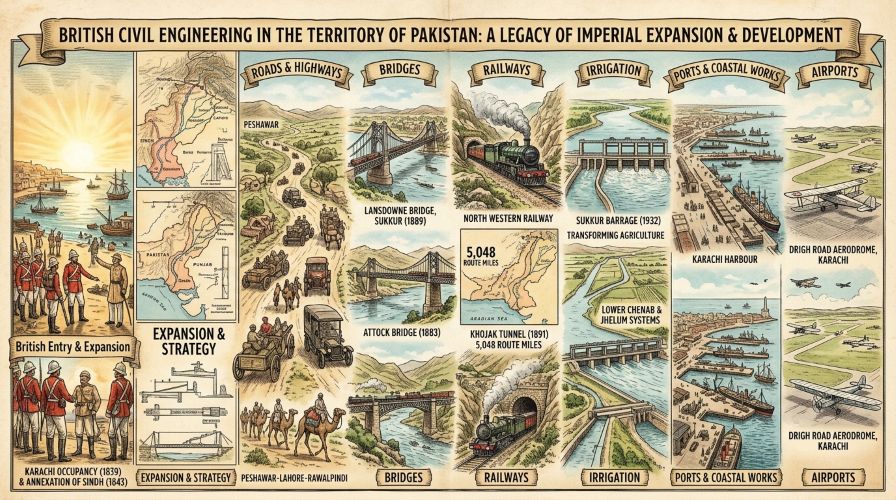
The story of British civil engineering in the territory that became Pakistan cannot be separated from British expansion. Their entry was gradual, beginning with the occupation of Karachi in 1839 during the First Anglo-Afghan War. Sindh was formally annexed in 1843 after the defeat of the Talpur rulers under Sir Charles Napier. Punjab and the settled areas of the North-West Frontier came under British rule after the Second Anglo-Sikh War in 1849. Balochistan followed a different path, with British influence developing through treaties, political agreements, military presence and frontier administration, particularly after the agreements of 1854 and 1876.
Until 1858, these expansions were undertaken under the East India Company. Following the uprising of 1857, authority passed to the British Crown. By 1947, Sindh, Punjab, the North-West Frontier Province and British Balochistan formed the principal British-administered territories that became part of Pakistan, alongside princely states and frontier areas having different political relationships with the British.
From Territorial Control to Engineering Development
As British control expanded, engineering became essential for administration, defence, agriculture, trade and communication.
By independence, Pakistan inherited a substantial civil engineering legacy comprising roads and highways, bridges, railways, mountain tunnels, irrigation canals and barrages, ports and coastal works, and airports and airstrips.
There was no single British engineer responsible for this transformation. Different departments undertook different classes of works. The Public Works Department played a major role in roads and bridges; Irrigation Departments developed canals, headworks and barrages; railway authorities constructed tracks, bridges and tunnels; port authorities developed harbours and coastal facilities; and military and civil aviation organizations established aerodromes and airfields.
Roads and Highways
Road development was among the earliest requirements of British administration. The Grand Trunk Road, particularly the Peshawar-Attock-Rawalpindi-Lahore corridor, became a major artery. In Sindh, roads progressively linked Karachi with Hyderabad, Sukkur and other important centres, while strategic routes in Balochistan connected Quetta with Sibi, Chaman, Zhob and frontier areas. By 1947, the inherited road network was extensive, although historical estimates differ according to definitions and classifications.
Bridges
The expansion of roads and railways demanded major river crossings. British engineers constructed important bridges over the Indus and its tributaries, including Attock Bridge, Lansdowne Bridge at Sukkur and Empress Bridge at Kotri.
Railways
Railways became the backbone of long-distance transportation. The first public railway in present-day Pakistan opened between Karachi and Kotri in 1861. Lines were subsequently extended through Sindh and Punjab towards Lahore, Rawalpindi and Peshawar, while difficult strategic routes penetrated Balochistan and the Khyber frontier. At partition, about 5,048 route miles of the North Western Railway passed to Pakistan.
Tunnels
Mountainous terrain demanded another level of engineering. The Khojak Tunnel on the railway towards Chaman, the tunnels of the Bolan Pass and the Khyber Railway tunnels demonstrated the ability of engineers to construct transportation routes through difficult terrain. Most major British-era tunnels in present-day Pakistan were railway tunnels rather than modern highway tunnels.
Irrigation and Hydraulic Engineering
Perhaps the most transformative legacy was irrigation. Large canal systems, headworks and barrages converted seasonal water availability into controlled irrigation over vast agricultural areas. The Lower Chenab, Lower Jhelum, Upper Chenab, Upper Jhelum and Lower Bari Doab systems reshaped Punjab’s agriculture. In Sindh, the Jamrao system and, above all, Sukkur Barrage, completed in 1932, transformed the province’s irrigated landscape.
Ports, Coastal Works and Airways
Karachi Harbour was progressively engineered through dredging, moles, groynes, breakwaters, piers, wharves and navigation facilities, turning Karachi into a major maritime gateway. Aviation arrived later. Karachi’s Drigh Road Aerodrome, together with airfields at Lahore, Rawalpindi and Peshawar, formed the principal aviation infrastructure inherited at independence, supported by military airfields.
An Engineering Foundation for Pakistan
The British legacy must be viewed in its historical context. Strategic defence, imperial administration, agricultural expansion, trade and economic interests were major motivations. Nevertheless, the resulting infrastructure provided Pakistan with a physical foundation at independence. Roads connected regions, bridges crossed rivers, railways linked ports with the interior, tunnels overcame mountains, irrigation works transformed agriculture, ports connected the country with international trade, and airfields opened a new era of transportation.
In the next parts of this series, each major component will be examined separately and in greater detail, including highways and roads, bridges, railways, tunnels, irrigation and hydraulic works, ports and coastal engineering, and airports and airstrips, with their history, locations, dimensions, engineering significance and contribution to the infrastructure inherited by Pakistan in 1947. (Continues)
Read: Swimming for Health, Swimming for Life
______________
 The author of this article, Engr. Ramesh Raja, is a Civil Engineer, visionary planner, PMP certified and literary enthusiast with a passion for art and recreation. He can be reached at engineer.raja@gmail.com