Swimming for Health, Swimming for Life
Gambat’s Two Canals Are Enough to Build a Healthy Future

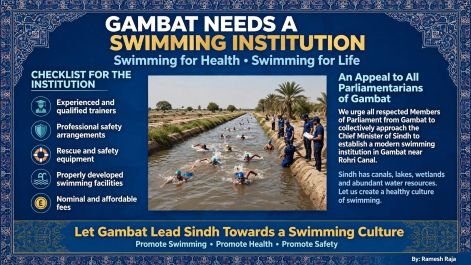
A swimming institution along the Rohri Canal could become a pillar of our well-being and help introduce a new culture of health and fitness.
By Ramesh Raja
One of my fondest memories of Gambat is still fresh in my heart. It takes me back to the days when Abul Wah was clean and flowing in the 1990s. At that time, Abul Wah was not merely a canal to me. It was a place filled with exercise, recreation and the youthful spirit of life. I used to swim there regularly, and perhaps that continuous practice developed in me such a strong attachment to swimming that, with time, I began to consider myself a swimmer. More recently, during my European tour, I even demonstrated my swimming skills with my friends in The Hague.
Swimming is compulsory for every child in the Netherlands. This is one reason why swimming has become such an integral part of life there and why the Dutch are widely regarded as one of the healthiest and most physically active populations in the world.
I am sure our friends Saah Sheikh, Altaf Bhatti, Munir Sheikh, Lutf Sahito, Nazir Sarohi, Kishore Kumar, Hafeez Mangi, Prakash Bebo, Manzoor Gulal and many others, who spend much of their time sitting, eating and thinking that this is the good life, would feel a remarkable difference if they began swimming regularly.
At that time, many young people in Gambat did not need a special club or an expensive facility to swim. Nature itself had provided an opportunity where young people could remain physically active, healthy and energetic.
But Times Have Changed
Today, Abul Wah no longer carries the water that was once a companion of our youth. It has been transformed into a sewage drain. A natural resource that was once connected with health, recreation and life now carries the burden of urban waste.
This transformation is not merely a change in the waterway. It is also a reflection of how our urban priorities and attitudes have changed over time.
But Gambat has not completely lost its relationship with water.
On the eastern side of the city, the Rohri Canal still flows with fresh irrigation water. It is a natural blessing for Gambat. At the same time, because the canal is wide, deep and carries a flowing current, swimming in it without proper supervision is certainly not safe.
Therefore, the solution is not to encourage people to enter the Rohri Canal for swimming.
The solution is to establish a safe, properly designed and affordable public swimming facility alongside the Rohri Canal.
Swimming Is More Than a Sport: It Is a Journey Towards Better Health
We often think of swimming simply as a sport, but its significance goes far beyond sport. It is physical exercise, a source of mental well-being, a means of building confidence and, importantly, a life-saving skill.
Swimming engages many parts of the body at the same time. It supports cardiovascular fitness and helps improve physical strength and endurance. For children, it develops coordination, confidence and discipline. For adults, it can provide an excellent way to remain physically active while escaping the pressures of daily life.
But in a region like Sindh, the importance of swimming is even greater.
We live among rivers, canals, lakes, irrigation channels and, ultimately, the sea. Water is an integral part of our environment and our lives. In such a setting, knowing how to swim is not merely about health and recreation. It can be a life-saving skill.
Every year, hundreds of thousands of people around the world lose their lives to drowning, with children and young people particularly vulnerable. The World Health Organization also recognizes basic swimming and water-safety education in safe, supervised environments as an important strategy for preventing drowning.
Against this background, establishing a swimming pool in Gambat should not be viewed merely as a sports project.
It can also be a public-health project.
Gambat Needs Not Just a Pool, but an Institution
Gambat needs a swimming facility that is not reserved for a handful of athletes, but is accessible to ordinary citizens.
A properly designed swimming pool could be established at a suitable location near the Rohri Canal, with qualified swimming instructors, trained lifeguards, changing rooms, showers, proper sanitation, first-aid facilities, CPR and emergency rescue arrangements.
Separate training sessions can be organized for children, beginners and experienced swimmers. Schools can be brought into the program so that students receive regular swimming lessons. Morning and evening sessions can be arranged for adults. Family hours can be introduced, while separate sessions for girls and women can provide a safe and comfortable environment suited to their needs.
The objective should not be to build an unnecessarily expensive or extravagant complex. The goal should be to create a safe, clean, affordable and professionally managed facility.
The project can then be expanded in phases as demand grows.
The principle is simple:
First create the facility, then the culture will follow.
Once parents know that their children can learn swimming in a safe environment, under trained instructors and at an affordable cost, people will naturally come forward.
Safety First, Swimming Second
The Rohri Canal certainly provides an opportunity for Gambat, but this does not mean that the canal itself should become a swimming pool.
The canal is an important irrigation resource. It is deep, wide and carries a flowing current. Uncontrolled swimming in such a waterway can therefore be extremely dangerous.
It is the responsibility of the government not merely to tell people to be careful, but to create practical and safe facilities for them.
Selection of an appropriate site, a properly designed swimming pool, boundary fencing, controlled entry and exit, trained lifeguards, rescue equipment, first aid, CPR, adequate lighting, water treatment and regular water-quality testing should all be integral parts of the project.
Safety should not be something added at the end of the project. It must be its first condition.
Local Representatives Must Step Forward
Along with the government, Gambat’s elected representatives have an extremely important role to play in making such a project possible.
The parliamentarians representing Gambat should take up this matter not merely as another development proposal, but as an issue concerning public health and the future of our young people.
They can approach provincial and federal governments, help identify suitable public land, seek development funding and bring together the departments responsible for health, education, irrigation, sports and local government.
This is not an issue belonging to any one political party.
It is an issue concerning the children, young people and future generations of Gambat.
We can ask our elected representatives a simple question:
If the health, fitness and safety of our children matter to us, why should Gambat not have a safe and properly designed swimming facility?
Doctors, teachers, engineers, parents, educationists, social workers, businesspeople and civil society can all contribute to this campaign.
A health professional such as Dr Raheel Bux Bhatti can also play an important role in connecting this initiative with the broader concept of preventive health.
A hospital is essential for treating illness, but facilities outside hospitals are equally important for protecting and promoting health.
The World Has Already Shown Us the Way
Connecting swimming with health and water safety is not a new idea.
In England, swimming and water safety have an established place in the school curriculum, with children taught basic swimming and water-safety skills.
In Australia, where beaches, rivers and other waterways are an important part of everyday life, swimming and water safety have developed into a strong school and community culture.
In the Netherlands, a country surrounded by canals and waterways, swimming has long been regarded as an essential practical life skill.
The example of Bangladesh is particularly relevant to us. Surrounded by rivers and ponds, Bangladesh has also developed community-level programs to teach children swimming and survival skills in water.
These examples make one thing clear:
Swimming is not only about winning medals. Swimming is also about living a healthier and safer life.
The Right to Health Should Not Be Limited to Big Cities
We need to broaden our understanding of health.
Health is not merely about hospitals, doctors and medicines. It also means a clean environment, physical activity, sports, exercise, mental well-being and a safe way of life.
If major cities can provide sports clubs, gyms and swimming pools, why should children in smaller cities and towns be deprived of such basic opportunities?
Health should not be a luxury available only to a particular class. It should be a right accessible to every citizen.
A proper swimming facility in Gambat can turn this principle into reality.
It would be more than a pool. It could become a place where children learn, young people exercise, families spend time together in a healthy environment and, most importantly, people living in a water-rich region learn a skill that can save lives.
Abul Wah remains, for me, a beautiful memory of the past. It reminds us how closely the people of Gambat were once connected with water.
The Rohri Canal is our natural opportunity in the present.
But the future is something we must create ourselves.
A future in which a child from Gambat does not have to enter a dangerous canal to learn swimming, but can learn in a properly designed and supervised swimming pool.
A future in which swimming is regarded not merely as a sport, but as an essential part of health, education and water safety.
The Rohri Canal is already there. The need for better health is already there. Our young people are already there. Parents already want a better future for their children.
What is needed now is simply the facility, the leadership and the will to begin.
Let us start a campaign in Gambat with a simple message:
“Swimming for Health, Swimming for Life.”
And let Gambat become an example for Sindh, where healthy living is not a dream, but an accessible reality for every child and every citizen.
Read: Changing Battle between Capital and Labor
_____________
 The author of this article, Engr. Ramesh Raja, is a Civil Engineer, visionary planner, PMP certified and literary enthusiast with a passion for art and recreation. He can be reached at engineer.raja@gmail.com