It is now up to the weak Sindhi political leadership to determine how it can protect and maintain the territorial integrity of Sindh.
- The powerful forces within Pakistan continue to seek control over the province’s resources and to direct them from outside.
- Karachi, the queen’s jewel of the province, is once again in danger. The Ranjit mindset establishment is in a constant struggle to wear the queen’s jewel on its head.
Dr. Shahban Sahito
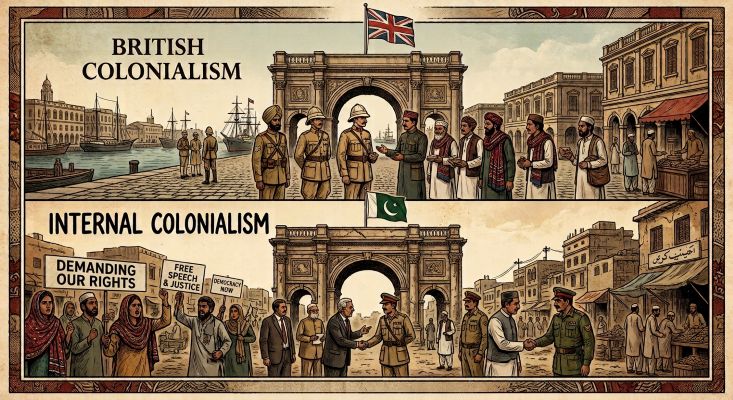
Some moments come to a nation that awaken it to understand its weaknesses and rise again. These moments come when a nation is hit by opponents who want to see it become weaker and more dependent on them. Unfortunately, colonialism came to an end with the promise of political stability and prosperity. The newly created, so-called independent states that emerged from colonial rule soon entered a new era of internal colonial structures and functions. People were dealt with strictly under the rule of new political elites in the name of the independence that had been granted. People were under the false consciousness that independence would improve their lives and social conditions. It was totally faint and fake.
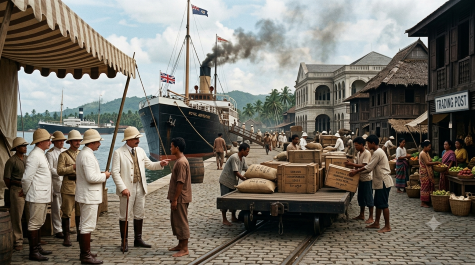
Sindhis were among the most wretched people in the subcontinent under British colonial rule. The British left them deprived and snatched everything from them. Their identity was suppressed when Sindh was merged into the Bombay Presidency for nearly a hundred years. It was kept isolated from the benefits of development while its resources were exploited. Its politics was ceased and directed by the Presidency. They cried for decades, but their cries fell on deaf ears. When the sovereignty of any territory is undone, political and economic decisions are made by non-residents who may have never even seen or visited the territory. So it happened with Sindh and the Sindhi people during the colonial era.
The wretched people of Sindh, observing their oppressed social and economic conditions, turned against the yoke of colonialism. They resisted every oppressor, whether insider or outsider. Sindh was among the large Muslim-populated areas of the subcontinent under British colonial rule. Therefore, the Sindhis decided first to seek separation from the Bombay Presidency and later to pursue a sovereign status. Throughout history, the people of Sindh had maintained an old consciousness of their homeland under despotic rulers. They were often weakened by foreign and barbarian invaders but remained sovereign under various forms of rule. The same happened when the British conquered Sindh in 1843.
Sindh was ravaged by all means. It again aspired to rise, but its political fate remained under the powerful tyranny of the British. Its people’s struggle did not become extinguished. They continued to strive to regain their sovereignty, at least by separating from the Bombay Presidency first. Their posterity succeeded after 90 years of an untiring movement. In 1936, Sindh emerged as a separate province under the Government of India Act of 1935.
It was too late for Sindhi politicians to build a strong province and a strong assembly for the future. The House of the Sindh Assembly remained divided because of political disputes that had emerged and grown during the Bombay Presidency. Unfortunately, the Bombay Presidency was under the control of the British and an allied Hindu elite that was socially and economically dominant in the region. Later, when the province came out of the Bombay Presidency, political wrangling between the two communities remained a major obstacle to running and controlling the affairs of the province. Muslim Sindhi politicians were too hasty to take control of the province from the Hindu Sindhi minority, who were more powerful and prosperous than the Sindhi Muslims. Owing to their majority, Sindhi Muslims needed alliances to come to power and dislodge the religious minority from control over political decisions.
In the beginning, until the 1936 elections, the Sindhi majority came to be elected in large numbers under the Sindh United Party, but Congress and Hindu elected candidates did not favor forming the government with them. The elected members of the Assembly were subjected to horse-trading, with members switching their loyalties away from their parties. Eventually, Khan Bahadur Allah Bakhsh Soomro emerged as the first Chief Minister of Sindh.
Throughout this period, the Assembly remained polarized, and political conspiracies were engineered by the British-appointed Governor. The political landscape was divided, and members switched their loyalties day and night. In the meantime, Indian politics took a new shape, and two major parties based largely on Hindu and Muslim political identities grew stronger. The provinces with Muslim majorities became increasingly involved in communal politics. Sindh was already politically fragile and therefore particularly vulnerable to this communal polarization.
Sindhi Muslims, when they saw an opportunity for political bargaining, allied themselves with the All-India Muslim League to gain support for their provincial agenda, but this alliance soon drifted apart. The Muslim politician G.M. Syed, who was a leading figure of the Muslim League in Sindh, crafted a resolution in favor of Pakistan, a new independent state for Muslims in the subcontinent.
The politicians of the province were too hasty in responding to the reality of minority dominance and the power of the feudal class. Until then, almost all politicians in Sindh came from the feudal class of the province. They were enraged by the discrimination they perceived from the Hindu minority, who shared the same cultural and linguistic identity as the Sindhi Muslims. But events turned them blind to the reality that the fundamental division was also a matter of class rather than merely communalism. Their irrational political realism led them into coming darkness.
They eagerly supported the Pakistan movement, while many were less aware of the consequences of its eventual impact. Once it was accomplished, Sindhis found themselves marginalized within the new country, and much of what they had expected was left unrealized.
Since partition and the creation of the new country, the province and its people have been pushed against the wall. They have struggled greatly to come out of this situation, but little has changed. As time has passed, many Sindhis have felt increasingly disgraced, fragile, depressed, oppressed, and suppressed within the country. Now, they feel that their territory is their only remaining hope: Sindh itself. Yet, despite this, they are no longer a majority in their beloved homeland.
It is now up to the weak Sindhi political leadership to determine how it can protect and maintain the territorial integrity of Sindh. At the same time, powerful forces within Pakistan continue to seek control over the province’s resources and to direct them from outside. Karachi, the queen’s jewel of the province, is once again in danger. The Ranjit mindset establishment is in a constant struggle to wear the queen’s jewel on its head.
Read: Sindh at the Crossroad
__________
 Dr. Shahban Sahito is an Assistant Professor at Department of International Relations, University of Sindh, Jamshoro