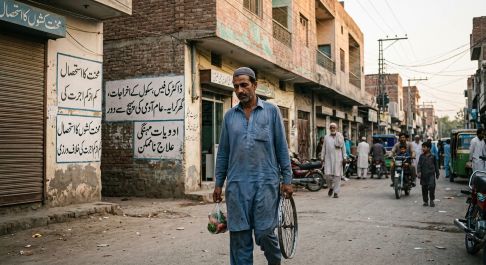
A fair living pay can be tool which enable people to afford nutritious food, secure housing, healthcare, education for their children, and even some savings for the future.
By Burhan Mehfooz
In today’s world, where prices rise faster than wages and everyday essentials feel increasingly out of reach, the idea of a minimum wage often rings hollow. While it’s meant to be a safety net, in many cases, it barely keeps people above the poverty line, let alone provides them with a dignified standard of living. What people truly need is a fair living pay: an income that meets basic needs and allows families not just to survive, but to live with hope, stability, and opportunity.
Across Pakistan, countless workers put in long hours whether in factories, fields, offices, or service jobs and still struggle to cover rent, school fees, or a doctor’s visit. That’s not just a personal hardship; it’s a systemic failure.
Recently, there has been a welcome shift in the corporate sector in Pakistan, with some business leaders recognizing that paying the bare minimum is not enough. Among them, the CEO of a major multinational company in Pakistan has publicly committed to ensuring a living wage across the company. This step signals a broader understanding: when employees are paid fairly, it creates a ripple effect boosting morale, improving productivity, and ultimately contributing to a more stable economy.
A fair living pay can be tool which enable people to afford nutritious food, secure housing, healthcare, education for their children, and even some savings for the future. It reflects the reality of what it actually costs to live in Pakistan not just an arbitrary figure set by policy makers.
In Pakistan’s context, this becomes even more urgent. Inflation has eroded the value of fixed incomes. Fuel, food, and utility costs continue to rise. The burden is hardest on those earning minimum wage, where every rupee is stretched to its limit. It’s a painful truth: working full-time should guarantee enough to live a decent life, yet that’s not always the case.
Read: Minimum Wage in Pakistan: Laws, Process and Current Rates
At its core, this is not just an economic issue, it’s a human one. Fair pay affirms a person’s worth. It tells them that their contribution is valued, their effort matters, and their life has meaning beyond just survival. When workers are respected, companies thrive. Communities grow stronger. Children go to school instead of work. Families look toward the future with optimism rather than fear.
While government policies are important in setting wage floors, real and lasting change comes when businesses step up voluntarily. It’s encouraging to see some leading companies in Pakistan begin this journey, committing not just to their direct employees, but also to contract and third-party workers.
This isn’t just good for workers, it’s good for business. Higher wages lead to lower turnover, stronger employee loyalty, and better performance. And in a society where inequality is a growing concern, fair pay helps build trust and social stability.
The idea of a fair living wage is not radical, it’s reasonable. It asks only that workers be paid in proportion to the value they create and the cost of living they face. As more companies begin to listen, act, and lead by example, we inch closer to a more equitable economy.
Read: Big Rides, Small Wages
____________
 Burhan Mehfooz is HR professional with over 15 years of diverse experience across both the public and private sectors. He is currently serving as Deputy Director of Human Resources with the Sindh Education Foundation, Government of Sindh.